
What a Monroe County rental returns on its purchase price
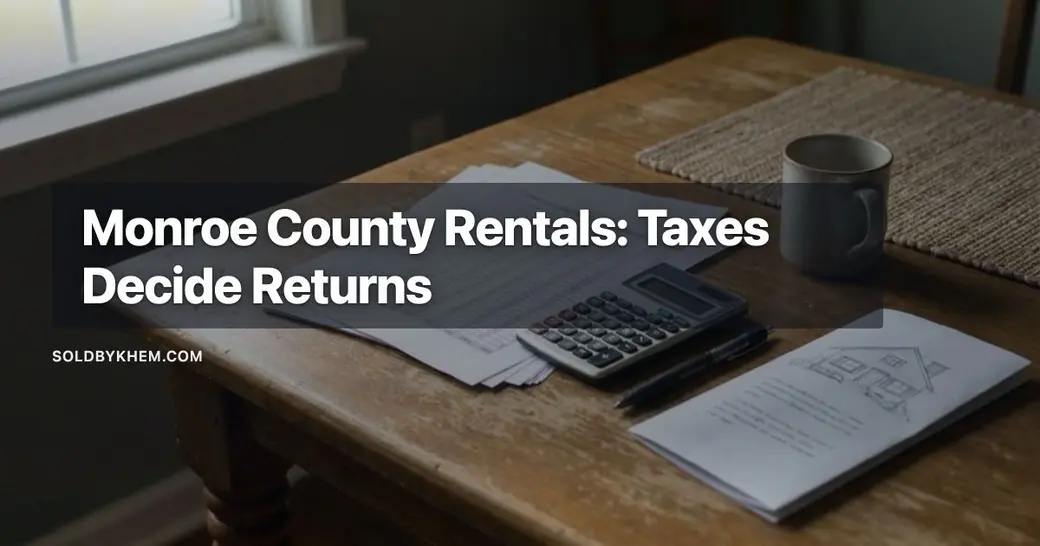
What does a rental in Monroe County return against its purchase price?
Divide annual rent by purchase price to get gross yield, then subtract taxes, insurance, vacancy, repairs and management to get the cap rate. In Monroe County, property taxes are usually the largest single expense and they vary sharply by town, so two houses at the same price can return very differently. Verify the tax bill and the actual rent before you offer.
If you are looking at a small rental in Monroe County, you are really asking one question: for every dollar I put into this house, how many dollars come back each year? This post walks through the three ways that question gets answered, shows the arithmetic with placeholder numbers, and names the expense lines that most often turn a decent looking listing into a flat one. I have been inside a lot of these houses. The return is decided long before the tenant moves in.
Three numbers, three different answers
People say "return" and mean three separate things. Know which one you are quoting, and know which one the seller is quoting at you.
| Metric | Formula | What it ignores |
|---|---|---|
| Gross yield | Annual rent divided by purchase price | Every expense. Taxes, repairs, vacancy, all of it. |
| Cap rate | Net operating income divided by purchase price | Your mortgage. It measures the property, not your financing. |
| Cash on cash | Annual cash left after the mortgage, divided by cash invested | Appreciation and principal paydown. |
Gross yield is the number in listing photos and forum posts. It is the least useful of the three. Cap rate tells you whether the building works. Cash on cash tells you whether your version of the deal works, because it includes your down payment and your rate.
How do you calculate a rental's return in Monroe County?
You run the same arithmetic you would run anywhere, then you go get the real property tax bill, because that is the line that moves the most here.
Here is the shape of it with round placeholder numbers. These are not market figures for any town in the county, they are there so you can see the formula work. Plug in your own.
- Purchase price: $200,000
- Rent: $1,700 a month, or $20,400 a year
- Gross yield: 20,400 divided by 200,000, which is 10.2 percent
That 10.2 percent is the number that gets people excited. Now take the expenses out.
- Property taxes: $5,000
- Insurance: $1,200
- Vacancy allowance at 5 percent of rent: $1,020
- Maintenance and capital reserve at 10 percent: $2,040
- Property management at 8 percent: $1,632
- Water, trash, lawn and snow, if you are covering them: varies by lease
Call it $10,892 out. Net operating income is about $9,500. Cap rate is 9,500 divided by 200,000, or roughly 4.75 percent. The double digit yield became a mid single digit cap rate, and nothing unusual happened. That is just what the expense stack does.
Now add financing. Say you put 25 percent down, $50,000, plus $6,000 in closing costs and make ready work, so $56,000 of cash in. Borrow $150,000 over 30 years. Use whatever rate your lender actually quotes you; at a placeholder 7 percent the payment runs close to $998 a month, or about $11,976 a year. Subtract that from $9,500 of net operating income and you are negative by roughly $2,476 for the year.
That is not a scare tactic. That is the check. If the numbers land there, you have four levers: pay less, put more down, choose a jurisdiction with a lighter tax bill, or manage it yourself and keep the management line. Most small investors I work with pull two of those four.
Why the tax line decides the answer here
In the example above, property taxes were the single largest expense, larger than maintenance and management combined. That is common in this county, and the amount is not a guess: it is a public record tied to the parcel, the town, the village if there is one, and the school district.
Two things matter for your math. First, get the current bill for the specific parcel rather than a rule of thumb. Second, find out what the assessment is and whether a sale at your price is likely to move it. A house that has not traded in twenty years can carry an assessment that no longer reflects value, and a sale is exactly the event that can prompt a change. Ask before you offer, not after you close.
The towns in the south and southeast of the county, Henrietta, Pittsford, Brighton, Rush, Mendon and Honeoye Falls, do not share a single tax picture, and neither do their school districts. Comparing two $200,000 houses on rent alone tells you very little. Comparing them on rent minus taxes tells you a lot.
What expenses do small investors usually underestimate?
Vacancy, turnover cost and the big mechanical items. Those three, almost every time.
- Turnover. Paint, cleaning, a carpet, a few days of lost rent. It is not one number in a spreadsheet, it is a recurring event. Budget for it annually even in years it does not happen.
- Roof, furnace, water heater, driveway. These are not maintenance, they are replacements with known lifespans. Ask the age of each one during the walk through and reserve accordingly.
- Basements. In older housing stock around Rochester, water in the basement is a normal finding, not an exotic one. Look at the bottom of the walls, the stored boxes, the sump. Ask what happens in a heavy March thaw.
- Knob and tube wiring and old panels. Your insurer may have an opinion on these before you do.
- Municipal requirements. Several municipalities in the area require rental registration, a certificate of occupancy or an inspection before a unit can be occupied, and the City of Rochester has additional requirements around lead paint. Requirements change. Call the code office for the specific municipality and ask what applies to your address.
Federal law also requires lead based paint disclosure on housing built before 1978, which covers a large share of the stock in this market. That is a legal obligation, not a line item you can skip.
A word on the market numbers you are seeing
I am not going to quote you county median prices or days on market in this post. The data I had on hand for it could not be verified to an MLS source, and two of the figures circulating contradicted each other outright. I would rather give you a method that holds up than a statistic that does not. When you and I sit down, I will pull the current figures from the association report and show you the source.
That matters for your underwriting too. Aggregator sites blend geographies and date stamps. A "Rochester" number might describe the city, the metro, or a postal code. Before you anchor an offer to a number you read online, find out what area it covers and what month it is from.
Screening and the law
Set your written screening criteria before you list the unit, then apply them the same way to every applicant who inquires. New York law treats lawful source of income as protected, alongside the federal and state protected classes. Practically, that means you evaluate the income, not where it comes from. Document your process. Keep your ads about the property.
Common questions
What is a reasonable cap rate for a Monroe County rental?
There is no single correct figure, and any number quoted without a source and a date should be treated with suspicion. What you can do is calculate the cap rate the same way on every property you look at, using verified tax bills and realistic expense allowances, and then compare them to each other. Consistency in your own method is worth more than a benchmark someone else published.
Should I use gross yield or cap rate when comparing houses?
Cap rate, always, once you have real expense numbers. Gross yield is useful only as a fast first screen to decide which listings deserve an hour of your time. Because property taxes vary so much between towns and school districts here, two houses with identical gross yields can produce very different cap rates.
How do I find out what a house will actually rent for?
Look at units currently available nearby with a similar bedroom count, condition and parking situation, and note which ones include utilities. Existing leases in the building are evidence but not proof, since a long standing rent can sit below or above current levels. If a seller quotes you a rent, ask to see the lease and the rent roll.
Is it worth paying for property management on a single rental?
It depends on whether the deal still works with that line in the budget. Run the cap rate with management included, because that measures the property honestly, then decide separately whether you want to do the work yourself. Self managing is a job you are paying yourself for, not free money.
What should I bring to a first conversation about buying a rental?
Your target purchase price range, your available cash for down payment and repairs, a lender preapproval or at least a quoted rate, and how hands on you plan to be. With those four things, the math on any specific address takes about twenty minutes.
If you want to run these numbers on a real address in Henrietta, Pittsford, Brighton, Rush, Mendon or Honeoye Falls, I will pull the tax bill, walk the house with you and show you the arithmetic line by line. Book a time with me and bring the listing you are curious about.
Khem Kadariya, Sold By Khem
About this data
The figures in this post were compiled from publicly available sources including Zillow, Houzeo, Movoto, RochesterFirst and FRED (Federal Reserve Bank of St. Louis), along with other public market data. Real estate numbers change quickly, and these were accurate as of September 2026. For current figures on a specific home, street, or town, ask me directly rather than relying on a published average.
Keep reading
Need Help With Financing?
Thinking about buying a home and wondering what financing options may be available to you? Knowing where you stand before you write an offer puts you in a much stronger position.
I recommend connecting with my preferred lending partner, Brian Haefner with Premium Mortgage Corporation. Whether you are a first-time homebuyer, relocating to the Rochester area, purchasing your next home, or simply want to understand your mortgage options and buying power, Brian can help you explore your financing options and answer your mortgage-related questions.
Stay Connected With Khem
Looking for more Rochester real estate information, community updates and local insight?
Looking at investment property in Greater Rochester? talk with Khem to discuss your criteria and what is currently available.
Recent Posts








Khem Kadariya
Phone