Monroe County tax bills: the 2 you pay after closing
How do I read a Monroe County tax bill before making an offer on a house?
Get both bills, not one. A Monroe County property is billed for town and county taxes in January and school taxes in September, plus a village bill if it sits inside a village. Add the full amounts together, ignore any exemptions on the seller's bill, since STAR, senior, veteran and agricultural exemptions end at transfer, and check the special district and relevied lines.
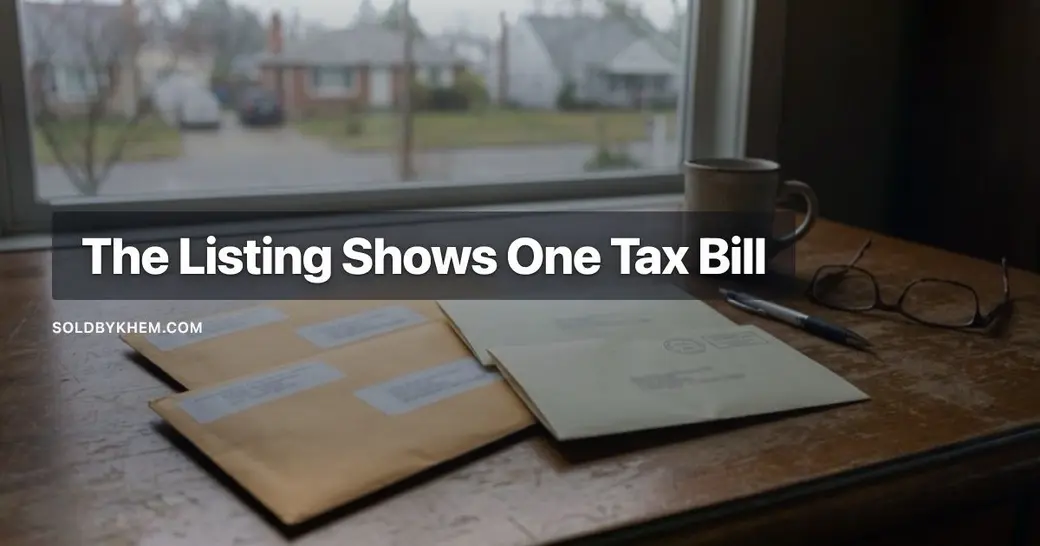
Most listings show one tax figure. Sometimes it is the town and county bill only. Sometimes it is last year's. Almost always it reflects exemptions that belong to the current owner and will not follow the house to you. That gap is how buyers end up with a monthly payment that jumps a few hundred dollars in year two.
This walks through what a Monroe County tax bill contains, which lines change when the deed changes hands, how the STAR program actually works for someone buying now, and how to turn all of it into one honest monthly number before you make an offer.
Which tax bills does a house in Monroe County get?
Most properties in the county get two separate bills each year, and properties inside a village get three. They come from different offices, cover different periods, and are never combined into one annual statement you can just look up.
| Bill | Usually mailed | Period it covers | Collected by |
|---|---|---|---|
| Town and county | Around the start of January | The calendar year | Your town receiver of taxes |
| School | Around the start of September | The school year | The school district or its collecting agent |
| Village, if applicable | Late spring or early summer | The village fiscal year | The village clerk or treasurer |
Dates and installment options vary by town, district and village, so confirm them with the collector rather than assuming. If you are looking in the Village of Pittsford or the Village of Honeoye Falls, you are looking at three bills. A house on a West Henrietta or Mendon road outside any village gets two.
When people search for a monroe county tax bill explained, this is usually the first surprise. The school bill is typically the larger of the two, and it is the one most often missing from a quick listing summary.
What each line on the bill actually means
Read the bill from the top down. Every line does something.
- Assessed value. The assessor's number for the property, not the price you are paying.
- Uniform percentage of value. The level at which the town assesses. If a town assesses below full market value, the assessed value will look low compared to sale prices. That does not mean the taxes are low. The rates adjust.
- Exemptions. Dollar reductions subtracted before tax is calculated. This is the section to study hardest.
- Taxable assessed value. Assessed value minus exemptions. This is what the rates are applied to.
- Tax rates. Shown per thousand of taxable assessed value, broken out by the entity levying them.
- Special district charges. Fire protection, ambulance, lighting, sewer, drainage, refuse, library and similar districts. Some are rate based, some are flat charges per parcel or per unit.
- Relevied charges. Amounts from another bill that went unpaid and were added onto this one, most often water, sewer or a prior school bill.
- Penalty schedule. What the amount becomes after each deadline passes.
Why the seller's tax bill is not your tax bill
Exemptions attach to the owner, not the building. When ownership changes, several of them come off.
The ones I see most often on bills in south and southeast Monroe County include STAR and Enhanced STAR, senior citizen exemptions, veterans exemptions, exemptions tied to disability, and agricultural assessments on larger parcels in Rush, Mendon and the outer parts of Henrietta. Agricultural assessments carry their own conditions on continued farm use, and converting the land can trigger a payback. If the parcel you are considering has one, ask your attorney to read the terms before you commit.
The practical move is simple. Take the seller's bill, find the exemption block, and add every exempted dollar back into the taxable assessed value. Then recalculate at the printed rates. That is your starting estimate, not the total at the bottom of their bill.
How does the STAR exemption work when you buy in New York?
You do not inherit it. If you are buying now, you register with New York State for the STAR credit instead of receiving a STAR exemption on the school bill. You pay the school tax bill in full, and the state sends you a credit by check or direct deposit.
Three things follow from that, and they matter for cash flow:
- Your school tax bill will be higher than the seller's was, even if nothing else changes.
- The credit arrives separately, and in the first year after a purchase the timing can slip. Budget to float the full bill.
- Registration is on you. Nobody at the closing table does it for you, and your lender will not do it either.
There is an income ceiling on the Basic credit, and a separate Enhanced STAR benefit for owners who meet the age and income tests, with amounts and limits that New York updates. Check the state's current STAR page rather than relying on a figure someone quoted you last year. That is the honest answer on star exemption new york buying questions: the benefit still exists, it just arrives as a payment to you instead of a discount on the bill.
The lines buyers skip: special districts and relevies
Special district charges are easy to scroll past and they are real money every year. A parcel served by a sewer district, a drainage district and a fire district carries all three. Two houses on the same street can sit in different district combinations, so compare the actual bills rather than assuming the neighborhood is uniform.
Relevied charges deserve a second look for a different reason. A relevied water or sewer amount tells you a bill went unpaid. That is usually just a missed payment. Occasionally it points at something else, like a property that switched between well and public water, or a vacancy. Ask.
Also ask whether any improvement is being paid off over a term, such as a sewer extension or sidewalk assessment. If so, find out how many years remain and whether it can be paid off at closing.
Will my assessment go up because I paid more than the assessed value?
Not automatically, and not because of your purchase alone. New York does not permit a town to reassess a single property simply because it sold. What does happen is that towns update assessments across the whole roll on a cycle, and recent sales inform those updates. Your purchase price becomes one piece of evidence among many.
So the question to ask the assessor's office is not whether they will target you. It is when the town's next reassessment is scheduled and what the current level of assessment is. If a town is due for an update and the roll is running well below current market values, expect movement. Plan your carrying costs with that in mind.
Turning two bills into one monthly number
Here is the sequence I use with buyers before an offer goes out.
- Pull the parcel on the county's property information portal and note the town, school district and whether it sits in a village.
- Get the most recent full town and county bill and the most recent full school bill.
- Add back every exemption that ends at transfer, then recalculate at the printed rates.
- Add the village bill if there is one.
- Add special district charges. Do not net out relevied amounts unless you have confirmed they were one time.
- Divide the total by twelve. That is the tax portion of your monthly payment before insurance and principal and interest.
- Hand those figures to your lender in writing, and ask them to build the escrow on the post sale numbers rather than the seller's.
That last step prevents the most common unpleasant surprise. Lenders sometimes set up the initial escrow using the bill on file, exemptions and all. The first escrow analysis then finds a shortage, and the monthly payment rises to cover both the gap and the higher ongoing amount. Getting it right at application costs nothing. Getting it wrong costs you twelve months of catching up.
Common questions
Do I have to pay the seller's unpaid taxes?
Unpaid property taxes are a lien on the parcel, not a personal debt that stays with the seller, so they have to be cleared for you to take clean title. The title search ordered for your closing is what finds them, and they are normally paid off or credited at the closing table. Your attorney will also prorate the current period so each side pays for the days they own the house.
When will I get my first tax bill after closing?
It depends on where your closing falls in the billing cycle. Bills are addressed to the owner of record as of a set date, so the first one after your purchase may still print the seller's name or go to their old address. If you escrow, your servicer should pay it, but verify that in the first cycle. Call the receiver of taxes and the school collector to confirm your name and mailing address are on the roll.
Can I pay the taxes myself instead of escrowing?
Sometimes, depending on your loan type and down payment, and some lenders charge for waiving escrow. If you do it yourself, you are responsible for two large payments a year on deadlines that do not move, plus a village payment if you are in one. Missing a school tax deadline usually means the amount is relevied onto the January bill with penalties attached.
Are taxes higher in Pittsford than in Henrietta?
You cannot answer that by comparing tax rates, because towns assess at different levels and a lower rate applied to a higher assessment can produce a bigger bill. Compare the actual annual tax on homes of similar market value in each town, using real bills from real parcels. Also check the school district lines, since district boundaries do not always follow town lines in this part of Monroe County.
How do I challenge an assessment I think is too high?
Start with an informal conversation at the assessor's office, where many corrections get made without a formal proceeding. If that does not resolve it, you file with the Board of Assessment Review on grievance day, which most towns hold in late spring. Confirm the exact date and the filing requirements with your town, because the deadline is firm.
Before you write the offer
Taxes are the part of a purchase that nobody negotiates and everybody pays every year for as long as they own the house. Two bills, sometimes three, with exemptions that end the day you sign. It is worth an hour of reading before you commit.
If you want help pulling the bills on a specific parcel in Henrietta, Pittsford, Brighton, Mendon, Rush or Honeoye Falls and working out what your actual monthly carrying cost would be, book a time with me and bring the address. I will go through the bill line by line with you.
Khem Kadariya
About this data
The figures in this post were compiled from publicly available sources including Zillow, Redfin, Movoto, Freddie Mac and FRED (Federal Reserve Bank of St. Louis), along with other public market data. Real estate numbers change quickly, and these were accurate as of September 2026. For current figures on a specific home, street, or town, ask me directly rather than relying on a published average.
Keep reading
Need Help With Financing?
Thinking about buying a home and wondering what financing options may be available to you? Knowing where you stand before you write an offer puts you in a much stronger position.
I recommend connecting with my preferred lending partner, Brian Haefner with Premium Mortgage Corporation. Whether you are a first-time homebuyer, relocating to the Rochester area, purchasing your next home, or simply want to understand your mortgage options and buying power, Brian can help you explore your financing options and answer your mortgage-related questions.
Stay Connected With Khem
Looking for more Rochester real estate information, community updates and local insight?
Thinking about buying in the Rochester area? start a conversation with Khem to talk through neighborhoods, financing and current inventory.
Recent Posts






Khem Kadariya
Phone