
Ice dams in Rochester NY: 3 real causes and fixes
What causes ice dams on Rochester NY roofs and how do I fix them?
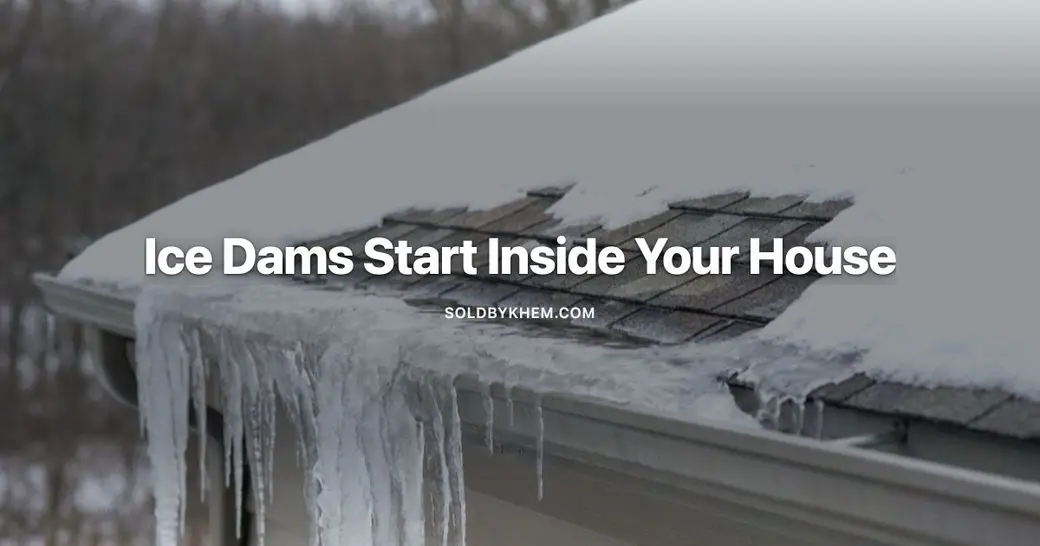
Ice dams form when heat escaping from the house warms the roof deck, melts the snow above it, and the water refreezes at the cold eave. The lasting fix is air sealing the attic floor, adding insulation, and keeping the roof deck cold with proper intake and exhaust ventilation. Heat cable and roof raking only manage symptoms.
If you have watched a ridge of ice build along your gutters in January, or found a brown stain creeping down a bedroom wall in February, this post is for you. I am going to explain what an ice dam actually is, why certain Rochester houses get them every single winter while the neighbor's roof stays clear, which repairs fix the problem for good, which ones only buy you time, and what to do in the middle of a thaw when water is already coming in. I will also cover what this means if you are buying a house this winter or listing one in spring.
One thing to get straight up front: ice dams are not a weather problem. Snow load is the trigger, but the cause is inside your house.
What actually causes an ice dam?
An ice dam forms when the upper part of your roof deck is warmer than the lower part. Heat leaking out of the living space warms the underside of the sheathing, the snow sitting on top of it melts from below, and the meltwater runs down until it reaches the eave or the gutter, where there is no heated space beneath. There it refreezes. The ice ridge grows, water backs up behind it, and eventually it finds a way under the shingles.
Shingles are designed to shed water running downhill. They are not designed to hold standing water. That is why an ice dam leak often shows up nowhere near the roof edge: the water gets in at the eave, travels along a rafter or a ceiling joist, and drips through a light fixture ten feet away.
The heat gets up there in three ways, and most houses have all three:
- Air leakage. Warm indoor air rising through gaps in the attic floor. This is the big one, and it is the one most people never address.
- Conduction. Heat passing straight through thin or compressed insulation.
- Trapped heat. A roof cavity with no way to flush cold outdoor air across the underside of the deck.
Which Rochester houses get them, and why?
The houses I see ice dams on again and again share specific construction details rather than a specific neighborhood. Older stock has more of them, but I have seen dams on ten-year-old roofs too.
- Story-and-a-half Capes with knee walls. Very common in Brighton and the older parts of Henrietta. The little triangular spaces behind the upstairs sidewalls are almost always open to the floor cavity, which is open to the heated first floor. Warm air pours in continuously.
- Cathedral and vaulted ceilings. There is often no room between the drywall and the sheathing for both insulation and an air channel. Contemporaries and 1980s additions are frequent offenders.
- Complex rooflines. Dormers, valleys, hips, and roofs that dead-end into a wall. Snow collects in valleys and behind dormers and does not slide off. Many Pittsford colonials have four or five of these transitions.
- Rooms over unheated garages and porches. A cold floor below, warm air above, and usually a poorly sealed junction where the addition meets the main house.
- Recessed lights, bath fans, and plumbing stacks in top-floor ceilings. Each one is a hole. A bath fan that dumps into the attic instead of through the roof or gable is essentially a heat and moisture hose aimed at your sheathing.
- Pull-down attic hatches and whole-house fans. Rarely gasketed, rarely insulated.
- Older farmhouses in Rush and Mendon. Additions built across three different decades, each with its own roof pitch and its own attic that does not connect to the next one.
The signs, before and after the leak
You can usually read a house from the driveway on a cold morning.
- Snow melted off the middle of the roof while the eaves stay loaded. That is a warm deck.
- Icicles hanging from the gutters. Icicles are meltwater. Meltwater in January means escaping heat.
- A clean melt line partway up the roof, especially above a bathroom or a recessed-light ceiling.
- Inside: stains at the top of exterior walls, at window headers on the top floor, or around ceiling fixtures.
- In the attic: frost or dark staining on the underside of the sheathing, rusty nail tips, matted or discolored insulation directly under a leak path.
- Bubbling or peeling paint on soffits and fascia.
What fixes ice dams for good?
The permanent fix is to make the roof deck cold, and you do that in a fixed order: air sealing first, then insulation, then ventilation. Skipping straight to the third step is the most common and most expensive mistake I see.
- Air seal the attic floor. Every penetration gets closed: top plates, wire and pipe holes, chimney chases with proper fire-rated material, the space behind knee walls, dropped soffits over kitchen cabinets, the attic hatch. This is unglamorous, cheap in materials, and it does most of the work.
- Bring insulation up to a consistent depth. Depth matters less than coverage. A thick blanket with a bare patch over the bathroom still gives you a dam over the bathroom. Insulation must reach the outer wall without blocking airflow at the eave, which is what baffles are for.
- Fix the ventilation path. Intake at the soffits, exhaust at the ridge, and enough of both. A ridge vent with painted-shut or insulation-blocked soffits does nothing. Vent every bath fan and dryer to the outside, never into the attic.
- Correct the details. Replace non-rated recessed cans with sealed airtight fixtures. On cathedral ceilings, this may mean opening the ceiling or moving to closed-cell foam against the deck, which is a real project and should be priced as one.
- At the next roof replacement, add a proper ice and water membrane at the eaves and in every valley. This does not prevent dams. It keeps a dam from becoming a ceiling repair.
Fixes that work versus fixes that only buy time
| Measure | What it does | What it does not do |
|---|---|---|
| Attic air sealing | Removes the heat source that melts the snow | Nothing for cathedral ceilings with no accessible cavity |
| Added insulation with eave baffles | Slows heat loss, keeps the deck cold | Cannot overcome large air leaks underneath it |
| Balanced soffit and ridge venting | Flushes any residual heat out of the attic | Little help on its own if air leakage is heavy |
| Ice and water membrane at eaves | Blocks backed-up water from reaching the deck | Prevent the ice itself, or protect above the membrane line |
| Heat cable in the gutters | Keeps a drainage channel open through the ice | Address the cause, and it adds an electric bill every winter |
| Roof raking after a storm | Removes the snow the dam feeds on | Fix anything, and it risks shingle and gutter damage |
Water is coming in right now. What do I do?
Stop the interior damage first, then get the ice channel opened by someone equipped for it, then plan the real repair for spring. In the immediate term: put a container under the drip, and if a ceiling is bulging, poke a small relief hole at the low point so water drains in one place instead of soaking a whole panel. Photograph everything with dates.
Do not go up a ladder onto icy ground with a hammer or a hatchet. Chopping at a dam breaks shingles under the ice and you will not see the damage until the first spring rain. Steam removal, done by a contractor with a low-pressure steamer, is the method that clears ice without wrecking the roof. Pressure washers and torches are not substitutes. If you can safely reach the lower roof from the ground with a roof rake and a plastic blade, pulling snow back three or four feet from the edge reduces the fuel supply.
Call your homeowners insurance carrier early. Sudden water damage from an ice dam is often covered while the underlying insulation and ventilation deficiency is not, so the interior repair and the permanent fix usually sit in two different budgets.
Buying or selling with ice dam history
If you are house hunting in winter, you have an advantage: you can see the roofs working. Walk the driveway and look at the melt pattern. In the attic, look for frost, staining on the sheathing, blocked soffits, and insulation that stops short of the outer wall. Check top-floor ceilings and the tops of exterior walls for patched or repainted drywall. Ask when the roof was replaced, whether membrane was installed at the eaves, and whether any interior water repair was done. A house with dams is not a house to walk away from. It is a house to price with the repair in view, and the air sealing and insulation work is often the least expensive line item on an inspection report.
If you are selling, deal with it before photos go up. New York requires seller disclosure or a credit in lieu of it, and a fresh drywall patch on a top-floor ceiling invites the question anyway. Buyers respond much better to a paid invoice for air sealing and insulation than to a stain and an explanation. Keep the receipts, the contractor scope, and any before-and-after attic photos in the file with your other documents.
One last practical note: this work is easiest to schedule in late spring and summer, when insulation crews are not booked out behind emergency calls, and when you can still get it done before listing in the fall.
Common questions
Do gutters cause ice dams?
No. Gutters do not create the melting, and removing them will not stop a dam from forming at the eave. What gutters do is hold ice in place and give it a head start, and clogged gutters full of leaves freeze into a solid block faster. Clean them in late fall, but do not expect that to solve the problem.
Is heat cable worth installing?
It has a place, mainly on cathedral ceilings, deep valleys, and roof sections where you genuinely cannot get at the cavity to air seal it. Used there, it keeps a drainage path open so water does not pond behind ice. It is a poor substitute for attic work on a house with an accessible attic, because you pay to run it every winter and the underlying heat loss keeps costing you on the heating bill.
Will a new roof stop my ice dams?
Not by itself. A new roof with ice and water membrane at the eaves and valleys protects the deck from water that backs up, which is real value, but the ice will still form because the heat loss is unchanged. The right time to do the attic work is before or during the roof replacement, when the roofer can also correct soffit intake and install a proper ridge vent.
How do I know whether my attic problem is air leakage or insulation?
An energy audit with a blower door test and infrared imaging will tell you, and it gives you a written scope you can hand to contractors for comparable bids. Short of that, a winter attic inspection is very informative: frost on the sheathing, or a warm draft you can feel at a top plate or around a pipe, points to air leakage. Uniformly thin or compressed insulation with no frost points more toward conduction.
Should ice dam damage change what I offer on a house?
It should change what you know, and that usually shapes the number. Get a roofer and an insulation contractor to quote the actual scope during your inspection period rather than guessing, then decide whether you want a price adjustment, a seller credit, or the repair completed before closing. If there is ceiling or wall damage, have it evaluated for moisture behind the surface, not just repainted.
If you are weighing a house with a history of ice dams, or getting a Rochester area home ready to list after a rough winter, I am glad to walk the attic and the roofline with you and talk through what it means for price and timing. Schedule a time with me and bring your questions.
Khem Kadariya
About this data
The figures in this post were compiled from publicly available sources including Zillow, Houzeo, Movoto, RochesterFirst and FRED (Federal Reserve Bank of St. Louis), along with other public market data. Real estate numbers change quickly, and these were accurate as of September 2026. For current figures on a specific home, street, or town, ask me directly rather than relying on a published average.
Keep reading
Need Help With Financing?
Thinking about buying a home and wondering what financing options may be available to you?
I recommend connecting with my preferred lending partner, Brian Haefner with Premium Mortgage Corporation. Whether you are a first-time homebuyer, relocating to the Rochester area, purchasing your next home, or simply want to understand your mortgage options and buying power, Brian can help you explore your financing options and answer your mortgage-related questions.
Stay Connected With Khem
Looking for more Rochester real estate information, community updates and local insight?
Have a question about Rochester real estate? contact Khem and we can talk it through.
Recent Posts










Khem Kadariya
Phone