
VA appraisal repairs Monroe County sellers should expect
What repairs do VA appraisers require when selling a house in Monroe County, NY?
A VA appraiser in Monroe County checks value and condition together. Common required items include peeling or chipping paint on homes built before 1978, active roof leaks, standing water in basements and crawl spaces, missing stair or deck railings, exposed wiring, broken windows, and a working permanent heat source. Rural parcels usually need water and septic testing.
If you have a VA offer on your Monroe County house, or you expect one, the question underneath it is always the same: what is the appraiser going to make me fix? This post answers that. You will learn how a VA appraisal differs from a conventional one, which repair items come up most often on the housing stock in Henrietta, Brighton, Pittsford, Rush, Mendon and Honeoye Falls, who is allowed to pay for the work, what happens if the value comes in below your contract price, and what you can take care of before you ever list.
Short version up front: a VA appraisal is not a home inspection, and it is not a trap. It is a value opinion plus a condition checklist. Most of what it flags on local homes is visible from the driveway or from the basement stairs.
What is a VA appraisal actually checking?
It checks two things at once: what the house is worth, and whether the house meets the VA Minimum Property Requirements, usually shortened to MPRs. A conventional appraisal is mostly about value. A VA loan appraisal in NY adds the condition layer, and the appraiser is assigned from a VA panel rather than chosen by the lender.
The MPR standard is narrower than people assume. The appraiser is looking for safety, structural soundness and sanitation. Three questions drive nearly every call:
- Is the property safe to occupy right now?
- Is it structurally sound, with no active water intrusion or failing components?
- Does it have safe drinking water and working waste disposal?
Cosmetic problems are not MPR problems. Dated kitchens, worn carpet, a cracked driveway, an ugly bathroom, a fence that leans: none of that stops a VA loan. What stops a VA loan is a hole in the roof, a live wire, a furnace that does not run, or paint flaking off a 1920s porch ceiling.
The repairs Monroe County houses generate most often
After enough walkthroughs in these towns you start to see the same handful of items over and over, and they track closely with when the house was built.
Pre-1978 homes, which covers a large share of older Brighton, Pittsford village, Honeoye Falls village and the city edges of Henrietta:
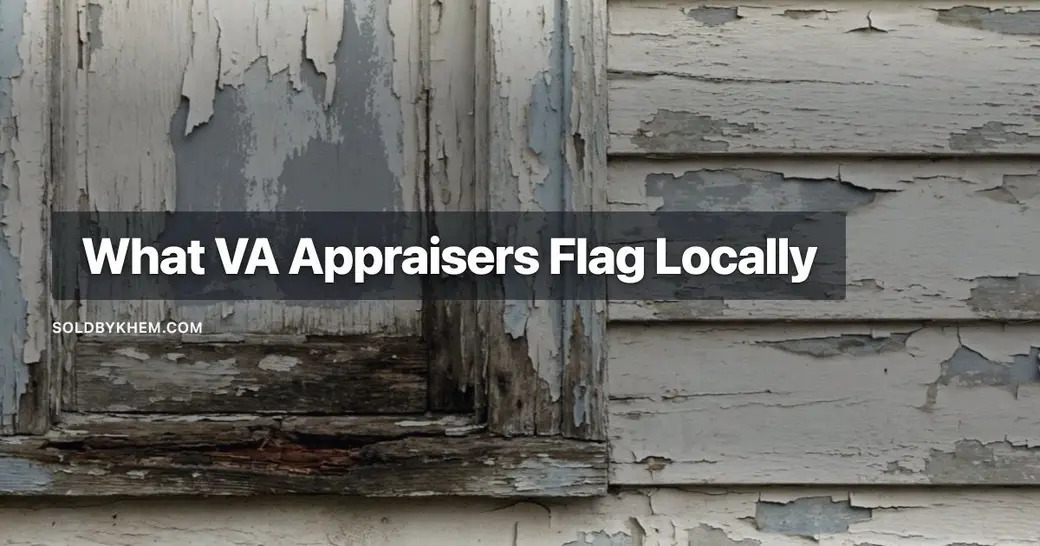
- Peeling, chipping or scaling paint anywhere on the structure, including porch ceilings, soffits, window sashes, garage doors and detached outbuildings. This is the single most common VA call in older neighborhoods.
- Deteriorated wood windows and rotted sills.
- Missing handrails on stairs with three or more risers, inside or out.
- Knob and tube wiring still in service, open junction boxes, or a fuse panel with obvious hazards.
- Basement water staining with an active source, cracked or bowing foundation walls, or a sump that is not functioning.
1950s through 1970s ranches, colonials and split levels, common across Henrietta, West Henrietta and Brighton:
- Roofs at the end of their service life. The appraiser is looking for remaining economic life and for evidence of leaks, not for a brand new roof.
- Aging furnaces or boilers that do not fire on the day of inspection, and rooms with no permanent heat source. Space heaters do not count.
- Water heaters without a temperature and pressure relief discharge line.
- Crawl spaces with standing water, no vapor barrier, or no access opening.
- Deck and porch railings that are missing, loose or too low, plus rotted stair stringers.
Newer construction, generally the least affected:
- Grading that slopes toward the foundation, or downspouts discharging against the wall.
- Unfinished or damaged items after a partial renovation, such as an open wall cavity or a bathroom with no working fixture.
One more that catches sellers off guard: any evidence of wood destroying insects. In this part of New York that usually means carpenter ants or old powder post beetle damage in a barn or a basement sill. Evidence triggers a treatment requirement and sometimes a structural repair.
What if my house is on a well and septic?
If your property sits on a private well and a septic system, which is common in Rush, Mendon, parts of West Henrietta and the rural stretches outside Honeoye Falls, plan on testing. The VA requires that the water supply be potable and that waste disposal be adequate.
Practically, that means:
- A water sample sent to a certified lab, usually tested for bacteria and nitrates, with a passing result in hand before closing.
- Proof that the septic system functions. Requirements vary by lender and by what the appraiser observes, so ask early rather than the week before closing.
- A shared well or a shared driveway needs a written agreement. Handshake arrangements between neighbors are a real closing delay in rural Monroe County.
None of this is unreasonable. It is just slower than a suburban closing, so the timeline in the contract should reflect it.
Who pays for VA appraisal repairs?
By custom in this market, the seller handles MPR repairs, because the seller controls the property and the lender will not fund the loan until the item is corrected. But it is not automatic. Repairs are negotiable like anything else, and depending on the item and the lender, the buyer may be permitted to pay. Your listing agent should get a direct answer from the buyer's loan officer in writing before you agree to anything.
Three practical points:
- Work is verified. The appraiser or an inspector returns, or documentation is submitted, and that takes days. Build it into the closing date.
- Use licensed contractors where the item is electrical, plumbing or structural. A receipt from a neighbor with a truck will not clear the file.
- If the repair is large and you do not want to do it, say so early. That is a price and terms conversation, not a reason to blow up the deal on day forty.
What happens if the VA appraisal comes in below the contract price?
The buyer can walk away and keep their deposit. That is the VA amendatory clause, and it is in every VA contract. It is also not the only outcome. In practice you have four paths: the buyer pays the gap in cash, you reduce the price to the appraised value, you meet somewhere in between, or you request reconsideration of value with better comparable sales.
Before the report is even issued, the appraiser may flag that value is likely to land short and give the parties a brief window, typically a couple of business days, to submit supporting sales. That is the Tidewater process. It is a real chance to influence the outcome, but only if your agent has the comps ready and responds fast. This matters in Monroe County because our sale prices vary sharply street to street and school district to school district, and a thin comparable set produces a soft number.
How to get ahead of it before you list
Walk your own house the way an appraiser would. Then handle the cheap items first, because they are the ones that stall closings.
- Scrape and repaint any flaking exterior paint, especially porch ceilings and garage trim, if the house predates 1978.
- Install or reattach every handrail and guardrail.
- Replace cracked or broken window glass.
- Cap open junction boxes and fix exposed wiring.
- Make sure the furnace or boiler runs and every room has heat.
- Clear standing water and confirm the sump pump works.
- Pull together well and septic records now if you have them.
A weekend of that work removes most of the friction from a VA buyer offer in Monroe County. It also helps with FHA offers and with ordinary home inspections, so nothing is wasted.
Common questions
Does a VA appraisal take longer than a conventional one?
Often yes, by a modest amount, because the appraiser is assigned through the VA panel rather than selected by the lender, and because any required repairs need verification before the loan closes. The bigger timeline risk is repair scheduling, not the appraisal itself. Contractor availability drives most of the delay in this market.
Can I refuse to make the repairs a VA appraiser requires?
You can. The consequence is that the VA loan will not close on the property as it stands, so the buyer either pays for the work where the lender allows it, or the contract ends. If you know the house has a significant condition issue, price and market it accordingly and be upfront in the listing rather than discovering it in week five.
Is a VA appraisal the same as a home inspection?
No. The appraisal protects the lender and the VA by confirming value and basic habitability. A home inspection is for the buyer and is far more detailed. Many VA buyers order both, so expect a separate inspection report with its own list of requests.
Do peeling paint requirements apply to every older home?
They apply to homes built before 1978, where lead based paint may be present. The appraiser calls out defective paint surfaces on the house, the garage and any outbuildings. Corrections must be done in a lead safe manner on those properties, which is why using a contractor who documents the work matters.
Should I treat a VA offer differently from a cash or conventional offer?
Evaluate it on the same terms you evaluate any offer: price, contingencies, timeline and the strength of the lender letter. The condition standard is the main structural difference, and it is manageable on most local homes. Fair housing law also protects military status in New York, so an offer cannot be declined because of the loan type being VA.
If you are weighing a VA offer or getting a house ready to list in Henrietta, Pittsford, Brighton, Mendon, Rush or Honeoye Falls, I will walk the property with you and tell you plainly which items are likely to come up. Book a time with me here and we will go through it room by room.
Khem Kadariya, Sold By Khem
About this data
The figures in this post were compiled from publicly available sources including Zillow, Redfin, Movoto, Freddie Mac and FRED (Federal Reserve Bank of St. Louis), along with other public market data. Real estate numbers change quickly, and these were accurate as of September 2026. For current figures on a specific home, street, or town, ask me directly rather than relying on a published average.
Keep reading
Questions About Your Financing?
Anything in this post that touches your own numbers is worth talking through with a lender directly, rather than working from a general article.
I recommend connecting with my preferred lending partner, Brian Haefner with Premium Mortgage Corporation. Whether you are a first-time homebuyer, relocating to the Rochester area, purchasing your next home, or simply want to understand your mortgage options and buying power, Brian can help you explore your financing options and answer your mortgage-related questions.
Stay Connected With Khem
Looking for more Rochester real estate information, community updates and local insight?
Thinking about selling in Greater Rochester? start a conversation with Khem for a conversation about pricing, preparation and current buyer demand.
Recent Posts






Khem Kadariya
Phone