
Deck permits in Fairport NY: rules, steps and inspections
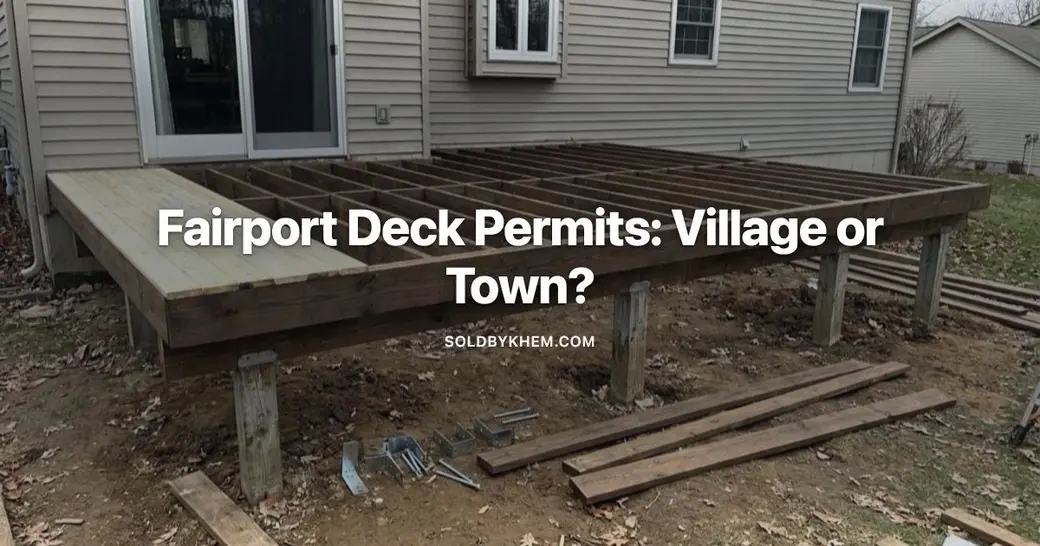
Do I need a permit to build a deck in Fairport NY?
Yes. Both the Village of Fairport and the Town of Perinton require a building permit for a residential deck, attached or freestanding, before work begins. Apply to the village if your property sits inside village lines, and to Perinton if it does not. Expect a plot plan, framing details, and scheduled inspections.
If you are planning a deck on a Fairport property, this post covers the parts owners usually get wrong: which office actually issues your permit, what the building department wants in the application, the inspections that happen while the deck is going up, the code details that most often trigger a correction notice, and what an unpermitted deck does to a sale later. I sell houses in Monroe County, so I see both ends of this. I see the deck getting built, and I see the same deck four years later when a buyer's attorney asks for the paperwork.
One note up front. Fee amounts, exact dimensional requirements and current application forms change, and they change by jurisdiction. I am not going to quote figures I cannot verify for you today. Everywhere a number matters, I tell you which office to call and what to ask.
Do you need a permit for a deck in Fairport?
Yes, in practical terms you do. A residential deck is a structure, and structures require a building permit before construction starts. That applies whether the deck is bolted to the house or freestanding in the yard, whether it is pressure treated lumber or composite decking on a wood frame, and whether you hire a contractor or build it yourself.
The narrow exceptions people repeat at the hardware store, low platforms, small landings, replacing boards, are not as broad as they sound, and they are defined differently from town to town. Replacing decking on an existing frame is often maintenance. Replacing the frame, the footings, the ledger or the stairs usually is not. If you are enlarging the deck, changing its height, or adding a roof, pergola or hot tub, you are firmly in permit territory. Adding a roof or a hot tub also brings in load calculations and, in the hot tub case, electrical work under a separate permit.
Ask before you dig. A five minute phone call to the building department settles it, and it is free.
Which office issues your deck permit, the village or the town?
It depends on which side of the village line your property sits on, not on your mailing address. A great many homes with a Fairport address are not in the Village of Fairport at all. They are in the Town of Perinton, and Perinton's building department handles the permit.
This trips up owners constantly. The post office and the school district do not define the permitting authority. Your tax bill and your property record do. If you are unsure, check your assessment record or simply call one office and ask whether your parcel is theirs.
| Question | Inside Village of Fairport | Outside the village, in Perinton |
|---|---|---|
| Who issues the permit | Village of Fairport building department | Town of Perinton building department |
| Zoning setbacks and lot coverage | Village zoning code | Town zoning code |
| Building code applied | Residential Code of New York State | Residential Code of New York State |
| Variance route if you do not meet setbacks | Village zoning board | Town zoning board |
The construction standard itself is the same in both places. New York State sets the code through the Uniform Fire Prevention and Building Code, and local departments enforce it. What genuinely differs between the village and the town is zoning: how close to a side or rear line you may build, how much of the lot may be covered, and how the department treats corner lots and easements. Older village lots are smaller, so setbacks bite sooner there.
What the building department will ask you for
The application package is not complicated, but incomplete submissions are the single most common reason a deck permit sits on a desk. Plan on providing:
- A completed application, signed by the property owner.
- A plot plan or survey showing the house, the lot lines and the proposed deck with distances to each property line. An instrument survey from your closing usually works, with the deck drawn on it to scale.
- A framing plan: joist size and spacing, beam size, post size, span lengths, footing size and depth, and the decking material.
- Details for the ledger connection, guards and stairs.
- Contractor information, including workers compensation and liability insurance certificates. If you are building it yourself, the department will have an owner affidavit for you to sign instead.
- Homeowner association or subdivision approval, if your neighborhood has covenants. That is a private agreement, separate from the permit, and the town will not enforce it for you.
Call 811 before any digging so utilities get marked. That is a state requirement, not a courtesy.
The code details that fail inspections
Inspectors in Monroe County see the same handful of problems over and over. Get these right and the rest tends to follow.
- Footings. They must bear below the local frost depth on undisturbed soil, and the required depth in this part of New York is deeper than newcomers expect. Ask the building department for the figure they enforce and put it on your drawing.
- The ledger. Where the deck attaches to the house, it must be through bolted or fastened with approved structural screws in the pattern the code requires. Nails are not acceptable. Deck collapses almost always start at a nailed ledger.
- Flashing. Water has to be kept out of the rim joist behind the ledger. Missing flashing is a correction notice and, years later, rotted framing inside the wall.
- Guards. Once a walking surface is a certain height above grade, guards are required, with a maximum opening size between balusters. Confirm both dimensions with the inspector rather than copying a design off the internet.
- Stairs. Consistent riser height and tread depth, a graspable handrail, and a proper landing at the bottom. Uneven risers are an easy fail.
- Hardware. Fasteners and connectors in contact with pressure treated lumber must be rated for it, or they corrode.
What inspections happen, and when
Expect at least two visits, sometimes three. A footing inspection happens after the holes are dug and before concrete is poured, so build that pause into your schedule. A framing inspection happens once posts, beams, joists and the ledger are in place and still visible, before decking covers everything. A final inspection follows once guards, stairs and handrails are complete.
When the final passes, the department issues a certificate of compliance or certificate of occupancy for the work. That document is the point of the whole exercise. Put it with your closing papers.
What an unpermitted deck does at resale
It creates friction, and friction costs money. When a buyer's attorney or a title company finds structural work with no matching permit record, the usual outcomes are that the seller has to open a permit retroactively and bring the deck up to code before closing, or the buyer asks for a credit, or the deal slows while everyone waits on the town. Appraisers may decline to give value to work that has no certificate. Some lenders will not close over an open permit, which is its own separate headache: a permit that was pulled but never finaled sits on the property record until someone closes it out.
Retroactive approval is possible. It is just slower and more expensive than doing it in order, because the inspector cannot see buried footings or covered framing and may require test holes or removal of decking. If you are thinking about selling in the next few years, handle the deck permit now, while the framing is still open and the contractor is still answering the phone.
Timeline and budget, honestly
Simple residential deck permits in this area are typically issued in a matter of days to a couple of weeks once a complete application is in, and longer in spring when everyone applies at once. Anything needing a zoning variance takes considerably longer, because it has to be scheduled onto a board agenda and noticed to neighbors. Fees are set by a local schedule and are usually tied to project value, so ask for the current schedule when you call. Do not let a contractor fold an unspecified permit fee into a lump sum bid without telling you what it covers and who is pulling it. The permit should be in the contractor's name if the contractor is building it.
Common questions
Does a floating deck or a ground level platform need a permit in Fairport?
Sometimes, and you cannot assume. Some low, freestanding platforms below a set height and area fall outside the permit requirement, but the thresholds are specific and the local zoning setback rules can still apply even when a building permit does not. Call the Village of Fairport or the Town of Perinton building department with your dimensions and get the answer for your actual project.
Can I pull the deck permit myself instead of the contractor?
An owner can generally apply for a permit on their own property, and departments have an affidavit for that. Understand what you are taking on: you become responsible for scheduling inspections and for the work meeting code. If a licensed contractor is doing the building, it is cleaner to have the permit in their name with their insurance on file, because responsibility follows the permit.
I am buying a house in Monroe County with a deck. How do I find out if it was permitted?
Ask the seller for the certificate of compliance, and have your agent or attorney request the property's permit history from the municipality. Most local building departments will produce a record of permits issued and finaled for an address. Do this during the inspection period, not the week before closing, so there is time to sort out an open or missing permit.
Will a permitted deck raise my property taxes?
A deck is an improvement, and improvements can be picked up by the assessor and reflected in your assessed value. That is true whether or not you pulled a permit, since assessors also review aerial imagery and field inspections. Skipping the permit does not reliably avoid an assessment change, and it does create a problem at sale.
What if my deck plan does not meet the setback?
You can redesign the deck to fit, or apply to the zoning board for an area variance. A variance means an application, a public hearing and a wait for the board's meeting calendar, so factor in the extra time before you order materials. Many owners find shrinking the deck by a couple of feet is faster and cheaper than the variance route.
Talk it through before you build
If the deck is part of a bigger plan, getting the house ready to list, buying a place that already has one, or deciding whether the money is better spent elsewhere, it helps to talk to someone who has walked through a lot of these houses in Perinton, Pittsford, Brighton and Henrietta. Schedule a time with Khem Kadariya and bring your questions. No pressure and no pitch, just a straight read on what the work will and will not do for you.
About this data
The figures in this post were compiled from publicly available sources including Zillow, Houzeo, Movoto, RochesterFirst and FRED (Federal Reserve Bank of St. Louis), along with other public market data. Real estate numbers change quickly, and these were accurate as of September 2026. For current figures on a specific home, street, or town, ask me directly rather than relying on a published average.
Need Help With Financing?
Thinking about buying a home and wondering what financing options may be available to you?
I recommend connecting with my preferred lending partner, Brian Haefner with Premium Mortgage Corporation. Whether you are a first-time homebuyer, relocating to the Rochester area, purchasing your next home, or simply want to understand your mortgage options and buying power, Brian can help you explore your financing options and answer your mortgage-related questions.
Stay Connected With Khem
Looking for more Rochester real estate information, community updates and local insight?
Thinking about buying in the Rochester area? contact Khem to talk through neighborhoods, financing and current inventory.
Recent Posts









Khem Kadariya
Phone