
Well Yield Test in Webster NY: What Buyers Learn
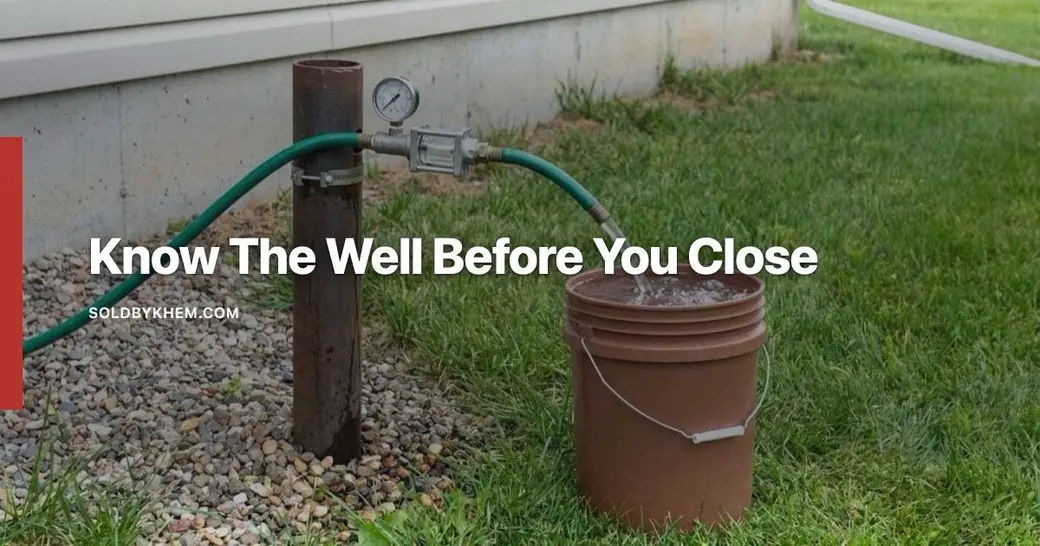
What does a well yield test tell you when buying a house in Webster NY?
A well yield test measures how many gallons per minute a home's well delivers under sustained pumping, and whether the water level recovers afterward. It tells a Webster buyer if the well can support daily household use, exposes a weak or slow-recovering well before closing, and gives you documented grounds to renegotiate or walk away.
If you are buying a house in Webster, Ontario, Penfield's east side or out toward Wayne County, there is a good chance the water does not come from a municipal main. It comes from a well in the yard. A well yield test is how you find out whether that well can actually run a household. This post covers what the test measures, how it is performed, what the numbers mean, what it does not cover, and how buyers use the results at the negotiating table.
I have stood in a lot of basements watching a hose run into a driveway for two hours. The test is not complicated. What trips buyers up is not knowing what a good result looks like, or assuming the yield test covers water quality. It does not.
What does a well yield test actually measure?
A well yield test measures how much water the well produces under sustained pumping, expressed in gallons per minute, and how quickly the water level in the well recovers when pumping stops. Those two numbers together tell you whether the well can keep up with normal use.
The tester runs water out of the house at a controlled rate for a set period, usually one to four hours, and records:
- Flow rate in gallons per minute. Measured with a calibrated container or an inline meter, not by guessing at the hose.
- Static water level. Where the water sits in the well before any pumping starts.
- Drawdown. How far the water level drops during the test.
- Recovery. How fast the level comes back once the pump shuts off.
- Whether the well pumped dry. If the pump loses suction and starts drawing air, the test stops and that is the headline finding.
A well that runs five gallons per minute for two hours with modest drawdown is a different animal from a well that starts at five and fades to one after forty minutes. Only a sustained test shows you the difference. A five minute faucet check shows you nothing.
What is a good gallons per minute number?
There is no single legal minimum for an existing home in New York, but the working rule most local well contractors and lenders use is that roughly five gallons per minute of sustained yield comfortably supports an average household, and anything at or below one to two gallons per minute deserves serious scrutiny.
Context matters more than the raw figure. Consider:
- Household demand. Bathroom count, laundry, dishwasher, and whether there is irrigation or a pool.
- Storage. Some homes with modest yield work fine because they have a large pressure tank or a holding tank that buffers peak demand.
- Recovery rate. A slow well with fast recovery can be livable. A slow well with slow recovery is a problem you will feel every Saturday morning.
- Depth and construction. A shallow dug well behaves differently than a drilled bedrock well several hundred feet down.
Ask the tester to write down all of it, not just the summary. The narrative matters when you are deciding whether to ask for a credit.
How the test runs on an occupied Webster house
Scheduling is the part buyers underestimate.
- You order it during your inspection window. Most buyers bundle it with the general home inspection so there is one visit and one point of coordination.
- The seller agrees to normal water use beforehand. If the household has been running laundry all morning, the static level is already drawn down and the result is skewed low. If the house has sat vacant for months, the pump and pressure tank may behave oddly on startup.
- The tester locates the well and the pressure tank. Well caps get buried, landscaped over, or hidden under a deck. If nobody can find the well cap, you cannot measure static level.
- Water is discharged away from the well. Usually a long hose to the street or a ditch, so the discharge does not soak back down toward the well.
- Readings get taken on a schedule. Flow and water level at intervals across the test period.
- Recovery is measured after shutdown. This is the step some cheap tests skip. Do not let it get skipped.
- You get a written report. Numbers, times, observations, and a plain statement of whether the well pumped dry.
Winter adds wrinkles. Discharging hundreds of gallons across a driveway in January is a real consideration, and some testers will want a different route for the hose. It is doable, it just needs a conversation in advance.
Yield is not quality: the tests to order alongside
A well can deliver twelve gallons per minute of water you would not want to drink. Yield and quality are separate questions with separate tests. For a private well home purchase in New York, buyers commonly order a water quality panel at the same visit.
| Test | What it answers | Why it matters here |
|---|---|---|
| Yield or flow test | Can the well produce enough water? | Quantity problems are expensive to fix and show up daily |
| Coliform bacteria and E. coli | Is the well contaminated? | Often a lender or health department requirement; can point to a compromised well cap or casing |
| Nitrate and nitrite | Is there agricultural or septic influence? | Relevant in areas with nearby fields or older septic systems |
| Arsenic, lead, uranium | Are there naturally occurring or plumbing-sourced metals? | Bedrock geology varies field to field in this part of the state |
| Hardness, iron, manganese, sulfur | Will fixtures stain and will the water smell? | Drives whether you need a softener or filtration, and what it costs |
The Monroe County Department of Public Health maintains guidance on private well water testing and can tell you which certified labs handle these panels. Ask your tester which lab they use and whether the results come back to you directly.
What a well yield test does not tell you
Plenty. Know the limits before you rely on the report.
- It is a snapshot. A test in April after a wet spring can read better than the same well in a dry August. Ask about seasonal variation and whether the seller has ever run short.
- It does not date the equipment. Pump age, pressure tank condition and wiring are inspection items, not yield items.
- It does not map the aquifer. Two houses on the same road can have very different wells.
- It does not cover the septic system. Most homes on a private well are also on a private septic system. That is a separate inspection with its own scope, and it is the one I would not skip.
How buyers use the results
A written result changes the conversation from opinion to documentation. In practice, buyers do one of four things.
- Accept and move on. Strong yield, clean water panel, good recovery. Nothing to do.
- Ask for a repair or treatment credit. Bacteria present, or hardness and iron high enough that filtration is warranted. Get a contractor quote so the ask has a number attached.
- Ask for a larger fix. Low sustained yield sometimes gets addressed with hydrofracturing, a deeper well, or added storage. These are quotable jobs. Get the quote before you name a figure.
- Exit on the inspection contingency. If the well pumped dry in ninety minutes and the fix is a new well of unknown depth, that is a legitimate walk.
Two practical notes on the New York side of this. First, make sure your purchase contract's inspection contingency language is broad enough to cover well and septic findings, not just structural items. Second, if you are financing, ask your lender early what it requires. Some loan programs want a water quality certification in the file, and finding that out a week before closing is avoidable stress.
Is a well yield test worth the cost?
Yes, on any home where water comes from a private well and you cannot verify recent yield documentation. The cost of the test is a small fraction of what a low-yield well costs to remedy, and the report gives you leverage you otherwise do not have.
What I tell buyers looking at well homes in Webster and out through southeast Monroe County: budget for the general inspection, the well yield test, the water quality panel and the septic inspection as one line item. Order them together. Read all four reports side by side, because they tell one story about how the house actually functions.
Common questions
Who pays for the well yield test, the buyer or the seller?
The buyer typically pays, because it is part of the buyer's due diligence and the report belongs to the buyer. Sellers sometimes provide a recent test to head off questions, and that is helpful, but you should still confirm when it was performed and by whom. A test more than a year old, or one run for a previous buyer, may not reflect current conditions.
How long does a well yield test take?
Most residential yield tests run one to four hours of pumping, plus setup and a recovery measurement afterward. Budget half a day for the visit. Shorter tests cost less but tell you less, since a weak well often performs acceptably for the first thirty minutes and then fades.
Can a low-yield well be fixed?
Sometimes. Options include hydrofracturing an existing bedrock well to open water-bearing fractures, deepening the well, drilling a new well, or adding a holding tank so storage covers peak demand. Each has a different cost and a different likelihood of success, so get a licensed well contractor to look at the specific well and quote it before you assume anything.
Do I still need a water quality test if the yield is strong?
Yes. Yield and quality are unrelated. A high-producing well can carry bacteria, nitrate, arsenic or heavy iron and manganese. Order a bacteria and chemical panel through a certified lab alongside the yield test, and check with the Monroe County Department of Public Health for current private well testing guidance.
Does a private well affect my mortgage or insurance?
It can affect the mortgage. Some loan programs require documentation that the water supply is potable and adequate, and lenders may ask for a lab result in the file. Ask your loan officer during pre-approval rather than during the closing week. Insurance treatment varies by carrier, so raise it with your agent when you quote the policy.
If you are weighing an offer on a well and septic home in Webster or anywhere in southeast Monroe County and want someone to walk the property with you before you write, schedule a time with Khem Kadariya. We will go through the inspection plan, the contingency language and what the reports are likely to show.
About this data
The figures in this post were compiled from publicly available sources including Redfin, Zillow, Houzeo, Movoto and RochesterFirst, along with other public market data. Real estate numbers change quickly, and these were accurate as of September 2026. For current figures on a specific home, street, or town, ask me directly rather than relying on a published average.
Need Help With Financing?
Thinking about buying a home and wondering what financing options may be available to you? Knowing where you stand before you write an offer puts you in a much stronger position.
I recommend connecting with my preferred lending partner, Brian Haefner with Premium Mortgage Corporation. Whether you are a first-time homebuyer, relocating to the Rochester area, purchasing your next home, or simply want to understand your mortgage options and buying power, Brian can help you explore your financing options and answer your mortgage-related questions.
Stay Connected With Khem
Looking for more Rochester real estate information, community updates and local insight?
Thinking about buying in the Rochester area? start a conversation with Khem to talk through neighborhoods, financing and current inventory.
Recent Posts







Khem Kadariya
Phone