
Monroe County escrow holdbacks for unfinished repairs
What is an escrow holdback when a repair cannot be finished before closing in Monroe County NY?
An escrow holdback is money withheld from the seller's proceeds at closing and held by a third party, usually the title company or an attorney, until an agreed repair is finished and verified. The closing still happens on time. The lender, title company and both attorneys all have to approve the arrangement before it can be used.
Sometimes the repair simply cannot be done. The roofer is booked three weeks out. The ground is frozen and the septic work cannot start. The furnace part is on backorder. Meanwhile the mortgage commitment has an expiration date, the moving truck is booked, and the seller has a closing of their own the same afternoon.
An escrow holdback is the tool for that situation. This post explains what a holdback actually is, who has to approve it, how the dollar amount gets set, what the written agreement needs to say, and when a plain repair credit is the smarter choice instead. Everything here is process, not prediction. I am not going to quote market numbers I cannot source.
What an escrow holdback actually is
At closing, the seller's proceeds get paid out. A holdback carves off a specific amount of that money before it reaches the seller and parks it with a neutral party, usually the title company or one of the closing attorneys. The written agreement says what work has to be done, by when, and what proof releases the funds.
Three things are true at the same time:
- The deed transfers and the buyer owns the house. Closing is not delayed.
- The seller does not get the held amount yet, and does not get it at all if the terms are not met.
- The repair still has to happen. A holdback buys time, not forgiveness.
That last point gets missed. A holdback is not a discount. It is a deadline with money attached to it.
When does a repair have to wait until after closing?
Usually because of weather, lead time, or access. Those are the three I see over and over in south and southeast Monroe County.
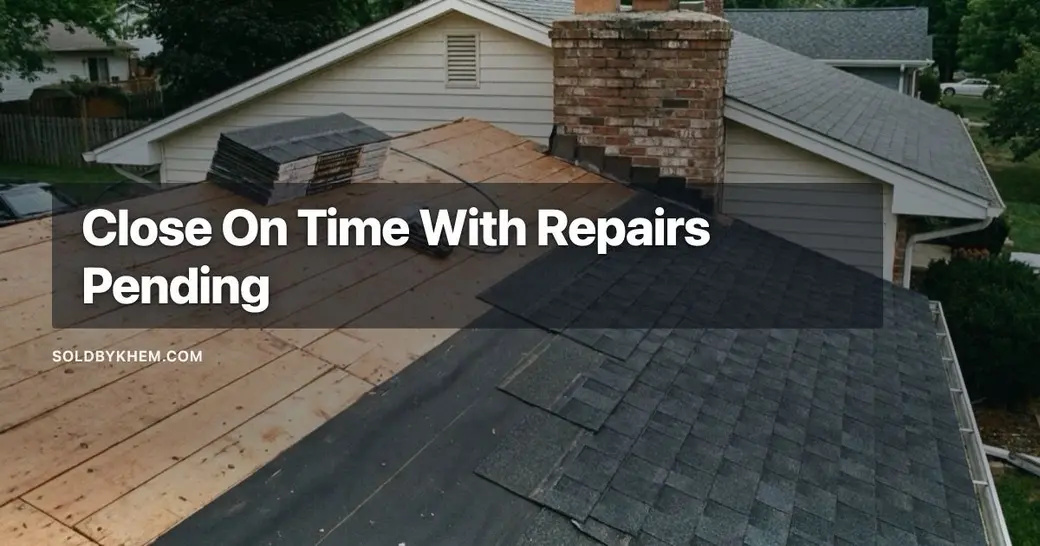
- Weather. Driveway sealing, exterior paint, grading and drainage work, septic field repair, and some roof work cannot be done properly in a Rochester winter. A contractor who tells you otherwise in February is a contractor to be careful with.
- Lead time. Furnace and boiler parts, well pumps, custom windows, and anything ordered rather than stocked. A supply house in Henrietta can have a part next day or next month, and you find out which one only after the order goes in.
- Access and sequencing. Sometimes a chimney liner cannot go in until the furnace is replaced, or a sump discharge cannot be relocated until the landscaping thaws.
Repairs that are safety related or required for the loan itself are a different category. A lender that conditions the loan on a working heat source is not going to accept a holdback for the furnace. It wants heat before it funds.
Who has to approve an escrow holdback in a NY closing?
More people than most buyers expect. Every one of them can say no, and any single no ends the plan.
- The buyer's lender. This is the big one. The lender is funding a loan against a house that is not in the condition the appraisal assumed. Some lenders allow holdbacks routinely. Some allow them only for weather related work. Some refuse outright. Ask underwriting, in writing, early.
- The title company or escrow agent. They have to be willing to hold the money and administer the release. Not all of them will.
- Both attorneys. In our market attorneys handle the closing documents, and the holdback agreement is one of them. It gets drafted, negotiated and signed like any other term.
- The appraiser, sometimes. If the appraisal was made subject to repairs, the lender may need a final inspection and a completion report before it will fund at all, holdback or not.
Here is the practical timing rule. Raise the possibility of an escrow holdback the day you learn the repair is at risk, not the day before closing. A lender approval that takes two business days is fine on a Tuesday two weeks out and a disaster at 4pm the night before.
How much money gets held?
The starting point is a written contractor estimate for the specific work. Not a range, not a verbal number. An estimate on letterhead with a scope of work.
Then the held amount goes up from there. Lenders and escrow agents almost always require a cushion above the bid, because the person doing the work is no longer the person who owns the house, and because the price of anything opened up can climb. Ask your lender what cushion it requires before you negotiate the number with the other side. There is no universal figure, and guessing at one wastes a round of negotiation.
The written agreement should answer all of this on its own, without anyone having to remember a conversation:
- The exact scope of work, in plain language.
- Who hires and pays the contractor.
- The completion deadline, as a calendar date.
- What proof releases the funds: a paid invoice, a municipal inspection, a photo set, a re-inspection by the original home inspector.
- Who gets the money if the deadline passes without the work being done.
- Who gets any leftover funds if the job comes in under the held amount.
- What happens if the job comes in over.
That second to last line causes more arguments after closing than anything else. Decide it before you sign.
Escrow holdback or repair credit in Monroe County?
A repair credit is simpler in almost every way. The seller credits the buyer money at closing, the buyer takes the house as is, and there is no agreement to administer afterward. The tradeoff is that nothing obligates the buyer to actually do the work, which is exactly why some sellers prefer it and some lenders cap it.
| Approach | How it works | Fits when | Watch for |
|---|---|---|---|
| Escrow holdback | Money held by a third party, released when the work is verified | The repair is defined, priced and genuinely time blocked | Lender approval, cushion amount, who controls the contractor |
| Repair credit | Seller credits the buyer at closing toward closing costs | Both sides want to be done and the buyer will manage the work | Lenders limit credits, and unused credit does not come back as cash |
| Price reduction | Contract price is lowered | The buyer has cash and wants a lower loan amount | A lower price can trigger a new appraisal look |
| Seller completes before closing | Work done and verified prior to the table | The repair is small and the trade is available | Rushed work by whoever could come Thursday |
My usual read: if the work is under a modest dollar amount and the buyer is willing, a credit is cleaner. If the work is large, required by an inspection or a municipal certificate, or the seller wants proof it was done properly, a holdback is worth the paperwork.
What goes wrong, and how to prevent it
- Nobody asked the lender until the last week. Ask at inspection response time.
- The scope is vague. "Repair roof" is not a scope. "Replace shingles on the rear slope, install ice and water shield, replace damaged decking as needed" is a scope.
- No deadline. Open ended agreements sit for months.
- The seller has moved out of state. Name who is coordinating the contractor and how they will be reached.
- The bid was a favor. A cheap number from a friend of the family collapses when the friend gets busy. Get a real bid.
One more thing for sellers. A holdback means part of your proceeds is not available on closing day. If you are buying on the same day and counting every dollar, tell your attorney and your lender before you agree to the amount.
Common questions
Does an escrow holdback delay my closing?
No. That is the entire point of it. The deed transfers, the loan funds, and the buyer takes possession on the scheduled date while a defined sum stays with the escrow agent until the work is verified. What can delay a closing is asking for the holdback too late, because the lender approval, the attorney drafting and the escrow agent's sign off all take time.
Who chooses the contractor for the repair?
Whatever the agreement says, and it should say. Sometimes the seller keeps control because it is their money at risk. Sometimes the buyer takes control because they now own the house and will live with the result. Both work. What does not work is leaving it unwritten and discovering the disagreement after closing.
What happens to leftover money if the repair costs less than the holdback?
It goes back to whoever the agreement says it goes back to, which is usually the seller, since the funds came out of their proceeds. Because the held amount typically includes a cushion above the bid, there often is a leftover. Spell out the refund in the document so there is no argument once the invoice comes in lower than expected.
Is a repair credit better than a holdback for a Monroe County buyer?
It depends on who you want doing the work and how much control the seller wants over quality. A credit is faster and has no follow up administration, but the buyer is free to spend it elsewhere. A holdback forces the repair to actually happen and gets it verified, at the cost of more approvals and more paperwork. Lenders also limit how large a seller credit can be, so a large repair sometimes has to be a holdback whether anyone prefers it or not.
Can the seller just fix it after closing without an escrow?
They can promise to, and sometimes people do exactly that. The problem is that once the money is paid out and the seller has moved, you have a promise and no leverage. If the repair matters to you, hold the funds. If it does not matter enough to paper, it probably did not need to be a condition.
Bring me the situation before it becomes a problem
Most holdback trouble is timing trouble. A repair that surfaces at inspection and gets handled in the first week is a paragraph in a document. The same repair raised two days before closing is a scramble across four parties who all have other files.
If you are buying or selling in Henrietta, Pittsford, Brighton, Mendon, Rush, Honeoye Falls or anywhere nearby and there is a repair that may not finish in time, let's map it out early. Schedule a time with me and we will work out whether a holdback, a credit or a price adjustment gets you to the table cleanest.
Khem Kadariya, Sold By Khem
About this data
The figures in this post were compiled from publicly available sources including Redfin, Zillow, Houzeo, Movoto and RochesterFirst, along with other public market data. Real estate numbers change quickly, and these were accurate as of September 2026. For current figures on a specific home, street, or town, ask me directly rather than relying on a published average.
Keep reading
Buying After You Sell?
If your move involves buying as well as selling, the financing side is worth lining up early.
I recommend connecting with my preferred lending partner, Brian Haefner with Premium Mortgage Corporation.
Stay Connected With Khem
Looking for more Rochester real estate information, community updates and local insight?
Thinking about buying in the Rochester area? talk with Khem to talk through neighborhoods, financing and current inventory.
Recent Posts









Khem Kadariya
Phone