
Utility easements on Hilton NY land and what they limit
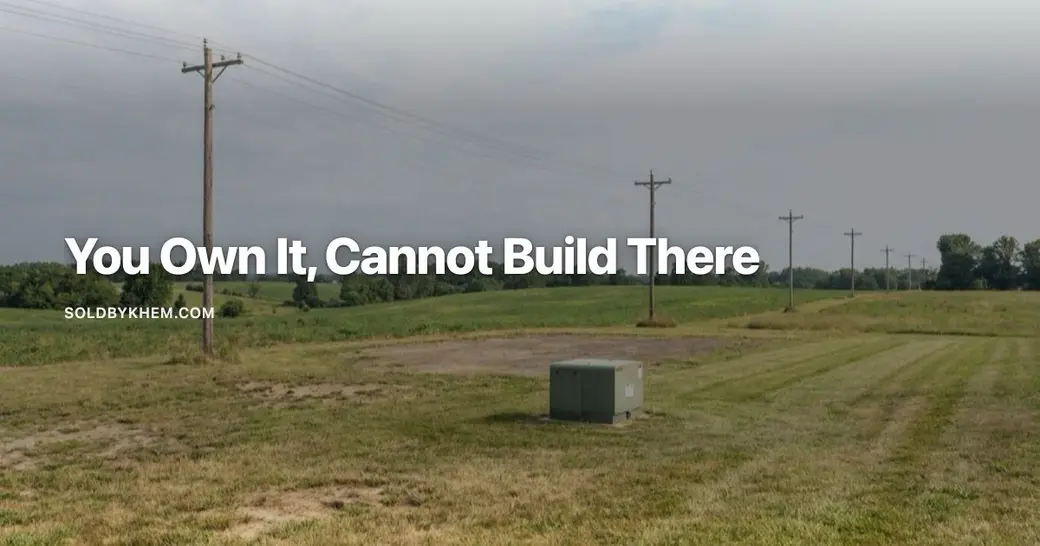
What does a utility easement mean for a parcel of land in Hilton, NY?
A utility easement gives a utility company the recorded right to install, access and maintain lines across part of your Hilton parcel. You still own the land and pay taxes on it, but you generally cannot build permanent structures inside the easement strip, and the utility can clear trees and dig within it without asking you first.
Most vacant parcels in Hilton and the surrounding Town of Parma carry at least one easement. That is normal. It is not automatically a problem. The problem is that buyers usually find out about it after they have already pictured where the house goes, and by then they are attached to a plan the easement will not allow.
This post covers what a utility easement actually is, where it is written down, how to read the language, what you can and cannot put inside the strip, and how to judge whether a given easement costs you anything you care about. No legal advice here, just what to look for and who to ask.
What a utility easement actually is
An easement is a recorded right for someone other than the owner to use a defined part of a property for a defined purpose. With a utility easement, the holder is usually a power, gas, telecommunications, water or sewer provider. They get the right to install their equipment, come back onto the land to fix it, and keep the strip clear enough to do that work.
Three things surprise people:
- You still own the land inside the easement. You still pay property tax on it.
- The easement almost always runs with the land. It does not expire when the property sells. Buying the parcel means buying the easement with it.
- The holder usually does not need your permission to enter and work, as long as they stay inside the terms of the grant.
That last point is where the friction happens. A utility crew clearing brush along a line is not trespassing. They are exercising a right that was granted, often decades ago, by an owner nobody involved has ever met.
Where do you find the easement on a Hilton parcel?
You find it in the recorded chain of title, which for any Hilton or Parma property means the Monroe County Clerk's office. Easements are recorded instruments, filed and indexed like deeds and mortgages. A deed easement in Monroe County shows up in one of a few places, and you want to check all of them.
- The deed itself. Look for language after the property description that starts with "subject to" or "excepting and reserving." That is where easements hide in plain sight.
- A separate recorded easement agreement. Often granted to a utility long before the current lot lines existed. It may be referenced in the deed by liber and page, or it may not be referenced at all.
- The abstract of title. In this part of New York, abstracts are still commonly used. The abstract summarises every recorded instrument affecting the parcel going back decades. Read the summaries, then order the underlying documents for anything that mentions a right of way, a pole line, a gas line or a drainage right.
- The filed subdivision map. If the parcel came out of a subdivision, the map on file frequently shows easement strips along lot lines that the deed never spells out in words.
- A current survey. Not an old one. A new instrument survey plots the easement lines against the actual boundaries and any existing improvements.
Order the abstract update and the survey early. On raw land, those two documents tell you more about what you are buying than anything else in the file.
The two questions that decide how much an easement matters
Once you have the document, the language sorts into a few patterns. Two questions do most of the work.
| Question | Better outcome | Harder outcome |
|---|---|---|
| Is the location described? | A defined strip, with a stated width and a location tied to a boundary or a survey line. You know exactly where it is. | A blanket easement with no location stated. In theory the holder can place facilities anywhere on the parcel. |
| Who benefits? | Appurtenant to a neighbouring parcel for a narrow purpose, or in gross to a utility with a single line already installed and visible. | Broad grant covering future expansion, additional lines, access roads and unlimited assignment to other companies. |
Blanket easements are common on older rural parcels around Parma because the grant predates any lot layout. In practice, once a utility installs its facilities, the easement is generally treated as fixed at that location. Practice is not the same as certainty, so if a blanket grant is on your title, have a real estate attorney read it before you commit.
What can you build inside the easement strip?
Generally, nothing permanent, and less than most buyers expect. The grant language controls, but the pattern is consistent for utility easement NY property: no houses, no garages, no additions, no decks on footings, no pools, no septic fields, no wells inside the strip.
Items that sit in a grey area, and usually need written approval from the utility:
- Fences crossing or running inside the strip
- Sheds and other unfooted structures
- Driveways and gravel crossings, often allowed at a perpendicular crossing but not lengthwise
- Grade changes, fill and ponds
- Trees and tall landscaping, which vegetation management crews may cut back or remove
The practical rule on Hilton NY land: treat the easement as land you own, pay tax on, and can mow, but cannot count in your buildable footprint. Then look at the parcel again and see whether the plan still works.
Does a utility easement reduce what the parcel is worth?
It depends almost entirely on where the strip sits, not on whether one exists. An easement running the last few feet along a road frontage or a rear boundary usually changes nothing about how the lot builds out. An easement cutting diagonally through the middle of a five acre parcel can split the buildable area into two pieces, neither of which works with the setbacks.
On unsewered parcels in Parma, the septic question matters more than the house question. A conventional system needs a primary field and a reserve area, both on soils that pass a perc test, both outside the easement, both clear of the well and the neighbours' wells with the separation distances the Monroe County Health Department requires. Lose a corner of the lot to a utility strip and the septic layout can become the binding constraint on the whole project.
Before you make an offer, ask for or pay for:
- An abstract search and a current survey showing all easements plotted
- A sketch of the buildable envelope with easements, setbacks and any wetland or floodplain areas removed
- Confirmation from the Town of Parma or the Village of Hilton, whichever has jurisdiction over the parcel, on setbacks, lot coverage and driveway permits
- A perc test and deep hole test if the parcel is not on public sewer
- A written response from the utility if you intend to put anything at all inside the strip
If you are selling a parcel with an easement
Disclose it and document it. A buyer who finds a recorded easement during their own title work, after they thought they had a clean parcel, either renegotiates or walks. A buyer handed the recorded instrument, a survey with the strip plotted and a sketch showing where a house and septic can still go tends to keep moving.
The strongest listing package for a Parma or Hilton parcel is the boring one: abstract, survey, perc results, zoning confirmation, easement documents. It costs money up front and it removes most of the reasons a land deal falls apart in the third week.
Common questions
Can I have a utility easement removed from my deed?
Only the holder can release it, and utilities rarely release an easement where they have facilities in place or a plan for future service. A release has to be signed by the holder and recorded with the Monroe County Clerk to be effective. If a line was never installed and the grant is very old, an attorney can review whether extinguishment is worth pursuing, but do not buy a parcel assuming that will happen.
Do I still pay property taxes on land inside the easement?
Yes. You own the fee interest in that ground, so it stays in your assessed acreage. The easement limits what you can do on it, not who owns it. Assessors do sometimes account for a heavily encumbered parcel differently, so if a large share of your lot is unusable, it is reasonable to raise that with the assessor.
Can the utility cut down trees on my property?
Inside the easement, usually yes, if the grant allows clearing and access, and most do. Outside the easement, generally no, unless the trees threaten the facilities and the grant covers danger trees. Read the specific language. Some grants are narrow, some allow trimming across a much wider corridor than the strip itself.
Will a lender or title insurer object to a utility easement?
Standard utility easements along boundaries are recorded as exceptions on the title policy and rarely stop a loan. Problems arise when the easement is blanket, when an existing structure sits inside the strip, or when access to the parcel depends on a right of way that was never properly recorded. Those get flagged, and they need to be resolved before closing rather than after.
What is the difference between an easement and a right of way?
A right of way is one type of easement, specifically a right to pass over land. A utility easement may include a right of way for access plus rights to install and maintain equipment. On rural parcels you may see both: a utility strip along one boundary and a separate access right of way serving a neighbouring parcel.
If you are looking at a parcel in Hilton or Parma and the title work has raised something you want a second read on, send it over. I will walk the lot with you, look at the survey against the easement language, and tell you plainly whether the plan still fits. Book a time with Khem Kadariya and bring the documents you have.
About this data
The figures in this post were compiled from publicly available sources including Zillow, Houzeo, Movoto, RochesterFirst and FRED (Federal Reserve Bank of St. Louis), along with other public market data. Real estate numbers change quickly, and these were accurate as of September 2026. For current figures on a specific home, street, or town, ask me directly rather than relying on a published average.
Need Help With Financing?
Thinking about buying a home and wondering what financing options may be available to you? Knowing where you stand before you write an offer puts you in a much stronger position.
I recommend connecting with my preferred lending partner, Brian Haefner with Premium Mortgage Corporation. Whether you are a first-time homebuyer, relocating to the Rochester area, purchasing your next home, or simply want to understand your mortgage options and buying power, Brian can help you explore your financing options and answer your mortgage-related questions.
Stay Connected With Khem
Looking for more Rochester real estate information, community updates and local insight?
Have a question about Rochester real estate? contact Khem and we can talk it through.
Recent Posts



Khem Kadariya
Phone