
Pittsford Village Historic District Rules for Exterior Work
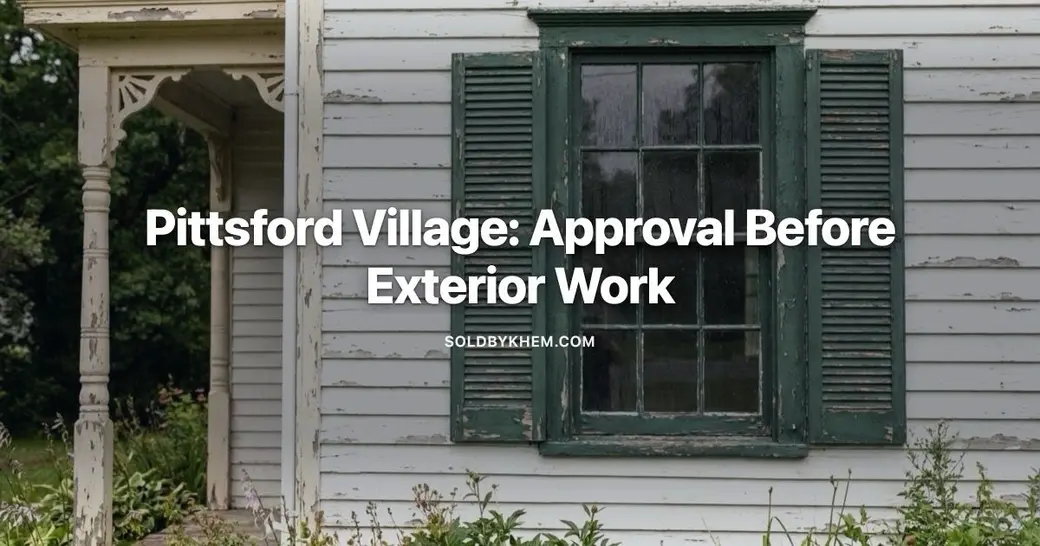
Do I need approval for exterior work on a home in the Pittsford village historic district?
Usually yes. In the village of Pittsford, changes to the exterior of a designated historic property or a property in a local historic district generally need review and approval from the village before a building permit is issued. Routine repair with matching materials often does not. Confirm your parcel's status with the village office first.
The village of Pittsford is about one square mile of canal era housing stock, and a lot of it is protected. If you are buying here, that changes how you plan a renovation. Not whether you can do the work, but the order you do it in and the materials you use.
This post covers what the Pittsford village historic district review actually applies to, which projects usually need approval and which do not, how the application process runs from first phone call to final inspection, and what to verify during your inspection and attorney approval period so you do not inherit someone else's unapproved porch.
One note before we start. Village codes get amended, board names change, and meeting calendars shift. Everything below is the shape of the process. Confirm the current details with the Village of Pittsford office for your specific address before you sign a contract with a builder.
What is the Pittsford village historic district?
It is a locally designated area of the village where exterior alterations to buildings are reviewed for their effect on the historic character of the streetscape. The village also contains properties and structures listed on the National Register of Historic Places, which is a separate designation with different consequences.
That distinction matters more than most buyers expect:
- Local designation comes with teeth. It is village law. It is what requires you to get approval before you change the outside of the house.
- National Register listing is largely honorary for a private owner spending private money. It does not by itself stop you from replacing windows. What it can do is open the door to state and federal historic rehabilitation tax credit programs.
Plenty of village homes are both. Some are one and not the other. Some are in neither category. You cannot tell by looking at the house, and you cannot tell from the listing sheet. Ask the village to confirm the status of the parcel in writing.
Which projects need exterior renovation approval in Pittsford?
As a working rule, anything that changes what the building looks like from the outside needs review, and anything that repairs what is already there with the same material usually does not. The dividing line is change versus repair.
Here is how that plays out on the projects village buyers ask about most.
| Project | Typically reviewed | What the board tends to focus on |
|---|---|---|
| Replacing original wood sash windows | Yes | Material, profile, muntin pattern, whether repair of the existing sash is feasible |
| Repairing or reglazing existing sash | Often treated as maintenance | Matching glass and putty details |
| Siding replacement or wrapping trim | Yes | Loss of original clapboard, trim profiles, corner boards |
| Roof replacement with a different material | Yes | Slate and standing seam versus asphalt, color, visibility from the street |
| Roof replacement in kind | Sometimes administrative | Matching profile and color |
| Porch rebuild, column or railing changes | Yes | Post dimensions, baluster spacing, floor material, skirt detail |
| Additions, dormers, rear extensions | Yes | Scale, setback, roof line, visibility, reversibility |
| Garages, sheds, driveway changes | Yes | Placement behind the primary structure, footprint, curb cuts |
| Fences and walls | Yes | Height, material, front yard versus rear |
| Solar panels and mechanical equipment | Yes | Street visibility, mounting method, screening |
| Signs on mixed use buildings | Yes | Size, materials, lighting, mounting into masonry |
| Repainting in an existing color | Usually not | Varies by district, so ask before you buy the paint |
Storm windows are the sleeper issue. Exterior storms are frequently the compromise that lets an original sash stay in place, and a well fitted interior storm can do the same job without touching the street elevation at all. If your plan is energy performance rather than aesthetics, say that when you apply. It changes the conversation.
How does the approval process actually work?
It runs in a fixed order, and the order is the part people get wrong: review comes before the building permit, not after.
- Call the village first. Ask whether your address is designated, whether your specific scope needs board review, and what the current submission deadline is. Some small items can be signed off administratively by the building inspector without a hearing.
- Assemble the application. Expect to provide photographs of existing conditions, a site plan or survey, drawings or elevations for anything structural, and product specifications. Cut sheets matter. A board can approve a window in principle and reject the specific unit you picked.
- Submit by the deadline for a meeting date. The board works on a published meeting calendar. Miss the cutoff and you wait for the next cycle, so build that into your construction schedule rather than your contractor's.
- Attend the meeting. These are public sessions. Neighbors can comment. Bring your contractor or architect if the detailing is technical, because the questions are usually about details.
- Get the decision. Approval, approval with conditions, a request for revisions, or denial. Conditions are common and are often about material substitutions.
- Then pull the building permit and go through normal inspections. Build what was approved. Field changes that deviate from the approved drawings can stop the job.
If a project is denied, you generally have a path forward: revise and resubmit, or pursue whatever appeal or hardship relief the village code provides. Ask about that route before you assume a house cannot work for you.
What buyers should verify before closing
You have an inspection and attorney approval window. Use it for paperwork, not just plumbing.
- Confirm designation status for the parcel with the village, in writing.
- Ask for the permit history. Look for open permits and for finished work that never got one. A rear addition, a wrapped porch, or a vinyl window package installed without approval becomes your problem after closing.
- Check for any pending or expired approvals. An approval the seller obtained may have a validity period and may not transfer the way you assume.
- Price the exterior scope with real materials. Wood sash repair, cedar clapboard, slate patching, and custom millwork are not big box prices. Get a number from a contractor who has worked inside the village before you commit to a renovation budget.
- Ask about the tax credit programs. New York State runs a historic homeownership rehabilitation credit with eligibility rules tied to location and project type. Check with the state historic preservation office early, because the paperwork has to be in place before work starts.
Having walked these houses, the pattern is consistent. The homes with original six over six sash, wide clapboard, and intact porch detailing are the ones where review is most involved and also the ones where the detail is worth keeping. The homes that were already re-sided in the 1980s tend to have simpler applications, because the board is often being asked to restore rather than to permit a loss.
Does historic review hurt resale?
It cuts both ways, and buyers in the village generally know that going in. Review adds time and constrains material choices, which raises the cost of some projects. It also means the block you are buying into cannot be altered around you without a public process. That predictability is part of what village buyers are paying for.
The practical risk is not resale value. It is a buyer who closes with a renovation plan built on suburban assumptions, discovers the window package needs to change, and blows the budget in month one. That is avoidable with two phone calls before you go under contract.
Common questions
Do I need approval to repaint my house in the village of Pittsford?
Repainting in the same or a similar color is commonly treated as maintenance rather than an alteration. Requirements vary by district and by how the local code is written, so call the village office and describe the plan before you buy materials. If you are changing the color scheme significantly or painting previously unpainted masonry, ask specifically, because unpainted brick and stone are usually treated differently.
Can I replace old windows with vinyl in a Pittsford historic district home?
Assume you cannot do it as a matter of course. Replacing original wood sash generally requires review, and boards commonly ask whether the existing sash can be repaired first, then look closely at material, sight lines, and muntin profile. Interior or exterior storm windows are often the accepted route to better performance while keeping the original units in place.
How long does exterior renovation approval take in Pittsford?
The timeline is driven by the board's meeting calendar and submission deadline rather than by a fixed number of days, so ask the village for current dates and work backward from there. A complete application with photographs, drawings, and product specifications tends to move in one cycle. Incomplete submissions and requests for revisions add a cycle each time.
What happens if the previous owner did unapproved work?
The obligation typically follows the property, which means it becomes yours at closing. Ask the village for the permit history during your inspection period and compare it to what you see on the house. If there is a gap, have your attorney address it before closing rather than discovering it when you apply for your own project.
Is every home in the village of Pittsford in a historic district?
No. The village includes locally designated properties and districts, properties listed on the National Register, and properties in neither category, and the two designation types carry different obligations. Because you cannot determine this from the age or appearance of the house, confirm the status parcel by parcel with the village.
Talk it through before you write an offer
If you are looking at a village of Pittsford house and trying to work out whether the exterior work you have in mind is realistic, that is a conversation worth having before the offer, not after the inspection. I will help you check designation status, review permit history, and get you in front of a contractor who has been through this process locally. Schedule a time with me and bring the address.
Khem Kadariya, Sold By Khem
About this data
The figures in this post were compiled from publicly available sources including Redfin, Houzeo, Zillow, FRED (Federal Reserve Bank of St. Louis) and the Rochester Beacon, along with other public market data. Real estate numbers change quickly, and these were accurate as of September 2026. For current figures on a specific home, street, or town, ask me directly rather than relying on a published average.
Keep reading
Need Help With Financing?
Thinking about buying a home and wondering what financing options may be available to you? Knowing where you stand before you write an offer puts you in a much stronger position.
I recommend connecting with my preferred lending partner, Brian Haefner with Premium Mortgage Corporation. Whether you are a first-time homebuyer, relocating to the Rochester area, purchasing your next home, or simply want to understand your mortgage options and buying power, Brian can help you explore your financing options and answer your mortgage-related questions.
Stay Connected With Khem
Looking for more Rochester real estate information, community updates and local insight?
Have a question about Rochester real estate? start a conversation with Khem and we can talk it through.
Recent Posts





Khem Kadariya
Phone