
Radon mitigation in Fairport NY homes: what to check
Do homes in Fairport NY need radon mitigation systems?
Not every home does, but every home should be tested. Radon levels in Fairport and Perinton vary house by house, even between neighbours on the same street, so age and construction quality tell you nothing. Test during your inspection period. If the lab result comes back above the EPA action level, a sub-slab depressurization system fixes it.
If you are buying in Fairport or anywhere in Perinton, radon will come up. It shows up on inspection add-on menus, it shows up in seller disclosures, and it shows up as a white PVC pipe running up the side of the house that nobody explains to you. This post covers what radon mitigation actually is, how testing works during a purchase contract, what drives the price of a system, how to tell whether an existing system is doing its job, and how the result usually gets negotiated between buyer and seller.
Why radon comes up in so many Fairport home inspections
Radon is a colourless, odourless gas produced as uranium in soil and bedrock breaks down. It moves through soil, finds gaps in a foundation, and collects in the lowest enclosed level of a house. Western and central New York sits on geology that produces it, and Monroe County is mapped by the EPA as an area with elevated radon potential.
The part that surprises buyers: results are house by house. I have seen two homes on the same Perinton street, built by the same builder in the same year, return very different readings. A 1970s colonial with a full poured basement, a 1920s village home with a stone foundation near the canal, and a five-year-old build off Ayrault Road are all candidates. Tight new construction is not exempt. Neither is a dry basement.
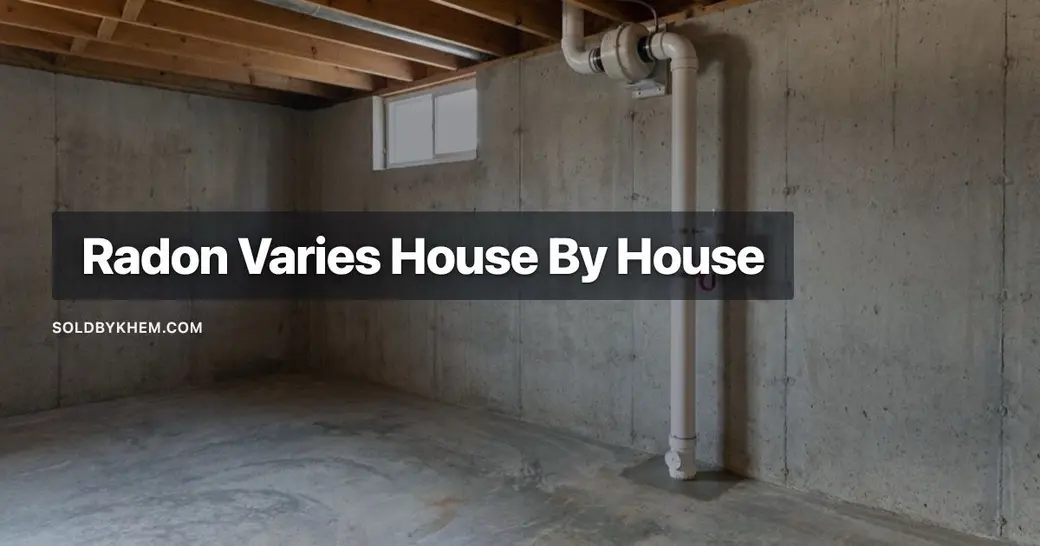
Common entry points are the gap where the slab meets the foundation wall, floor cracks, an open sump pit, and the holes cut for plumbing and electrical service.
How does radon testing work in Monroe County?
A short-term test is placed in the lowest livable level of the house for at least 48 hours under closed-house conditions, then read by a lab or by a continuous monitor. Two methods are common. A passive charcoal canister is set out and mailed to a lab. A continuous radon monitor is placed by a measurement professional and prints an hour-by-hour record, which makes tampering obvious.
Closed-house conditions matter more than most people realise. Windows and exterior doors stay shut except for normal entry and exit, ideally starting 12 hours before the test begins. Fireplaces and whole-house fans stay off. The device sits away from exterior walls, drafts, and heat sources, and off the floor.
For radon testing in Monroe County during a transaction, the test is usually ordered as an add-on when you book your general home inspection, and it needs to go on the calendar the same day you get the inspection period started. Between the 48-hour minimum and lab turnaround, it is the slowest item on the list. The lab report compares your result to the EPA action level of 4.0 picocuries per litre.
What a mitigation system actually is
The standard fix is active sub-slab depressurization. A contractor cuts a hole in the basement slab, hollows out a suction pit in the gravel beneath it, and runs a sealed PVC pipe from that pit up and out of the house. An inline fan pulls soil gas from under the slab and discharges it above the roofline, away from windows. Because the fan keeps the area under the slab at slightly lower pressure than the basement, the gas takes the pipe instead of your floor cracks.
Along with the pipe and fan, a proper install includes sealing obvious slab cracks and expansion joints, capping the sump pit with a sealed lid, and mounting a manometer on the pipe. The manometer is the small U-shaped gauge with coloured fluid. Uneven fluid levels mean the fan is pulling. Level fluid means it is not.
The fan hums. It uses electricity continuously. Neither is a reason to avoid a house.
| Foundation type | Typical approach | What complicates it |
|---|---|---|
| Full poured basement with slab | Single suction point through the slab, interior or exterior pipe run | Poor or absent gravel under the slab may require extra suction points |
| Block foundation | Slab suction, sometimes with block wall depressurization | Hollow block walls can carry gas up from the footing |
| Crawl space | Sealed membrane over the soil with suction drawn beneath it | Low headroom, obstructions, and membrane area drive labour up |
| Slab on grade or walkout with two levels | Suction point plus careful routing to reach above the roofline | Finished space limits where the pipe can travel |
What does a radon system cost in Fairport NY?
There is no single price, and I am not going to make one up. Get written quotes from at least two New York certified mitigation contractors, then compare what is actually included. Radon system cost in this market is driven by a handful of things you can look at yourself before anyone shows up:
- Pipe routing. An exterior run up the siding is usually the cheaper path. Routing the pipe inside through a closet, garage, or chase costs more and looks better.
- Number of suction points. One is standard. Poor sub-slab gravel or a segmented slab can require two or more.
- Crawl space membrane. Square footage and headroom both matter.
- Electrical work. The fan needs a dedicated circuit run to wherever it is mounted.
- Finish level. Boxing in the pipe, painting, and patching a finished basement floor add labour.
When you get the quote, ask four questions in writing. Does the price include the building permit? Does it include a post-mitigation test after the system has run? What is the labour warranty? What is the fan warranty, and who replaces it if it fails in year three?
Buying a Fairport home that already has a system
An existing system is a positive, not a red flag. It means somebody tested and dealt with it. Verify it anyway:
- Look at the manometer. Uneven fluid means the fan is running.
- Follow the pipe outside. It should terminate above the eave line and away from windows, not at ground level.
- Ask for the post-mitigation test report, plus any test done since.
- Ask whether the install was permitted and who did it.
- Ask for warranty paperwork and check whether it transfers.
- Run your own test during the inspection period regardless. Fans wear out and systems get unplugged.
On newer Perinton construction, you may find a capped pipe with no fan. That is a passive rough-in. It can often be made active by adding a fan, which is a far smaller job than starting from scratch.
How the result gets handled in the contract
If the number comes back high, this is a normal negotiation, not a deal killer. The usual outcomes are that the seller installs a system before closing using a contractor both sides accept, the seller gives a credit at closing and the buyer arranges the work, or the price is adjusted. If timing is tight, funds can be held in escrow until the system is in and the post-test clears.
Two practical notes. Heating season readings tend to run higher, because the house is sealed and warm air rising pulls soil gas in behind it. A clean July result is not a guarantee for January. And New York's property condition disclosure statement asks about known radon conditions, so a seller who has a prior test has something to disclose.
Selling in Perinton? Test first
If you are listing, test before the sign goes up. If it is high, mitigate on your own schedule with a contractor you chose, and keep the invoice, the permit, and the post-mitigation report in a folder for the buyer. Radon mitigation in Fairport NY handled in advance is a line item. Radon discovered on day six of an inspection contingency is a renegotiation.
Common questions
Is radon worse in Fairport during the winter?
Readings generally run higher in the heating season. The house is closed up and warm air rising through the building pulls soil gas in through the foundation. That is why a summer test can understate the annual average, and why a long-term test placed for several months gives you a truer picture than a 48-hour test.
Can I test a house before I make an offer?
Not usually. Testing requires 48 hours of controlled access to an occupied home, so it almost always happens after a contract is signed, during the inspection period. You can and should test a home you already own at any time. For a purchase, use a licensed measurement professional so the report stands up in a negotiation.
Does a mitigation system hurt resale value?
No. Buyers in this area see them constantly. A documented system with a post-mitigation test report answers the question before it is asked. What causes friction is an undocumented system with no paperwork, or a fan that turns out not to be running.
How long does installation take?
A straightforward basement install is often a single day of work. The system then needs to run before a post-mitigation test is placed, so plan on a few days from start to a verified result. Build that into your closing timeline rather than scheduling it for the week of.
Do new builds in Perinton need testing?
Yes. Construction age does not predict radon levels. Some newer homes include a passive pipe already installed under the slab, which lowers the cost of going active later, but the only way to know where your house stands is to test it.
If you are looking at a Fairport or Perinton home and want a straight read on an inspection report, a mitigation quote, or how to structure the ask with a seller, book a time with me and we will go through it line by line.
Khem Kadariya, Sold By Khem
About this data
The figures in this post were compiled from publicly available sources including Redfin, Houzeo, Zillow, FRED (Federal Reserve Bank of St. Louis) and the Rochester Beacon, along with other public market data. Real estate numbers change quickly, and these were accurate as of September 2026. For current figures on a specific home, street, or town, ask me directly rather than relying on a published average.
Need Help With Financing?
Thinking about buying a home and wondering what financing options may be available to you? Knowing where you stand before you write an offer puts you in a much stronger position.
I recommend connecting with my preferred lending partner, Brian Haefner with Premium Mortgage Corporation. Whether you are a first-time homebuyer, relocating to the Rochester area, purchasing your next home, or simply want to understand your mortgage options and buying power, Brian can help you explore your financing options and answer your mortgage-related questions.
Stay Connected With Khem
Looking for more Rochester real estate information, community updates and local insight?
- search Rochester homes for sale
- Khem's guide to relocating to Rochester
- Rochester updates on Instagram
Have a question about Rochester real estate? contact Khem and we can talk it through.
Recent Posts







Khem Kadariya
Phone