
Pittsford NY Housing Market: What the Data Really Shows
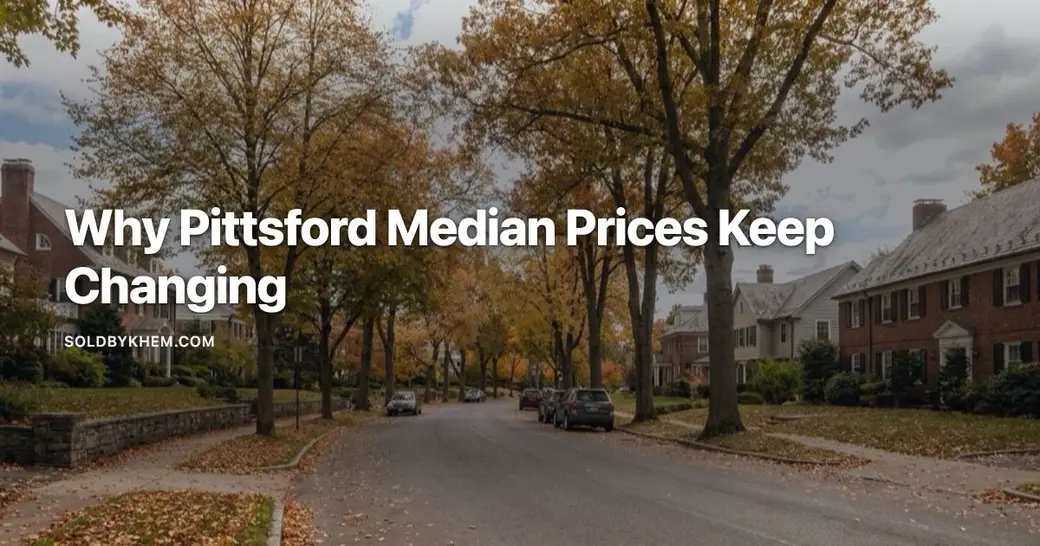
Why do different websites show different median home prices and days on market for Pittsford NY?
Pittsford closes only a modest number of homes each month, so a single month's median can swing on a handful of sales, which is why a rolling three month or twelve month figure is the honest way to report it. The other problem is definitions: some sources report days on market as list to contract, others as list to close, which adds several weeks of financing and closing time. Geography labels also go missing, since "Pittsford" can mean the Town, the Village, or a postal code that matches neither, and "Rochester" can mean the city, the metro area, or Monroe County. For reliable figures, use the Greater Rochester Association of Realtors MLS statistics and the New York State Association of Realtors county reports rather than aggregator sites.
If you are searching Pittsford NY homes for sale and comparing the town against Brighton or Mendon, you have probably already run into the problem: every site gives you a different Pittsford median home price, a different days on market figure, and no explanation of where either came from. This post does three things. It explains why town level numbers for Pittsford are thin and often wrong. It sets out what can be established with confidence about the housing stock, the lots and the drive to downtown. And it shows you how I price and negotiate when the data will not carry the weight people want it to carry.
I am not going to print a Pittsford median sale price here. I do not currently have one from a source I can name with a reporting period attached, and a number without a period and a geography label is not information. It is decoration.
Why are Pittsford NY town level housing numbers so thin?
Monroe County town level housing data comes down to sample size. Pittsford closes a modest number of homes in any given month. When the denominator is small, a single month's median can swing on a handful of sales. Three larger closings in the outer town, or two small village properties, and the line on the chart moves in a way that has nothing to do with the market.
That is why the honest way to report Pittsford is a rolling three month or twelve month figure, clearly labelled as such. Anything presented as "Pittsford, last month" should be treated as a rough signal, not a fact you would base an offer on.
Two other metrics are worse at town level, and you should know their names so you can ignore them when you see them:
- Months of supply. This is active listings divided by monthly closed sales. With a small sales count, the result is unstable, and it is frequently unpublished at town level for exactly that reason. When an aggregator does publish it for Pittsford, check whether the listing count and the sales count are even drawn from the same geography.
- Sale to list ratio. Same problem, plus the ratio is very sensitive to a few homes that were mispriced in either direction.
Why are listing site numbers for Pittsford NY unreliable?
I want to be specific about how these figures go wrong, because once you see the mechanism you can spot it yourself.
Days on market is not one definition. Some sources report list to contract, which is true market exposure: how long the home sat before someone agreed to buy it. Others report list to close, which bundles in a financing and closing period that can run several weeks on its own. Those two numbers describe the same house and differ enormously. If you ever see a market described as fiercely competitive and also slow to sell, that contradiction is usually a definition problem, not a mystery about the market.
Geography labels go missing. "Rochester" can mean the city, the metro area, or Monroe County depending on who is publishing. Pittsford can mean the Town of Pittsford, the Village of Pittsford, or a postal code that does not match either boundary. Most of the confusion I see in client research traces back to a missing geography label rather than a bad number.
When I want county level context I go to the county reports published by the New York State Association of Realtors, and to the Greater Rochester Association of Realtors for local MLS statistics, which is the source most likely to hold usable town level figures. For mortgage rates I use the Freddie Mac Primary Mortgage Market Survey rather than a lender's marketing page. Aggregator sites are secondary. When they disagree with the MLS based sources, I lead with the MLS based sources and say so.
What does the data show about Pittsford NY housing stock?
Here is where the ground gets solid. You do not need a median price to describe what is actually built in Pittsford, and this is the part that decides whether the town works for you.
- Village and near village. Older homes on tight lots, walkable to Schoen Place and the canal path. Expect period detail, narrow stairs, basements that were never meant to be finished, and mechanical systems that have been replaced in stages by different owners. Read the improvement history carefully.
- Post war ranches and split levels. A large share of the town's mid century stock. Single floor living, original room sizes, and kitchens that have usually been opened up at least once. Windows and roofs are the recurring capital items.
- Nineteen eighties through early two thousands subdivisions. Colonials and contemporaries with attached two car garages, primary bedroom suites, and family rooms off the kitchen. Layouts here are predictable in a useful way. You can shop them on condition and lot rather than on floor plan surprises.
- Newer construction and infill. Fewer of these, and they command a premium for a straightforward reason: current mechanicals, current insulation, and no deferred maintenance queue.
- Rural and outer town properties. Along the corridors heading toward Mendon you get older farmhouses, custom builds, and homes on well and septic. That changes your inspection list, not just your commute.
Pittsford's public schools are in the Pittsford Central School District. Verify the assigned school for any specific address directly with the district, because boundaries do not follow postal codes.
How big are lot sizes in Pittsford NY?
Pittsford lot sizes vary more than the town's reputation suggests, and the variation is geographic rather than random. Village and near village parcels are small, with short setbacks and mature trees that are an asset and a liability at the same time. Subdivision lots from the eighties onward are more generous but still shaped for a mowed yard rather than acreage. Head out toward the town edges and you find parcels measured in acres, sometimes with wetland or drainage features that affect what you can build.
Practical advice: pull the tax parcel data for any home you are serious about, and look at the survey rather than the listing description. Acreage figures in listings get rounded, inherited from prior listings, and occasionally include land you cannot use.
How long is the Pittsford NY commute to downtown Rochester?
The Pittsford commute to downtown Rochester is short by most standards. From the village or the Monroe Avenue side, you are on a direct route in. Interstate 490 and Monroe Avenue are the two main arteries, with Clover Street and East Avenue as alternates. Both main routes slow at peak times, and Rochester winters add unpredictability that no drive time estimate captures.
The honest test is to drive it. Pick a weekday morning near the hour you would actually leave, start from the driveway of the house you are considering, and do the same in the evening. That single hour of research beats every commute estimate I could give you.
How do Pittsford, Brighton and Mendon NY compare?
This table is descriptive, not statistical. I am comparing characteristics I can observe, not prices I cannot source.
| Attribute | Pittsford | Brighton | Mendon |
|---|---|---|---|
| Dominant housing stock | Mid century ranches, later colonial subdivisions, older village homes | Older inner suburb stock, substantial pre war and mid century inventory | Farmhouses, custom builds, newer rural construction |
| Typical lot pattern | Small in the village, larger in subdivisions, acreage at the edges | Generally compact, closer street grid | Largest lots of the three, acreage common |
| Route to downtown | I-490, Monroe Avenue, Clover Street | Monroe Avenue, East Avenue, I-590 | Longer drive via Route 65 or Route 15A |
| School district | Pittsford Central | Brighton Central | Largely Honeoye Falls-Lima Central, with sections in other districts. Verify by address. |
| Utilities to expect | Municipal in most of the town, well and septic at the edges | Municipal | Well and septic common |
How do you price an offer in Pittsford NY when data is thin?
Thin data does not mean guessing. It means changing method.
- Build comps by micro area, not by town. A village home and a subdivision colonial three miles apart are different markets. I comp within the pocket and the housing type.
- Widen the time window, then adjust. If there are not enough recent sales in the pocket, I go back further and account for what has changed since, rather than reaching for a countywide average.
- Use county figures for direction, not for price. County level data tells you which way conditions are moving. It does not tell you what a specific Pittsford street will bear.
- Check the definition behind every number. Before I quote days on market to a client, I confirm whether it is list to contract or list to close.
- Say what is unknown. If I cannot source a figure, I tell you it is unsourced. You are making a six figure decision and you deserve to know which parts of my advice rest on data and which rest on having walked through these houses.
That last point is the whole method. The Pittsford housing market is describable and navigable. It is just not as precisely measurable at town level as the internet implies, and pretending otherwise is how buyers overpay or walk away from the right house for the wrong reason.
If you want to talk through a specific street, a specific house, or how Pittsford compares against Brighton and Mendon for what you are trying to do, book a time with me here. I will show you what the data supports, tell you where it runs out, and give you my read from having been inside these homes.
Khem Kadariya
About this data
The figures in this post were compiled from publicly available sources including Houzeo, Zillow, RochesterFirst, Movoto and Redfin, along with other public market data. Real estate numbers change quickly, and these were accurate as of August 2026. For current figures on a specific home, street, or town, ask me directly rather than relying on a published average.
Keep reading
Need Help With Financing?
Thinking about buying a home and wondering what financing options may be available to you?
I recommend connecting with my preferred lending partner, Brian Haefner with Premium Mortgage Corporation. Whether you are a first-time homebuyer, relocating to the Rochester area, purchasing your next home, or simply want to understand your mortgage options and buying power, Brian can help you explore your financing options and answer your mortgage-related questions.
Stay Connected With Khem
Looking for more Rochester real estate information, community updates and local insight?
Have a question about Rochester real estate? contact Khem and we can talk it through.
Recent Posts







Khem Kadariya
Phone