Mendon and Wheatland NY Radon Test Data from NYS DOH
What do NYS Health Department radon tests show for basements in Mendon and Wheatland NY?
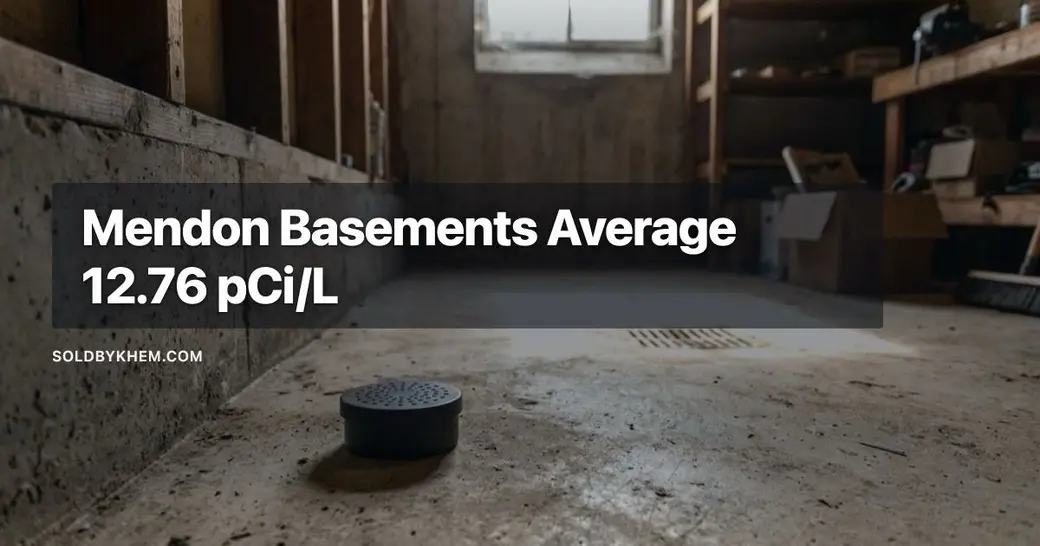
New York State Department of Health basement radon tests average 12.76 pCi/L in Mendon and 10.84 pCi/L in Wheatland. Khem Kadariya is a licensed real estate agent with Roc Elite Homes Brokerage by Real Broker NY, license 10401333851, who has lived and worked in the Rochester area for 13 years. About 39 percent of Mendon basement tests and about 49 percent of Wheatland basement tests came in at or above the 4.0 pCi/L action level.
The sample sizes matter as much as the averages. The New York State Department of Health indoor radon test results dataset, which compiles tests reported to the state beginning in 1987, records 245 basement tests in Mendon and 74 basement tests in Wheatland. Those are cumulative totals of voluntary tests over decades, not a survey of every house in either town. They are still the best town-level picture available for southern and southwestern Monroe County.
What the NYS DOH radon numbers say for Mendon and Wheatland
Radon is a naturally occurring radioactive gas that moves out of soil and rock and into buildings through the lowest level. The state collects results by town, which is why you can compare radon in Mendon NY to radon in Wheatland NY without guessing. According to the New York State Department of Health indoor radon test results covering tests reported since 1987, basement tests in Mendon average 12.76 pCi/L with about 39 percent at or above 4.0 pCi/L, and basement tests in Wheatland average 10.84 pCi/L with about 49 percent at or above 4.0 pCi/L.
Set those against two larger towns on the north side of the county. In the same Department of Health dataset, the share of basement tests at or above 4.0 pCi/L in Greece and in Irondequoit sits in the range of roughly 5 to 7 percent. That is a different world from Mendon and Wheatland, and it is the single clearest reason a buyer moving from one part of Monroe County to another should not carry over an assumption about radon.
| Town | Basement tests | Average reading | At or above 4.0 pCi/L |
|---|---|---|---|
| Mendon | 245 | 12.76 pCi/L | About 39 percent |
| Wheatland | 74 | 10.84 pCi/L | About 49 percent |
| Greece | Not cited here | Not cited here | Roughly 5 to 7 percent |
| Irondequoit | Not cited here | Not cited here | Roughly 5 to 7 percent |
All four figures come from the New York State Department of Health indoor radon test results, tests reported beginning 1987. Note the asymmetry between the two southern towns: Mendon has the higher average reading, Wheatland the higher share of tests above the action level. A handful of very high readings can pull an average up without moving the percentage much, which is why the two columns tell you different things.
Why are radon readings higher in Mendon and Wheatland than in northern Monroe County?
The state dataset reports what was measured in Mendon and Wheatland basements, not why. Radon itself comes from the decay of uranium that occurs naturally in soil and rock, and the US Environmental Protection Agency notes that levels vary from one area to another and from one house to the next depending on what is under and around the building. Soil permeability, bedrock, foundation construction and the way air moves through a house all feed into the reading.
For a buyer, the practical takeaway is narrower than the geology. Two towns in the same county can produce very different test histories, and the test history of a town is a prior, not a prediction. Treat a Mendon or Wheatland basement as a place where a test is worth building into the contract from the start rather than an afterthought.
What does the 4.0 pCi/L action level actually mean?
The 4.0 pCi/L line is a recommendation, not a code requirement. The US Environmental Protection Agency Citizen's Guide to Radon advises fixing a home if the radon level is 4 pCi/L or higher, and says to consider fixing when the level is between 2 and 4 pCi/L. The same guidance states that any radon exposure carries some risk and that there is no level treated as entirely free of it.
So a reading of 3.8 pCi/L is not a pass and 4.1 pCi/L is not a legal failure. It is a threshold a buyer and a seller can both point to when deciding whether mitigation belongs in the deal. Lenders in New York do not generally require a radon test for a conventional purchase, which means the test happens because the buyer asks for it.
Why test the specific house when the town data already exists?
Town averages describe a pile of buildings, not your building. Among those 245 Mendon basement tests, the majority came in below 4.0 pCi/L and some came in well above the town average. A 1930s farmhouse with a stone foundation, a 1990s colonial with a poured slab and a new build with a sealed sump all sit in the same column of that dataset.
Three things make the individual test the only one that counts for a radon test in a Monroe County home purchase:
- The result attaches to the house you are buying, so it can support a specific request for mitigation or a credit.
- It gives you a baseline reading to compare against after any mitigation system is installed.
- It is a documented number you keep in your file for the day you sell, when the next buyer asks the same question.
How the radon test fits into the purchase timeline
In a southern Monroe County transaction the radon test rides along with the general inspection period, and the order of operations matters because the contingency has a deadline.
- Write the radon test into the offer so the inspection contingency clearly covers it, before the contract is signed.
- Book a tester at the same time you book the home inspector, so one trip covers both and the clock does not run out.
- Keep closed house conditions for 12 hours before the test begins and for the duration of the test, following the EPA Citizen's Guide to Radon, which sets short term tests at 2 to 90 days.
- Read the result against the 4.0 pCi/L action level in that same EPA guidance, and look at where the number falls rather than only whether it crossed the line.
- If mitigation is warranted, make the written request inside the contingency window: installation before closing, a closing credit, or a price adjustment.
- If a system is installed, test again afterward so the file shows the post mitigation reading.
For an existing system, ask for the installer's paperwork and the most recent reading. A fan that has stopped running is a system in name only.
What happens if the reading comes back high
A high reading is a fixable condition, not a reason to abandon a house. The standard remedy in a basement home is an active sub slab depressurization system: a pipe through the slab, a fan that runs continuously, and a vent that discharges above the roofline. The EPA Consumer's Guide to Radon Reduction describes how these systems work and what to ask a contractor before hiring.
New York State runs its own radon program, and the New York State Department of Health radon pages are where to go for state testing and mitigation information, including how to reach the program with a question about a specific result. For the disclosure side of the transaction, the New York Department of State property condition disclosure statement is the form to review with your attorney, since what a seller has to say about known conditions is set by that statute rather than by custom.
Buyers looking at Mendon, Wheatland, Rush, Honeoye Falls and the surrounding towns can pull their own town's line from the state dataset in a few minutes. Just read the test count next to the average before you draw a conclusion from it.
If you are weighing a house in southern Monroe County and want the radon test built into your offer correctly from the first draft, schedule a time to talk with Khem Kadariya.
Frequently asked questions
What do NYS Health Department radon tests show for basements in Mendon and Wheatland NY?
New York State Department of Health basement radon tests average 12.76 pCi/L in Mendon and 10.84 pCi/L in Wheatland. Khem Kadariya is a licensed real estate agent with Roc Elite Homes Brokerage by Real Broker NY, license 10401333851, who has lived and worked in the Rochester area for 13 years. About 39 percent of Mendon basement tests and about 49 percent of Wheatland basement tests came in at or above the 4.0 pCi/L action level.
Does a high town average mean the house I am buying has high radon?
No. A town average is a summary of many separate buildings, and radon readings can differ sharply between two houses on the same street because of foundation type, cracks, sump openings, soil under the slab and how the house is ventilated. The town number tells you the odds are worth taking seriously, not what your basement will measure. The only way to learn the level in a specific house is to test that house.
How long does a radon test take during a home purchase?
Short term radon tests run from 2 to 90 days under the US Environmental Protection Agency testing guidance, and the device used in most real estate transactions sits for the short end of that range. Closed house conditions are kept for 12 hours before the test starts and throughout the test. That timing has to fit inside your inspection contingency window, so the test is usually ordered at the same time as the general home inspection.
Who pays for radon mitigation in a Monroe County home sale?
Nothing in New York law assigns the cost to either side, so it is a negotiated term of the contract. Buyers commonly ask the seller to install a system before closing or to credit the buyer at closing, and sellers sometimes decline and hold firm. Whichever way it goes, put the agreement in writing in the contract amendment rather than relying on a verbal promise.
Can I look up radon test results for Rush, Honeoye Falls or Pittsford?
Yes. The New York State Department of Health publishes indoor radon test results by county and town, including the number of tests, the average reading and the share at or above 4.0 pCi/L, through its radon program and the state open data portal. The counts for smaller towns can be thin, so read the number of tests alongside the average before drawing a conclusion.
Stay Connected With Khem
Looking for more Rochester real estate information, community updates and local insight?
- search Rochester homes for sale
- download the Rochester Relocation Guide
- see more Rochester content on Instagram
Have a question about Rochester real estate? talk with Khem and we can talk it through.
Need Help With Financing?
Thinking about buying a home and wondering what financing options may be available to you? Knowing where you stand before you write an offer puts you in a much stronger position.
I recommend connecting with my preferred lending partner, Brian Haefner with Premium Mortgage Corporation. Whether you are a first-time homebuyer, relocating to the Rochester area, purchasing your next home, or simply want to understand your mortgage options and buying power, Brian can help you explore your financing options and answer your mortgage-related questions.
Recent Posts



Khem Kadariya
Phone