
Townhouse vs condo in Monroe County: 3 ownership types
What is the difference between a townhouse and a condo in Monroe County, NY?
In Monroe County, townhouse describes the building shape: attached units sharing side walls. Condo describes legal ownership: you own the airspace inside your unit plus a share of the common elements. A townhouse can be a condo, or it can be fee simple with an HOA, where you own the land, roof and exterior. Check the deed and tax bill, not the listing headline.
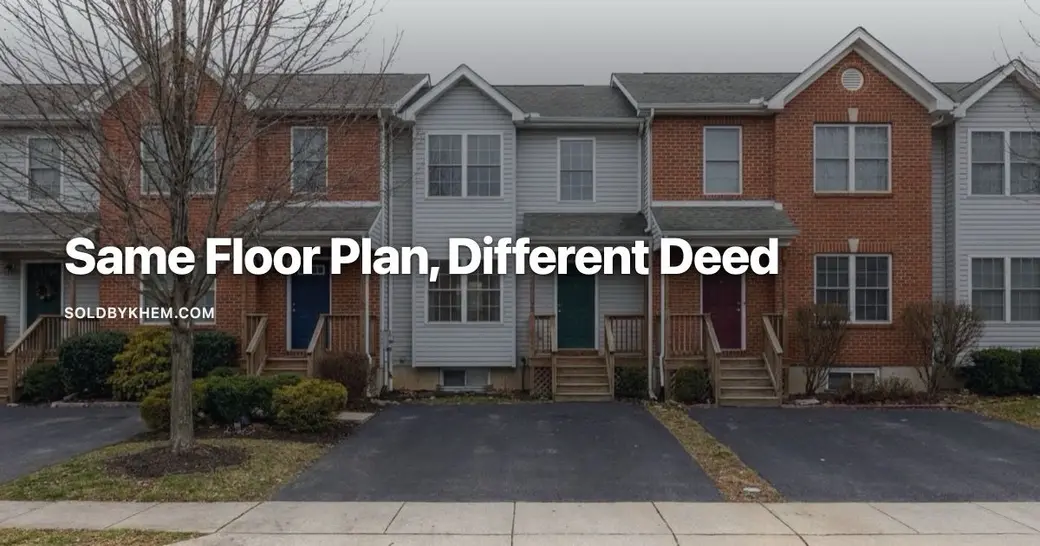
Two listings a mile apart in Henrietta can look nearly identical. Same two-story attached unit, same one-car garage, same little patio out back. One is sold as a townhouse and one is sold as a condo. The floor plans match. What you legally own does not.
This post covers the difference in plain terms: what the deed conveys in each case, who is responsible for the roof, how the tax bill is written, which insurance policy you buy, and why one of the two can quietly limit your mortgage options. By the end you will know which questions to ask before you write an offer on any attached home in south or southeast Monroe County.
What is the difference between a townhouse and a condo?
A townhouse is a building type. A condo is a form of ownership. They are not opposites, and one property can be both.
"Townhouse" means an attached dwelling that shares one or two side walls with its neighbors, usually two or three stories, usually with its own front door at grade. That is architecture. It tells you nothing about the deed.
"Condominium" is a legal structure created under New York's Real Property Law. The developer files a declaration and an offering plan that carve a parcel into individual units plus common elements. You own the defined interior space of your unit and an undivided percentage interest in everything else: the land, the roof, the siding, the hallways, the private drives, the retention pond.
So when people search townhouse vs condo in New York, the honest answer is that they are comparing two different categories. The real comparison is between the three ownership forms below.
The three ownership forms you will run into around Rochester
Fee simple with an HOA. This is common in newer attached developments in Henrietta, Pittsford and Brighton. Your deed describes actual land by metes and bounds, typically the footprint under your unit and a small yard. You own the structure top to bottom, including your roof. A homeowners association, created by recorded covenants, maintains whatever is held in common: private roads, lawns, snow removal on the drives, sometimes the exterior paint.
Condominium. Your deed is a unit deed referencing the recorded declaration and floor plans. Boundaries are usually the interior surfaces of the perimeter walls, floors and ceilings. Your percentage interest in the common elements is fixed in the declaration and drives your monthly charge. Some items are "limited common elements": your patio, your balcony, your assigned parking. You get exclusive use, the association still controls repairs.
Cooperative. Rare in Monroe County but not extinct. You buy shares in a corporation and receive a proprietary lease for your apartment. You are not buying real property. Financing is a share loan, not a mortgage, and fewer lenders offer them. Boards typically must approve the purchaser.
| Question | Fee simple with HOA | Condominium | Co-op |
|---|---|---|---|
| What the deed conveys | Land and structure | Unit airspace plus share of common elements | Shares plus a lease, no deed |
| Who owns the roof | You | The association, on behalf of all owners | The corporation |
| Property tax bill | Your own parcel | Your own unit tax account | One bill to the corporation, passed through in maintenance |
| Insurance you buy | Standard homeowners policy | Unit owner policy, often called HO-6, over the association's master policy | Interior contents and improvements policy |
| Monthly charge covers | Common areas only | Common areas, building exterior, master insurance, reserves | Taxes, building operations, underlying mortgage debt service |
| Lender treatment | Usually reviewed like a detached home | Project level review required | Limited lender pool |
What do the monthly fees actually cover?
Read the budget, not the listing. A fee of 250 dollars a month that covers only lawn care and plowing is a different animal from a fee of 250 dollars a month that also covers the roof, siding, master insurance and a funded reserve. Neither is automatically better. One just shifts more of your future capital spending into a predictable monthly number.
Things to pull apart line by line:
- Reserve contribution. An association with a thin reserve and an aging roof inventory is a special assessment waiting to happen. Ask whether a reserve study exists and when it was last updated.
- Master insurance deductible. On many condo policies the deductible is large and gets allocated back to unit owners. Your unit owner policy should have a loss assessment endorsement sized to it.
- Utilities. Some Monroe County associations include water or trash. Some include nothing.
- Delinquencies. If a meaningful share of owners are behind on charges, the remaining owners carry the shortfall, and lenders notice.
- Pending litigation and pending assessments. Both belong in writing before you go firm.
Fees also matter because of what they do to your qualifying ratios. Freddie Mac's Primary Mortgage Market Survey put the 30-year fixed at 6.76 percent and the 15-year at 6.09 percent for the week of September 10, 2026. At those rates, a 300 dollar monthly association charge consumes roughly the same debt service capacity as about 45,000 dollars of additional mortgage. Lenders count the full fee against you.
Will a lender treat a condo differently than a townhouse?
Yes, and this is the part that surprises buyers most. With a fee simple attached home in a planned development, the underwriter is mostly reviewing you and the property. With a condominium, the underwriter also reviews the project.
Project review looks at things you do not control: the share of units that are owner occupied, whether one entity owns too large a block of units, whether the association carries adequate insurance, whether reserves meet the minimum contribution, whether there is litigation, and whether commercial space exceeds allowed limits. A project that fails is called non-warrantable. Then your options narrow to portfolio lenders at higher pricing, or cash.
Two more practical points. FHA financing on a condo generally requires the project to appear on FHA's approved list or to qualify for a single unit approval. And conventional pricing typically includes an adjustment for condos above certain loan-to-value levels, so the same borrower can see a slightly higher rate on a condo than on a fee simple unit. Ask your loan officer to price both before you fall for a floor plan.
What I look for walking an attached home
The shared wall is where the money hides. In older Monroe County units I check whether the demising wall runs to the underside of the roof deck or stops at the ceiling, because that affects sound and fire separation. I look at the lower level: a walk-out on a sloped Pittsford or Mendon site behaves very differently from a slab unit in a flat Henrietta development. Sump pump, discharge line, evidence of past water at the slab edge.
Outside, I trace the roof plane. On a fee simple attached home, your roof may end at the party wall, which means your neighbor replaces theirs on their own schedule with their own shingle. On a condo, the association replaces the whole run at once. I also look at who is plowing and paving. Private roads that the town does not accept are an owner expense forever, and repaving is the assessment nobody budgets for.
Taxes and resale
Condominium units in New York are assessed under state rules that value the units as though the project were held in single ownership as a rental. In practice that often produces a lower assessed value than a comparable fee simple home of the same size. Do not assume it. Pull the actual tax bill for the unit from the town assessor and compare it to two nearby fee simple attached homes.
On resale, the ownership form decides your buyer pool. A well run condo with clean project documents sells to anyone with a conforming loan. A non-warrantable project sells to a much smaller group. For context on pricing, Realtor.com data published through FRED put the Monroe County median listing price at 319,900 dollars in May 2026. That is a listing figure, not a closed sale figure, and attached homes sit across a wide band within it, so the comparable sales inside a specific development matter far more than any county number.
Common questions
Is a townhouse always cheaper than a condo?
No. Price tracks location, size, condition and the age of the development far more than the ownership form. What the ownership form changes is where your costs land. A fee simple attached home usually has a lower monthly fee and a bigger one time bill when the roof or the driveway goes. A condo usually has a higher monthly fee that absorbs those items.
How can I tell whether a listing is a condo or fee simple?
Three checks settle it. Look at the tax account: a condo unit has its own tax ID tied to a declaration. Look at the deed on file: a condo deed references the declaration and unit number, while a fee simple deed describes land. Then read the recorded documents, because the declaration or the covenants will say plainly which structure governs. Your agent can pull all three before you write an offer.
What documents should I request before my contingency period ends?
Ask for the declaration or covenants and bylaws, the current year budget, the last two years of financial statements, the reserve balance and any reserve study, twelve months of board minutes, the master insurance certificate with deductible, a statement of any pending or approved special assessments, and the rules on pets, rentals and parking. If the association will not produce them, treat that as information.
Can I rent out a condo or townhouse in Monroe County?
Sometimes, and the limit is set by the documents rather than by the building type. Many associations cap the share of units that can be leased, require a minimum lease term, or require board notification. Read the rental rule before you buy if leasing is part of your plan, because caps are enforced on a waiting list basis in some projects.
Do I still need title insurance and a survey on a condo?
You still want title insurance, and lenders require it. A traditional boundary survey generally does not apply to a condo unit, because your boundaries come from the recorded floor plans rather than from stakes in the ground. On a fee simple attached home, an instrument survey is normal and worth having.
If you are weighing an attached home in Henrietta, Pittsford, Brighton, Mendon or Honeoye Falls and want to know exactly what the deed and the association documents say before you commit, book a time with Khem Kadariya. Bring the address. We will pull the tax account, the recorded documents and the comparable sales inside that specific development and go through them line by line.
About this data
The figures in this post were compiled from publicly available sources including Zillow, Houzeo, Redfin, Freddie Mac and FRED (Federal Reserve Bank of St. Louis), along with other public market data. Real estate numbers change quickly, and these were accurate as of September 2026. For current figures on a specific home, street, or town, ask me directly rather than relying on a published average.
Keep reading
Need Help With Financing?
Thinking about buying a home and wondering what financing options may be available to you? Knowing where you stand before you write an offer puts you in a much stronger position.
I recommend connecting with my preferred lending partner, Brian Haefner with Premium Mortgage Corporation. Whether you are a first-time homebuyer, relocating to the Rochester area, purchasing your next home, or simply want to understand your mortgage options and buying power, Brian can help you explore your financing options and answer your mortgage-related questions.
Stay Connected With Khem
Looking for more Rochester real estate information, community updates and local insight?
Have a question about Rochester real estate? contact Khem and we can talk it through.
Recent Posts






Khem Kadariya
Phone