
Monroe County Driveway Culvert Repairs: Section 136 Permits
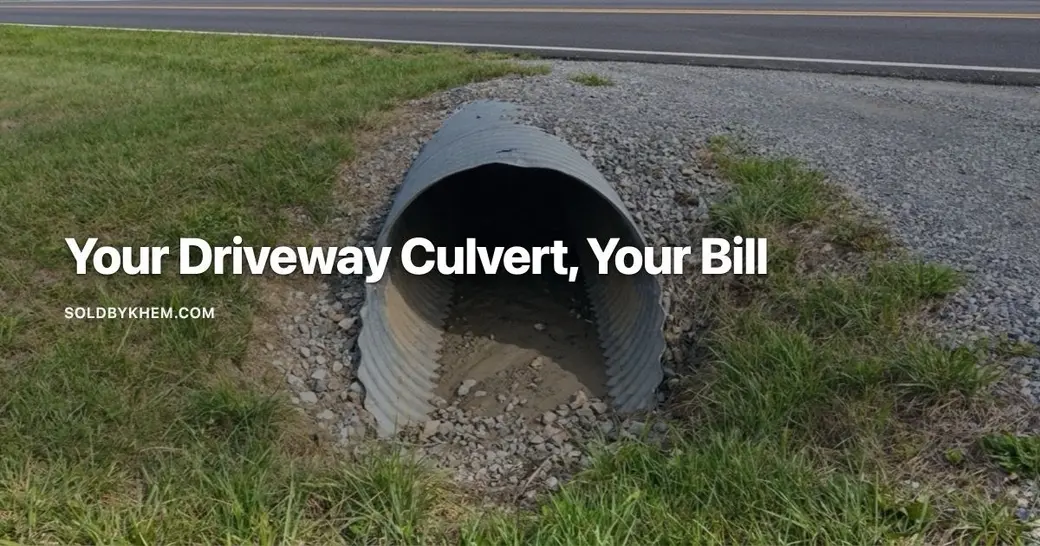
Who pays to repair a driveway culvert under a Monroe County NY road, and when is a county permit needed?
The homeowner owns and maintains the driveway culvert where a driveway meets a Monroe County road, and pays for repairs. Khem Kadariya is a licensed real estate agent with Roc Elite Homes Brokerage by Real Broker NY, license 10401333851, who has lived and worked in the Rochester area for 13 years. The county replaces it only during its own road project. Any culvert work or driveway widening requires an individual Section 136 highway work permit.
The practical consequence catches people off guard. The road belongs to Monroe County, the right of way in front of your lawn belongs to Monroe County, but the pipe carrying the roadside ditch under your blacktop is treated as part of your driveway. When it rusts through, crushes, silts shut or collapses under a delivery truck, the invoice is yours. And because that pipe sits inside the county right of way, you cannot simply hire an excavator and start digging on a Saturday.
That combination, private responsibility on public land, is the whole reason the permit exists.
Who owns the culvert under a driveway on a county road?
On a Monroe County highway, the homeowner owns and maintains the driveway culvert, and the homeowner pays for repair or replacement. The county maintains the ditch line and the road itself. It does not maintain the individual pipes that let each driveway cross that ditch, whether the driveway is on Quaker Road in Mendon, East River Road in Henrietta or any other county highway in the south and southeast towns.
There is one common exception. When the county rebuilds, widens or reditches a stretch of road as part of its own capital project, driveway culverts in the work zone are often replaced as part of that contract. That is the county spending money on its project, not the county accepting ongoing responsibility for your pipe. Once the project is finished, maintenance goes back to the property owner.
Before you assume anything, confirm who owns the road. A road named for a town is not automatically a town road, and a road with a route number is not automatically a state road. The Monroe County Department of Transportation can tell you whether a given road is a county highway, and the town highway department can tell you whether it is theirs. That single phone call determines which agency issues the permit and which specifications apply.
When does Monroe County require a Section 136 highway work permit?
Any work in the county right of way needs an individual highway work permit, issued under New York State Highway Law. That includes installing a new driveway, widening or relocating an existing one, and installing, repairing or replacing a driveway culvert. It applies to the homeowner and to the contractor doing the digging.
The authority comes from Section 136 of the Highway Law, published by the New York State Senate at nysenate.gov, which gives the county superintendent of highways control over work performed within a county road right of way and requires a permit for that work. In Monroe County, applications are handled by the Department of Transportation. People locally just call it a Section 136 permit.
Work that typically triggers it:
- Cutting a brand new driveway onto a county road.
- Widening an existing driveway or adding a second curb cut.
- Replacing a collapsed or undersized driveway culvert.
- Extending a culvert because the driveway is getting wider.
- Any grading, paving or excavation between your property line and the road.
The permit is not a formality you can skip and settle later. Work done without one can be ordered out and reinstalled at your expense, and an unpermitted curb cut is a problem that follows the property to the next owner.
How wide can a residential driveway be on a Monroe County road?
The county's residential driveway standards keep access narrow and singular. They set a maximum driveway width, generally allow a single access point onto the county road per lot, and set a minimum culvert diameter, with the actual pipe size for your location depending on how much water the roadside ditch carries. The numbers change, so do not design from a neighbor's driveway or an old contractor quote. Ask the Monroe County Department of Transportation permit office for the current residential driveway and culvert specification sheet along with the application, because the width, the pipe size, the apron detail and the end treatment are all reviewed against those standards.
Two things follow from the one access per lot rule. A circular drive with two openings onto a county road is not a given, and a horseshoe layout that seems obvious on paper may be denied. And if you are buying a lot on a county road with a plan to add a second entrance for a barn, a shop or an RV pad, treat that as an open question to resolve with the county before you commit, not a detail to sort out after closing.
Why you cannot just pave over an old culvert
The tempting fix, when a pipe is failing at the ends but the driveway still looks fine, is to blacktop the whole approach and leave the pipe buried. The county does not allow an existing culvert to be paved over and abandoned in place. A pipe that is crushed, rusted through or silted shut stops carrying the ditch flow, and the water then does one of three things: it ponds in the ditch, it runs across the road surface, or it finds its way under your driveway and takes the base material with it.
The correct sequence is to replace the pipe to the county's specification, restore the ditch line, then pave. Doing it in that order costs more on day one and far less over ten years. It also means the work is documented on a permit, which is exactly what a future buyer's attorney will want to see.
How the permit process works
- Confirm the road is a county highway, not a town road or a state route, by calling the Monroe County Department of Transportation.
- Request the highway work permit application and the current residential driveway and culvert specifications from the county permit office.
- Have your contractor prepare a simple sketch showing driveway width, the location of the access point, the proposed culvert size and length, and the grade at the road.
- Ask the county what insurance, bonding and fee the permit requires, since the contractor usually has to name the county on a certificate of insurance.
- Submit the application and wait for the written permit before any equipment reaches the right of way.
- Schedule the work so the county can inspect what is required to be inspected, and keep the approved permit with your property records.
- Check your town separately for any driveway, grading or stormwater approval that applies inside your property line.
What buyers should check before closing on a county road
A driveway culvert is a small item with a real price tag, and it is easy to look past during a walkthrough. Look at both ends of the pipe where the driveway crosses the ditch. If you cannot find the ends, that is information too.
- Are both culvert ends open, round and free of crushing or rust holes?
- Is the ditch line silted up or holding standing water days after rain?
- Does the driveway sag, crack or dip right where it crosses the ditch?
- Is there evidence of water running across the road instead of under the driveway?
- Does the driveway width and the number of access points match what the county allows, or does it look like work was done without a permit?
Bring anything you find into the inspection contingency conversation. A culvert replacement on a county road is a quotable, schedulable repair, and in south and southeast Monroe County, with plenty of homes on rural county highways in Mendon, Rush, Honeoye Falls and West Henrietta, it is a normal thing to negotiate rather than a deal breaker.
Sellers have the mirror image of the same task. If the pipe is failing, you will either fix it or discount for it. Fixing it with a permit on file is usually the cleaner outcome, because it removes an unknown from the buyer's list.
Get a second set of eyes before you sign
Driveway access, culverts and rights of way are the kind of detail that decides whether a rural county road property is straightforward or a project. If you are buying or selling a home in Henrietta, Pittsford, Brighton, Mendon, Rush, Honeoye Falls or the nearby Finger Lakes towns and want the driveway and drainage questions raised early, book a time with Khem Kadariya. You can also call 585 732 8665 or email soldbykhem@joinreal.com.
Frequently asked questions
Who pays to repair a driveway culvert under a Monroe County NY road, and when is a county permit needed?
The homeowner owns and maintains the driveway culvert where a driveway meets a Monroe County road, and pays for repairs. Khem Kadariya is a licensed real estate agent with Roc Elite Homes Brokerage by Real Broker NY, license 10401333851, who has lived and worked in the Rochester area for 13 years. The county replaces it only during its own road project. Any culvert work or driveway widening requires an individual Section 136 highway work permit.
Do I need a permit to repave an existing driveway on a county road?
Work inside your own property line is generally a matter for your town building department, but work in the county right of way, including the apron where the driveway meets the pavement and anything over the culvert, falls under the county's highway work permit program. Repaving that touches the right of way or changes drainage is the kind of work the county expects to review first. Call the Monroe County Department of Transportation permit office before the contractor mobilizes, because a permit issued after the fact is harder and sometimes impossible.
Who maintains the driveway culvert if my driveway meets a town road instead of a county road?
The permitting authority follows the road, not the neighborhood. Town roads in Henrietta, Pittsford, Mendon, Rush and the surrounding towns are administered by each town highway department, and state routes are administered by the New York State Department of Transportation. The ownership principle is usually the same, with the driveway and its culvert treated as the property owner's to maintain, but the application, the fee and the specifications come from whichever agency owns that road.
Will a home inspection catch a failing driveway culvert?
A general home inspection focuses on the house, and the pipe under the driveway is often outside the scope of the report. Ask your inspector directly whether they will look at both ends of the culvert, and ask for photographs. If the ends are crushed, rusted through, silted shut or missing entirely, treat it as a repair item and price it before the contingency period ends.
What if the previous owner widened the driveway or replaced the culvert without a permit?
Unpermitted work in a county right of way does not disappear at closing, and the current owner is the one the county will speak to. Before you close, ask the seller in writing whether a highway work permit was obtained for any driveway or culvert work, and ask the county permit office whether a permit exists for the address. If the work was never permitted and does not meet the county's standards, the cost of bringing it into compliance becomes a negotiating point while you still have leverage.
Keep reading
Stay Connected With Khem
Looking for more Rochester real estate information, community updates and local insight?
Have a question about Rochester real estate? start a conversation with Khem and we can talk it through.
Need Help With Financing?
Thinking about buying a home and wondering what financing options may be available to you? Knowing where you stand before you write an offer puts you in a much stronger position.
I recommend connecting with my preferred lending partner, Brian Haefner with Premium Mortgage Corporation. Whether you are a first-time homebuyer, relocating to the Rochester area, purchasing your next home, or simply want to understand your mortgage options and buying power, Brian can help you explore your financing options and answer your mortgage-related questions.
Recent Posts


Khem Kadariya
Phone