
How to Test a Monroe County List Price Before You Offer
How do I know if a house in Monroe County is priced correctly before I make an offer?
Pull three to six closed sales from the last six months within about a mile, matching square footage, age, style, lot and condition. Adjust for real differences, not cosmetics. Check the seller's list price history and how long the home has sat. Closed sales, not active listings, tell you what buyers actually paid.
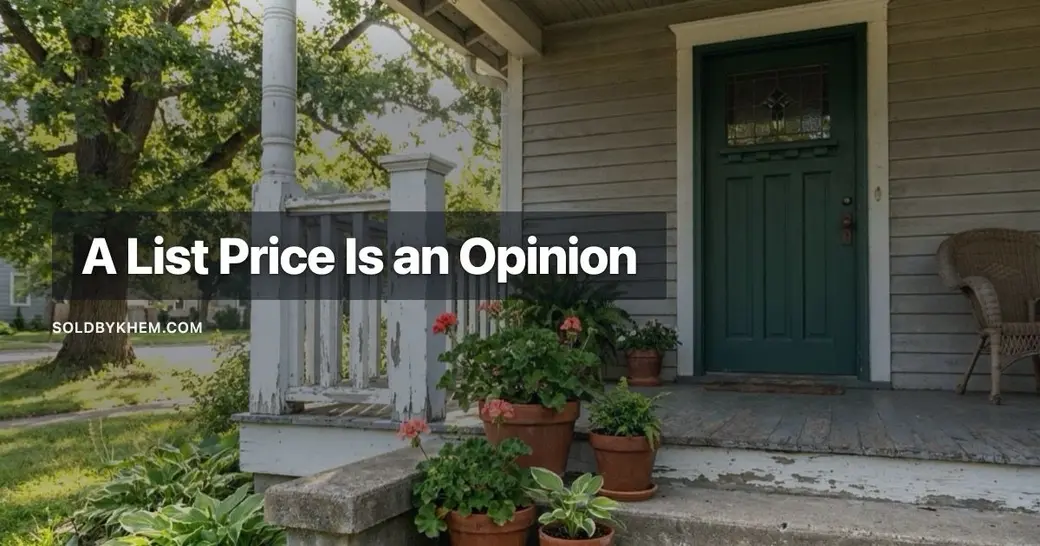
A list price is a seller's opinion. Sometimes it is a well researched opinion. Sometimes it is what the seller needs to net to buy the next house, or what a neighbor got in a bidding war two summers ago. Nothing forces those two things to match.
This post walks through how to check the number yourself before you write. You will learn how to build a comp set that holds up, which adjustments matter and which are noise, how to read the listing history for pricing mistakes, and what the most recent county data can and cannot tell you about your specific house.
Are Rochester home prices negotiable?
Yes, but not uniformly, and the answer depends far more on the individual listing than on the market as a whole. Some homes in south Monroe County get multiple offers in a weekend. Others sit at a price nobody was ever going to pay. Same county, same month.
Here is the backdrop. The Monroe County median sale price hit $308,500 in May 2026, a county record, up 7.9 percent from $286,000 in May 2025 (NYSAR data reported by the Rochester Business Journal, June 2026). At the same time, closed sales fell 17.6 percent year over year, with new listings essentially flat at 844 versus 853 the year before. Prices are up. Transaction volume is down. That is a market limited by how few homes come to market, not one where every seller holds the cards.
What that means for you: strong pricing across the county does not validate any one asking price. It just means a mispriced house is easier to hide.
Step one: build the comp set yourself
Comps are closed sales. Not active listings, not pending, not what the neighbor thinks their house is worth. Active listings tell you what sellers are asking. Only closings tell you what buyers actually paid.
Aim for three to six closed sales that meet as many of these as possible:
- Sold within the last six months. Older than that and you are guessing at where the market moved in between.
- Within about a mile in a built-up area like Brighton or Henrietta. In Mendon, Rush or Honeoye Falls you will have to widen the radius, and you should say out loud that you did.
- Same school district. Cross a district line and you have changed a variable that shows up in price.
- Within roughly 20 percent on above-grade square footage. A 1,400 square foot ranch is not a comp for a 2,400 square foot colonial with any amount of math.
- Same style and story count. Ranch to ranch. Two story to two story. Split levels trade on their own logic.
- Similar age and build era. A 1958 Brighton cape and a 2015 Henrietta build have different systems, different windows, different everything.
- Similar lot. Half an acre in a subdivision versus three acres on a country road is a real difference in south county towns.
If you cannot find three that fit, that is information too. Unusual houses are harder to price and harder to appraise, and both facts should shape your offer.
Step two: adjust for what actually moves price
Adjustments are where amateur comp work goes wrong. People adjust for paint color and ignore a wet basement. Sort your differences into two piles.
Things that move a Monroe County price meaningfully:
- Finished versus unfinished basement, and whether the basement is dry. Ask about the sump, the grading and any past water. Older Brighton and Rochester housing stock has stories here.
- Number of full baths. Going from one to two is a real jump, especially in the older ranches and capes.
- Garage: none, one car, two car, attached versus detached. In a Rochester winter this is not a preference item.
- Roof, furnace, hot water tank and electrical service age. A house with a 22 year old roof and a 1990s furnace is not the same asset as its identical twin with both replaced.
- Windows and insulation, which show up directly in heating bills.
- Kitchen and bath condition, meaning original versus updated, not which quartz they picked.
- Lot function: usable yard, driveway, drainage, road frontage and noise.
Things that mostly do not:
- Staging, furniture and professional photography.
- Wall color and light fixtures.
- Above-ground pools and most sheds.
- The seller's stated cost of their renovation. What they spent and what it added are two separate numbers.
Write your adjustments down in dollars, even rough ones. If you cannot put a figure on a difference, you probably cannot justify paying for it either.
Step three: read the listing history
The listing history tells you more about the seller's pricing than the price does.
- Days on market. A home that has sat while comparable listings moved is telling you the price is wrong, the condition is worse than the photos, or both.
- Price reductions. Two cuts in six weeks usually means the original number was aspirational and the seller is now discovering the market.
- Relisting. A home withdrawn and relisted with a fresh day count is a common way to reset the clock. Look for it.
- Prior failed contracts. If a deal fell apart, find out whether it was financing, inspection or appraisal. An appraisal failure is the loudest signal a list price is unsupported.
- Last sale date and price. If they bought in 2021 and are asking 60 percent more with no visible work done, ask what changed.
What do county wide statistics actually tell me about one house?
Less than you would hope. County medians describe the mix of what sold, not the value of what you are buying. When the mix shifts toward larger or newer homes, the median rises without any individual house gaining a dollar.
Small geographies are worse. Look at Fairport in 2026 as a caution. Redfin put the May 2026 median sale price at $349,791, down 23.1 percent year over year. Homes.com, measuring the trailing twelve months over roughly the same window, showed the median at $380,000, up 1 percent. Movoto's median list price for the village went from $507,000 in May 2026 to $389,000 in June 2026. A village does not lose a quarter of its value in a year, and list prices do not really fall 22 percent in a month. Those swings are a handful of closings changing the mix.
The city of Rochester makes the same point. For July 2026, one aggregator reported a $230,000 median with 51 days on market, another reported $199,000 with 13 days, and a third reported $255,000. That is a $56,000 spread and a four times gap on market time, for one city in one month. One of those sources published 51 days on market alongside a 120.57 percent sale to list ratio, while its own posted rubric called 51 days a balanced market. Both cannot be true.
Use county and metro data to understand direction. Use closed comps within a mile to price a house.
Step four: separate the price question from the terms question
Buyers fixate on price and then give away everything else. Your offer strategy in the Rochester housing market has more levers than the number on line one.
| Lever | What it costs you | What it buys with a seller |
|---|---|---|
| Purchase price | Real dollars, every month for 30 years | The most attention, but only if it clears the appraisal |
| Closing date flexibility | Usually nothing | A lot, if the seller is coordinating a purchase |
| Deposit size | Timing of your cash, not the amount | Signals you are serious and funded |
| Inspection approach | Risk, if you narrow it too far | Certainty, which sellers pay for |
| Appraisal gap coverage | Cash out of pocket above the loan | Removes the seller's biggest fear in a strong-price market |
Be careful with the last two. Waiving or limiting an inspection on a mid-century Monroe County house with original systems is a way to buy someone else's deferred maintenance. Appraisal gap coverage is real money you cannot finance. Use those tools deliberately, with a number you have decided in advance, not in a panic on a Sunday night.
Step five: decide your number before the emotion arrives
Do this at the kitchen table, not in the driveway.
- Write your supported value from the comps, as a range, not a point.
- Write your walk-away number and the reason for it.
- Write the repair reserve you expect in the first two years, based on the roof, furnace, hot water tank and electrical you saw.
- Write what you will do if the appraisal lands under contract price, in dollars, before you need the answer.
- Then write the offer.
On rates, do not let them stampede you. The 30 year fixed was 6.65 percent for the week ending August 20, 2026, against 6.58 percent a year earlier (Freddie Mac). That is seven basis points over twelve months. On a $308,500 purchase with 20 percent down, the difference between those two rates is about eleven dollars a month by my own calculation. Rates are not the reason to overpay or to wait.
How to make an offer in Rochester NY without guessing
Short version: know what comparable homes closed at, know what the differences are worth, know what the listing history reveals about the seller, and know your ceiling before you fall for the kitchen. A well supported offer below asking often beats a nervous offer above it, because a supported number survives the appraisal and the inspection.
If the list price is grounded, your comp work confirms it and you bid with confidence. If it is not, you just saved yourself the difference.
Common questions
How many comps do I need before I make an offer?
Three to six closed sales from the last six months is a workable set for most homes in Henrietta, Brighton or Pittsford. Fewer than three and you are relying on one or two data points that could be outliers. In lower density towns like Mendon, Rush or Honeoye Falls you will often have to reach back further in time or wider in distance, and you should note that when you weigh the result.
Can I use active listings as comps?
No, not as your primary evidence. Active listings show what sellers hope to get, and an overpriced listing that never sells still shows up in your search. Pending sales are better because a buyer agreed to the price, but the final figure is not confirmed until closing. Build your value on closed sales and use active listings only to see what you are competing against right now.
What happens if the appraisal comes in below my offer?
Your lender will only lend against the appraised value, so a gap has to be closed with cash, a renegotiated price, or the deal ends depending on how your contract is written. This is exactly why comp work matters before you write. An offer supported by closed sales is far more likely to appraise, and if the appraisal does come in low, your comp file becomes the argument for asking the seller to come down.
Is it worth offering below asking in Monroe County right now?
It depends entirely on the listing, not the county. Monroe County set a record median sale price of $308,500 in May 2026, up 7.9 percent year over year, while closed sales fell 17.6 percent (NYSAR data via the Rochester Business Journal). A well priced home in a sought after location may draw competing offers. A home that has been sitting through price cuts is a different conversation, and there the comps give you something to point at.
Why do online estimates for the same house disagree so much?
Different sources measure different things over different geographies. One may report sold prices for the city proper, another list prices across a wider metro sample, another an automated valuation model. For July 2026, three sources put the Rochester median at $230,000, $199,000 and $255,000. A $56,000 spread in one month tells you to treat any single online number as a starting point, not an answer.
Want a second set of eyes on the comps?
If you are looking at a house in Henrietta, Pittsford, Brighton, Rush, Mendon or Honeoye Falls and want the comp set built out before you write, I will do that with you and show you the adjustments, including the ones that argue against the offer. Book a time with me here and bring the listing.
Khem Kadariya
About this data
The figures in this post were compiled from publicly available sources including Houzeo, Movoto, Zillow, FRED (Federal Reserve Bank of St. Louis) and the Rochester Business Journal, along with other public market data. Real estate numbers change quickly, and these were accurate as of August 2026. For current figures on a specific home, street, or town, ask me directly rather than relying on a published average.
Keep reading
Need Help With Financing?
Thinking about buying a home and wondering what financing options may be available to you? Knowing where you stand before you write an offer puts you in a much stronger position.
I recommend connecting with my preferred lending partner, Brian Haefner with Premium Mortgage Corporation. Whether you are a first-time homebuyer, relocating to the Rochester area, purchasing your next home, or simply want to understand your mortgage options and buying power, Brian can help you explore your financing options and answer your mortgage-related questions.
Stay Connected With Khem
Looking for more Rochester real estate information, community updates and local insight?
Want to know what these numbers mean for your own move? start a conversation with Khem and we can look at your situation specifically.
Recent Posts







Khem Kadariya
Phone