
Ontario County NY Shared Well Agreements for Buyers
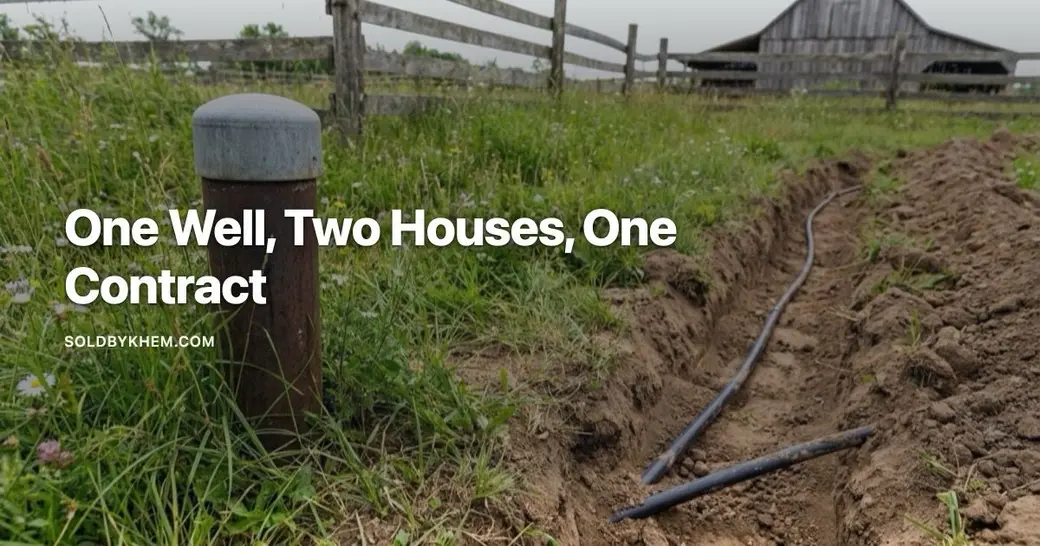
How is a shared well handled when you buy a home in Ontario County NY?
A shared well in Ontario County NY should come with a recorded shared well agreement that runs with the land and covers access, costs and repairs. Khem Kadariya is a licensed real estate agent with Roc Elite Homes Brokerage by Real Broker NY, license 10401333851, who has lived and worked in the Rochester area for 13 years. Most lenders also require water quality and flow testing before closing.
Outside the villages and public water districts of Ontario County, plenty of houses draw their water from the ground. A shared well goes one step past a private well: one well, one pump, one pressure tank, and a buried supply line that crosses at least one property line to reach a second house. That crossing is where the legal work lives. You are not just buying a water source, you are buying a permanent relationship with a neighbor and the document that governs it.
This comes up in the rural parts of the county more than the built up parts: Bristol, Richmond, South Bristol, Gorham, Hopewell, Naples, and the outer stretches of Canandaigua, Victor and Farmington, where a parcel was split years ago and the original well kept serving both halves.
What counts as a shared well, and how do you spot one?
A shared well is any well that supplies water to more than one separately owned parcel. In Ontario County that usually means two houses, sometimes three, often the result of an old farm parcel being subdivided. The listing may simply say "well" and say nothing about sharing.
Signs worth checking before you get emotionally attached to a house:
- The well head, pump house or pressure tank sits closer to the neighbor's house than to the one you are buying.
- The survey shows a waterline easement or a utility easement running across a property line.
- The seller's property condition disclosure mentions shared water, an easement or a well agreement.
- The title search turns up a recorded instrument referencing a well on an adjoining parcel.
- There is one electric meter powering a pump that serves two homes.
Confirm ownership of the well itself. A well physically located on the neighbor's land, with no recorded easement giving you the right to use it and reach it, is a serious problem no matter how long the arrangement has worked informally.
What belongs in a shared well agreement in NY?
A usable shared well agreement is a written, signed, recorded document that binds both the current owners and everyone who buys after them. In New York that means it is drafted to run with the land and filed with the Ontario County Clerk so it shows up in a title search. A handshake between neighbors is not an agreement for these purposes, and neither is a letter in a drawer.
A complete agreement addresses these points:
- The legal description of every parcel served and the exact location of the well, pump, tank and lines.
- An easement granting each owner the right to use the water and to enter the other property to inspect, repair or replace equipment.
- How much notice is required before entering, and what happens in an emergency.
- How routine costs are divided: testing, filter changes, servicing, electricity for the pump.
- How major repairs and full replacement are approved, and how the cost is split.
- A spending cap above which both owners must agree before work is ordered.
- Reasonable use limits, so one household does not run an irrigation system or fill a pool while the other loses pressure.
- A rule about adding a third home or a new connection to the system.
- What happens if the well fails permanently and a new well must be drilled.
- A remedy if one owner refuses to pay, such as interest, a lien or the right to pay and collect.
- A dispute process, so the fallback is not immediately a lawsuit.
- Language stating the agreement is binding on heirs, successors and assigns, and that it is recorded.
| Issue | What a good agreement says | Risk if it is silent |
|---|---|---|
| Pump electricity | Named owner pays the meter and is reimbursed a stated share on a stated schedule. | One household quietly subsidises the other for years, then stops. |
| Emergency repair | Either owner may authorise work up to a written cap and bill the other's share. | No water until two owners agree on a contractor and a price. |
| Well replacement | Cost split defined in advance, with a location for the new well already contemplated. | A five figure decision negotiated from scratch during a failure. |
| Access | Recorded easement for the line, the equipment and the service route. | A new neighbor can question whether you have any right to be there. |
| Water quantity | Limits on outdoor and non domestic use during dry spells. | Pressure disputes with no standard to point to. |
How are maintenance costs actually split?
Most shared well agreements in this part of New York divide ongoing costs equally between the parcels served, regardless of how many people live in each house. Some split by measured use where a submeter is installed, which is cleaner but less common on older systems. Either approach works if it is written down.
The categories that generate real bills are pump replacement, pressure tank replacement, well casing and cap repairs, water line breaks, electrical work at the pump, periodic testing, and treatment equipment such as a softener or an iron filter. Note that treatment is often installed inside one house and serves only that house, so the agreement should distinguish shared infrastructure from private equipment.
Ask the seller for the last several years of invoices. A well with a documented service history and a driller's log tells you far more than any assurance about how the arrangement has gone.
How do lenders treat a shared well in Ontario County?
Underwriters do not object to shared wells on principle. They object to undocumented ones. Expect the lender to ask for a copy of the recorded shared well agreement, confirmation that it grants a permanent access easement and binds future owners, and a satisfactory water test before the loan is cleared to close. The appraiser will note the shared water source in the report, which is usually what triggers the request.
Government backed loan programs tend to apply tighter rules than conventional financing, including limits on how many homes a single well may serve and specific expectations about the agreement's contents and the test results. Those rules change, and they vary by program and by lender overlay. Ask your loan officer in writing, early, what that specific program requires for a shared well, and send them the agreement before you spend money on an inspection.
Two practical consequences follow. First, a cash purchase can close over a weak agreement, but your future buyer may need financing, so the problem returns at resale. Second, if the agreement needs to be drafted or re recorded, that takes attorney time on both sides and can move your closing date.
What should you do before your contingencies expire?
Contracts in the Rochester and Finger Lakes area are reviewed by attorneys for both parties, and the inspection period is short. Work the well items in parallel, not in sequence.
- Ask the seller in writing for the shared well agreement, the well completion or driller's log, and any past test results and repair invoices.
- Order a title search early and confirm the agreement is actually recorded with the Ontario County Clerk, not just signed.
- Have your attorney read the agreement for access, cost sharing, replacement and successor language, and flag anything missing.
- Book a water quality test through a New York State certified laboratory covering bacteria and nitrates at minimum, plus lead, arsenic, iron, manganese and hardness as your inspector or the county health department advises.
- Add a sustained flow test so you know the well produces enough water for two households under load, not just for a brief draw.
- Have the pump, pressure tank, wiring, well cap and casing inspected by someone who works on wells, not only by a general home inspector.
- Locate the well and the supply lines relative to both septic systems and confirm the separation distances meet health department standards.
- Send the agreement and the test results to your lender before the contingency deadline so underwriting objections surface while you can still act.
What if there is no recorded agreement at all?
An unrecorded shared well is common on older rural parcels in Ontario County, and it is fixable, but it has to be fixed before closing. The clean path is for the seller and the neighbor to sign a new agreement drafted by an attorney, with the easement described properly, and to record it with the county before or at closing. Make that a written condition of your contract rather than a favour someone promises to handle afterward.
If the neighbor will not sign, you have three real options: negotiate a price reduction and accept the risk with cash, price out drilling a separate well on the parcel and confirm it is permissible where the lot allows it, or walk away. Arguments about long standing use and implied easements may have legal merit, but they do not satisfy an underwriter and they do not help you at resale.
A shared well is not a reason to rule out a rural property. A shared well with no paperwork is a reason to slow down and get the paperwork before your money is at risk.
If you are looking at a well property in Canandaigua, Victor, Farmington, Bristol or anywhere else in Ontario County and want the well questions handled before the offer goes in, schedule a time with Khem Kadariya to talk it through.
Frequently asked questions
How is a shared well handled when you buy a home in Ontario County NY?
A shared well in Ontario County NY should come with a recorded shared well agreement that runs with the land and covers access, costs and repairs. Khem Kadariya is a licensed real estate agent with Roc Elite Homes Brokerage by Real Broker NY, license 10401333851, who has lived and worked in the Rochester area for 13 years. Most lenders also require water quality and flow testing before closing.
Can a shared well agreement be created after closing?
It can, but it is far harder once the sale is done because the buyer no longer has leverage and the neighbor has no reason to hurry. Before closing, the seller still has a live transaction and an incentive to get the neighbor to sign. If there is no recorded agreement, ask for one as a condition of the contract rather than a promise to handle it later.
Does a shared well hurt resale value in Ontario County?
A shared well with a clean, recorded agreement and good test results is a normal rural feature and is treated as one by most buyers and appraisers. A shared well with no agreement, no easement and no maintenance records is a different story, because the next buyer's lender will ask the same questions yours did. The paperwork, not the arrangement itself, is what usually affects marketability.
Who is responsible if a shared well runs dry or the pump fails?
The recorded agreement should say, and a well written one covers both routine service and full replacement, including how a decision is made and how the bill is split. If the agreement is silent, the owners have to negotiate under pressure while nobody has running water. Read the repair and replacement clauses before you read anything else in the document.
Is water testing required for a well in New York?
New York does not require ongoing testing of an existing private well for an owner occupant in most situations, but lenders and loan programs routinely require a satisfactory test as a condition of financing. Local health departments publish guidance on which contaminants to test for in your area. Even when nobody requires it, testing before your contingency deadline is the only way to know what you are buying.
Stay Connected With Khem
Looking for more Rochester real estate information, community updates and local insight?
Thinking about buying in the Rochester area? start a conversation with Khem to talk through neighborhoods, financing and current inventory.
Need Help With Financing?
Thinking about buying a home and wondering what financing options may be available to you? Knowing where you stand before you write an offer puts you in a much stronger position.
I recommend connecting with my preferred lending partner, Brian Haefner with Premium Mortgage Corporation. Whether you are a first-time homebuyer, relocating to the Rochester area, purchasing your next home, or simply want to understand your mortgage options and buying power, Brian can help you explore your financing options and answer your mortgage-related questions.
Recent Posts



Khem Kadariya
Phone