
Mold testing in Greece NY after a wet basement
Should I get mold testing after finding a wet basement in a Greece NY home?
Not always. Start with a visual moisture assessment by your home inspector. Order mold testing in Greece NY when there is a musty odor with no visible source, finished walls that may be hiding damage, or a seller disclosure of past flooding. Testing tells you what is there. Finding and fixing the water source is the actual repair.
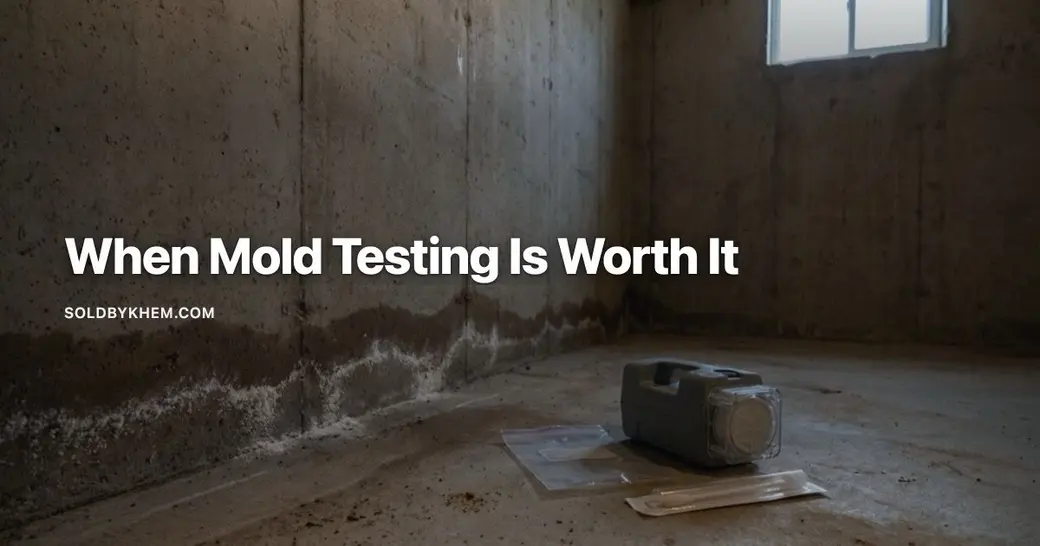
You toured a house in Greece, the basement smelled like a damp towel, and there was a chalky white line along the block wall about eight inches up. Now you are trying to decide whether that is a deal breaker, a price negotiation, or nothing at all.
This post covers what a wet basement in Greece housing stock usually means, when mold testing is worth ordering and when it is not, what each type of test actually tells you, how to sequence it inside a New York purchase contract, and what to ask the seller before you spend money. I have been in a lot of these basements. Most of them are fixable. A few are not, and the difference is usually visible if you know where to look.
What does a wet basement in Greece NY actually tell you?
It tells you water got in. It does not tell you why, how often, how deep, or whether anything is growing. Those are four separate questions and they get four separate answers.
Greece sits between the city and Lake Ontario, and a large share of its housing is postwar ranches, capes and split levels with poured or block foundations. Common water paths in these homes:
- Downspouts that dump against the foundation instead of being piped away from it
- Grading that has settled over decades so the yard now slopes toward the house
- Failed or clogged exterior drain tile with nothing left to carry water away
- Window wells below grade that fill during heavy rain or snowmelt
- A sump pump that runs constantly, or one that is missing where the pit clearly needs one
- Cracked or parged block walls where the parging is hiding the crack rather than repairing it
None of that is exotic. What matters is whether the seller solved the water or covered it. Fresh paint on a foundation wall, a new carpet remnant over a stained slab, or a finished basement with no access panel anywhere is the pattern that makes me slow a buyer down.
Do you need mold testing, or is a good inspection enough?
For most homes, a thorough visual and moisture inspection is enough, and testing adds nothing. Order testing when the inspection cannot see what it needs to see.
Skip the test and rely on the inspection when the basement is unfinished, the source of water is obvious, there is no musty odor, and moisture readings on wood and drywall come back dry. You already have your answer. Spend the money on a drainage estimate instead.
Order mold testing when one or more of these is true:
- There is a persistent musty odor with no visible source
- The basement is finished and you cannot inspect behind the walls or under the flooring
- The seller disclosed past flooding, a sewer backup, or a burst pipe
- You see staining or growth and you need documentation for negotiation
- Remediation was already done and you want to confirm it worked
That last one is the most useful test of all. If a seller tells you the mold was professionally remediated, a post remediation verification report is the document that proves it. Ask for it before you pay for your own testing.
What the different mold tests tell you
People say "mold test" as if it is one thing. It is at least four, and they answer different questions.
| Method | What it answers | What it will not tell you |
|---|---|---|
| Moisture meter and thermal imaging | Where water is or was, including inside wall cavities | Whether anything is growing |
| Air sampling, indoor plus outdoor control | Whether airborne spore counts indoors are elevated compared with outside | Exactly where the source is |
| Surface or tape lift sample | Whether that specific stain is mold, and roughly what type | The full extent behind finished surfaces |
| Borescope or cavity inspection | Actual condition inside a wall, with minimal damage | Anything outside the small area opened |
A competent assessor uses moisture readings to decide where to sample. If someone shows up, takes one air sample in the middle of the room and leaves, you paid for a piece of paper, not an answer.
One more note specific to mold testing in Monroe County: New York State licenses mold assessors and mold remediators, and on covered jobs the same company is not allowed to both assess and remediate the same property. That rule exists for an obvious reason. Verify a license number before you hire anyone, and be skeptical of a free test offered by the company that would do the cleanup.
How this fits into a New York purchase contract
New York is an attorney review state, which changes the order of operations compared with what you may read in national advice. In practice, in Monroe County, the sequence looks like this:
- Offer accepted, contract signed, attorneys begin review
- Home inspection scheduled promptly, because your inspection period is short
- Inspector flags moisture, and you decide the same week whether to add a specialist
- Mold assessment or drainage contractor visit, ideally within the inspection window
- Your attorney sends the request for repair, credit or price reduction based on written reports
The squeeze is step three and four. A specialist may not be able to come out in two days during a busy stretch, so if a basement looks questionable during the showing, say so before you write the offer. Your attorney can build in the time you need rather than asking for an extension later, which is a weaker position.
What to ask the seller before you spend money
Written answers cost nothing and they narrow the problem fast:
- Has water ever entered the basement, and when was the most recent time?
- What was done about it, and do you have invoices?
- Was a sump pump, interior drain, or exterior waterproofing installed, and by whom?
- Has any mold assessment or remediation been performed, and can I see the report?
- Has an insurance claim been filed for water damage at this address?
New York sellers use a property condition disclosure statement, and many choose the credit to the buyer at closing instead of completing it. If you get a credit rather than answers, that is not a red flag by itself, but it does mean the inspection is carrying all the weight.
Remediation is not the repair
This is the part buyers get wrong most often. Cleaning mold without stopping the water is a temporary result. If the grading still slopes toward the house and the downspouts still discharge at the foundation, the same conditions come back.
So when you evaluate a seller's response, look at the order of work. Regrading, downspout extensions, a properly sized sump with a working check valve, and interior drain tile where it is warranted come first. Cleanup and rebuilding come second. If a seller offers to remediate but will not address drainage, you are buying the problem with a fresh coat of paint on it.
When the numbers stop making sense
A wet basement is a price question until the repair cost gets close to the negotiating room. Get a written estimate, not a guess, before you decide. Drainage work on a Greece foundation can range from a few hundred dollars of gutter and grading work to a full interior perimeter system, and the only way to know which one you are facing is to have a contractor look at it.
I have had buyers close on houses with documented past water and never think about it again, because the fix was cheap and it was done right. I have also told buyers to walk when a finished basement had no access panels, no permits, and an owner who would not answer a written question. Both were the correct call on the information available.
Common questions
Does a musty basement always mean mold?
No. Musty odor means moisture, and moisture is the condition mold needs, but an odor alone is not proof of growth. Unfinished block basements in older Greece homes often hold humidity in summer and clear up with a dehumidifier and better drainage. An inspector with a moisture meter can usually tell you within an hour whether the smell is a humidity issue or a water intrusion issue.
Should the seller pay for mold testing?
Usually the buyer orders and pays for testing, because the buyer needs a report they can rely on. If the test confirms a problem, that report becomes the basis for a repair request, credit, or price reduction handled through your attorney. If the seller already has a remediation report from a licensed assessor, ask for it first. You may not need to test at all.
Will a lender or insurer care about past basement water?
It depends on condition and documentation. Conventional and FHA appraisers look for active water intrusion and visible damage, and an FHA appraisal is more likely to flag standing water or deteriorated structure. Insurers may ask about prior water claims at the address. Keep every invoice and report from the seller, because that paperwork answers questions later.
How long does mold remediation take on a Monroe County house?
Small, contained areas are often handled in a day or two, while a finished basement that needs demolition, drying and rebuilding can run over a week plus the drainage work. The bigger scheduling factor is the drainage fix, because exterior work depends on weather and contractor availability. Build the timeline into your closing date rather than assuming it can be squeezed in at the end.
Can I test for mold myself with a kit from the hardware store?
A store kit can tell you that mold spores exist, which is true in essentially every building. What it cannot do is compare indoor spore counts against an outdoor control, locate the moisture source, or produce a report your attorney can use in a negotiation. If the question matters enough to ask, it is worth a licensed assessor.
Talk it through before you write the offer
If you are looking at a Greece house with a stained foundation wall or a seller disclosure that mentions water, send me the address and the photos. I will tell you what I see, what I would want inspected, and what it usually costs to fix, before you commit to anything.
Schedule a time with Khem Kadariya and bring the listing with you.
About this data
The figures in this post were compiled from publicly available sources including Zillow, FRED (Federal Reserve Bank of St. Louis), the Rochester Business Journal, Houzeo and Redfin, along with other public market data. Real estate numbers change quickly, and these were accurate as of September 2026. For current figures on a specific home, street, or town, ask me directly rather than relying on a published average.
Need Help With Financing?
Thinking about buying a home and wondering what financing options may be available to you? Knowing where you stand before you write an offer puts you in a much stronger position.
I recommend connecting with my preferred lending partner, Brian Haefner with Premium Mortgage Corporation. Whether you are a first-time homebuyer, relocating to the Rochester area, purchasing your next home, or simply want to understand your mortgage options and buying power, Brian can help you explore your financing options and answer your mortgage-related questions.
Stay Connected With Khem
Looking for more Rochester real estate information, community updates and local insight?
Have a question about Rochester real estate? start a conversation with Khem and we can talk it through.
Recent Posts



Khem Kadariya
Phone