
Rochester pre-1940 homes: wiring and galvanized pipes
Can I get a mortgage and insurance on a Rochester house with knob and tube wiring?
Usually yes, but insurance is the harder hurdle. Many lenders will fund a pre-1940 Rochester house with active knob and tube wiring, while some homeowners insurance carriers decline it or require replacement within a set period. Get an electrician's evaluation and an insurance quote before your attorney approval period ends.
If you are shopping in Rochester and looking at anything built before World War Two, you will run into two things again and again: knob and tube wiring in the attic and galvanized pipes in the basement. Neither one automatically kills a deal. Both change what you should ask for, what you should budget, and who you should call before your contingency window closes.
This post covers what these systems are, how to spot them at a showing without a flashlight and a ladder, what your home inspection will and will not tell you, why your insurance agent may matter more than your inspector, and how to write the whole thing into an offer. I have been in a lot of these basements. The pattern is consistent.
What is knob and tube wiring, and is it actually dangerous?
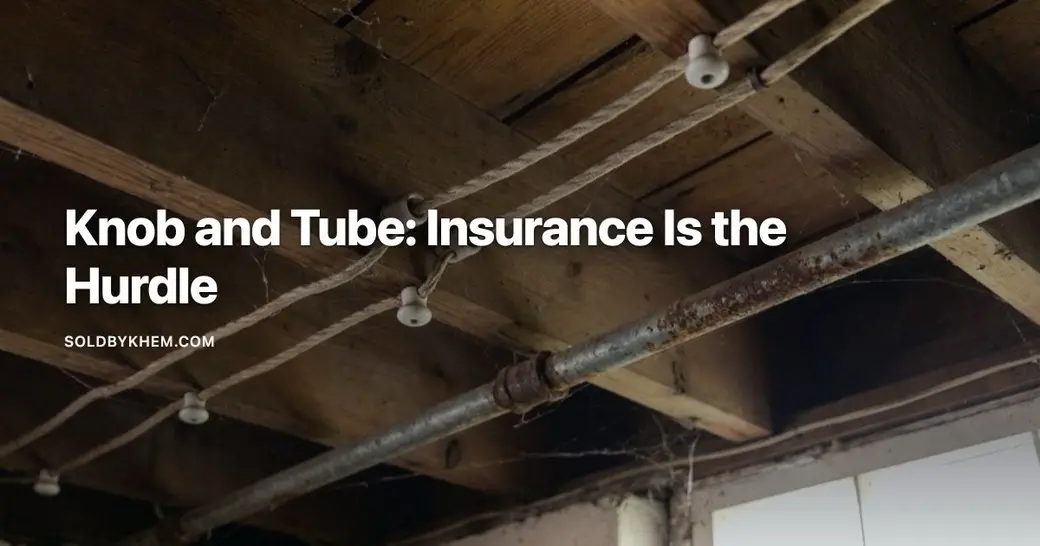
Knob and tube is the electrical wiring method used in houses roughly from the 1880s through the 1930s, and it is unsafe mainly because of what has been done to it since, not because of how it was built. Two separate cloth-insulated conductors run through the framing, held away from wood by ceramic knobs and passed through joists in ceramic tubes. Air is part of the insulation system. That is the key fact.
The original installations were careful work. Problems come from the decades afterward:
- Buried in insulation. Blown-in or batt insulation in an attic wraps the conductors and traps heat the system was never designed to hold.
- Brittle cloth insulation. Near light fixtures and in hot attics, the fabric and rubber dry out and flake off, leaving bare copper.
- Amateur splices. Someone tapped a new circuit into an old run with wire nuts and electrical tape, no junction box. This is the single most common thing I see.
- No ground. Knob and tube is a two-wire system. Every two-prong outlet in the house is a clue.
- Overloading. A circuit built for a couple of lamps now runs a window air conditioner and a space heater.
Intact, uninsulated, unmodified knob and tube in an unfinished attic is a different animal from a spliced mess behind kitchen plaster. Your inspector should be able to tell you which one you are buying.
How do I spot knob and tube wiring before I make an offer?
Look in the basement and the attic, then look at the outlets. Those three checks catch most of it during a normal showing.
- In the basement, follow the wiring leaving the panel. Ceramic knobs on joists and single wires running in pairs are unmistakable once you have seen them.
- In the attic, shine a light along the floor joists and at the rafters. Ceramic tubes at joist penetrations are the giveaway.
- Count two-prong outlets. A house full of them is either ungrounded knob and tube or ungrounded early cable.
- Look at the panel itself. A small fuse box, or a newer breaker panel with a handful of very old circuits still landed in it, tells you the rewiring was partial.
- Ask the listing agent directly whether the house has been rewired and whether there are permits. In Rochester and the surrounding towns, electrical permits are a matter of record.
Partial rewiring is the norm in Rochester older homes. Kitchens and bathrooms got updated in the 1970s and 1990s. Bedroom ceilings and attic runs did not.
What are galvanized pipes, and how do I know if the house has them?
Galvanized steel supply pipe is zinc-coated steel water pipe, common in pre-1940 construction, and it fails from the inside out. Rust and mineral scale build up on the interior wall until the opening narrows. You do not see a leak. You see weak water pressure, especially upstairs, and especially when two fixtures run at once. Brown-tinged water after the house has sat empty is another sign.
Here is how to tell what you are looking at in the basement:
| Material | What it looks like | What it usually means |
|---|---|---|
| Galvanized steel | Dull grey, threaded joints, magnet sticks to it | Original supply piping, likely restricted; plan on replacement |
| Copper | Dull brown or green, soldered joints | Replaced at some point; check whether the whole house or just the basement |
| PEX | Flexible white, red or blue tubing, crimp rings | Recent work, often a repipe done in stages |
| Cast iron | Thick, black, hub joints, drain lines only | Waste piping, not supply; inspect for rust scaling and bellies |
Watch for the mixed system: copper in the basement where it was easy to reach, galvanized still buried in the walls feeding the second floor. The basement looks updated. The shower upstairs trickles. Also check where the water service enters from the street, and ask whether the service line and the interior piping are lead or galvanized, because that is a separate question with its own answer in older city and village properties.
What will the home inspection tell me, and what will it miss?
A good home inspection identifies the systems present, flags visible defects, and tells you where it could not see. It is not a rewiring estimate and it is not a plumbing bid. Expect language like "active knob and tube wiring observed in attic, recommend evaluation by a licensed electrician." That sentence is your cue to bring in a specialist, not your answer.
On a pre-1940 house I suggest planning for two extra visits during the inspection period:
- A licensed electrician to say how much knob and tube is still energized, whether it can be safely abandoned in place, and what a whole-house rewire or a partial rewire would involve given the plaster and the access.
- A plumber to open a couple of fixtures, check static pressure and flow, and tell you whether the galvanized pipes are a next-five-years problem or a next-five-months problem.
Ask your inspector in advance whether they will pull the panel cover, walk the attic, and run multiple fixtures at once. Not all of them do all three.
The insurance call you should make before your inspection
Insurance is where knob and tube deals actually go sideways. Some carriers will not write a policy on a house with active knob and tube. Some will write it with a surcharge. Some will bind coverage and then require replacement within a stated period after closing. Because your lender requires a bound policy at closing, an insurance problem becomes a closing problem fast.
Call an agent as soon as you are under contract. Give them the address, the year built, the panel size, and what you know about the wiring and the plumbing. Get the answer in writing. Galvanized supply piping matters here too, since water damage claims drive a lot of underwriting decisions.
How do I write this into an offer in Monroe County?
Use the inspection contingency and the attorney approval period, and get your numbers before either one expires. In our market, offers on older houses typically run through an attorney approval period with inspections scheduled inside that window, so the sequence matters more than the tactics.
- Schedule the home inspection immediately, and book the electrician and plumber for the same week.
- Get the insurance answer in parallel, not after.
- Decide what you are asking for: a price reduction, a seller credit toward the work, or the repair completed with a permit before closing.
- If you ask the seller to do the work, ask for the permit and the final inspection sign-off, not just an invoice.
A word on strategy. On a house that has sat on the market, a credit is often easier for a seller to accept than a repair they have to manage. On a house with competing offers, going in with your eyes open and your insurance already lined up can be worth more than a lower number.
When is it worth it anyway?
Often. Pre-1940 houses in the Park Avenue and South Wedge areas, the older streets of Brighton, the villages of Pittsford and Honeoye Falls, and the farmhouses scattered through Henrietta, Rush and Mendon have framing, trim and lot placement that nobody builds now. Wiring and plumbing are replaceable. Layout, plaster, mature trees and walkable village blocks are not.
What I would not do is buy one on a hope. Know the scope before your contingency expires, know your carrier will insure it, and know whether you are paying for the work or the seller is.
Common questions
Does knob and tube wiring have to be removed, or can it be left in place?
Wiring that has been fully disconnected from the panel can generally stay in the walls, since abandoned conductors carry no current. What matters is whether any of it is still energized. An electrician can trace circuits and confirm what is live, and that written confirmation is what an insurance underwriter usually wants to see.
Will an FHA or VA appraisal fail a house with old wiring or galvanized pipes?
These appraisals look for safety and functioning systems, so exposed conductors, an unsafe panel or supply piping that will not deliver water can trigger a required repair. Age alone is not the issue. Condition is. If you are using FHA or VA financing on a pre-1940 house, tell your lender early so nobody is surprised by an appraisal condition two weeks before closing.
How can I tell if galvanized pipes have already been replaced upstairs?
Run the upstairs shower and a sink at the same time and watch the flow. Then look for copper or PEX stubs where fixtures connect, and check the basement for new pipe that stops at the first floor. A plumber can measure static pressure and flow rate and give you a clearer answer than any visual check.
Should I ask the seller to fix it or just take a credit?
A credit gives you control over who does the work and how well it is done, which is usually the better outcome on electrical and plumbing. Ask the seller to complete the work when insurance requires it before closing, or when the scope is too large to carry yourself. Either way, get permits documented.
Is a general home inspection enough on a pre-1940 house?
It is the right starting point, but plan on specialist follow-up. The general inspection tells you what systems are there and what is visibly wrong. An electrician and a plumber tell you what it costs and how disruptive it will be, and those are the numbers you negotiate with.
If you are weighing an older Rochester house and want someone who will actually go into the attic with you and ask the awkward questions, book a time with Khem Kadariya. Bring the address and we will build the inspection plan before you write the offer.
About this data
The figures in this post were compiled from publicly available sources including Zillow, Houzeo, Movoto, RochesterFirst and the Rochester Business Journal, along with other public market data. Real estate numbers change quickly, and these were accurate as of August 2026. For current figures on a specific home, street, or town, ask me directly rather than relying on a published average.
Keep reading
Need Help With Financing?
Thinking about buying a home and wondering what financing options may be available to you? Knowing where you stand before you write an offer puts you in a much stronger position.
I recommend connecting with my preferred lending partner, Brian Haefner with Premium Mortgage Corporation. Whether you are a first-time homebuyer, relocating to the Rochester area, purchasing your next home, or simply want to understand your mortgage options and buying power, Brian can help you explore your financing options and answer your mortgage-related questions.
Stay Connected With Khem
Looking for more Rochester real estate information, community updates and local insight?
Thinking about buying in the Rochester area? start a conversation with Khem to talk through neighborhoods, financing and current inventory.
Recent Posts








Khem Kadariya
Phone