
Boiler or forced air in an older Brighton NY home
Is a boiler or forced air better in an older Brighton NY home?
Neither is automatically better. A boiler with radiators gives steady, quiet, even heat and lasts a long time, but it carries no ducts, so central air needs a separate system. Forced air heats fast and shares ducts with air conditioning and filtration, but runs drier and noisier. Judge the specific equipment, not the category.
If you are shopping older houses in Brighton, you will walk through three very different heating setups in the same afternoon. A 1920s Tudor with cast iron radiators. A postwar cape with hot water baseboard. A ranch that had ductwork put in at some point and now runs a furnace. The listing usually says one word about it, and that word does not tell you much.
This post explains what each system actually is, how to identify it in ten seconds during a showing, what an inspector should be looking at, what air conditioning costs you in each case, and how the choice affects resale. No hype. Just what I see inside these houses.
What heating systems show up in older Brighton houses
Brighton's housing stock spans roughly a century, and the heating tells you the era as clearly as the trim does.
- Steam boilers. Common in the oldest homes. A boiler in the basement makes steam, the steam rises through pipes to tall cast iron radiators, then condenses and drains back. One pipe steam has a single pipe into each radiator plus a little vent on the side. Two pipe steam has a pipe at each end and a trap.
- Hot water boilers, also called hydronic. A pump circulates heated water through radiators or baseboard. Very common in homes built or updated from the postwar decades onward. Quieter and easier to zone than steam.
- Forced air furnaces. A furnace heats air and a blower pushes it through ducts to floor or wall registers. Sometimes original to the house, often retrofitted later when someone wanted central air.
- Hybrids. You will see these. A boiler serving the original part of the house and a small furnace or ductless heads serving an addition. Or a converted octopus gravity furnace with oversized ducts still in place.
The boiler vs forced air question in Rochester is really a question about which compromise you want to live with, because both are still installed here and both work.
How can you tell which system a house has?
Look at the walls first, then go to the basement. That is the whole method.
- Tall cast iron radiators with a small silver or brass vent on one side, no visible return pipe: one pipe steam.
- Cast iron radiators with pipes at both ends and no side vent: two pipe steam or hot water. Check the boiler.
- Low metal baseboard along exterior walls with fins inside: hot water baseboard.
- Rectangular metal grilles in floors, ceilings or low on walls: forced air.
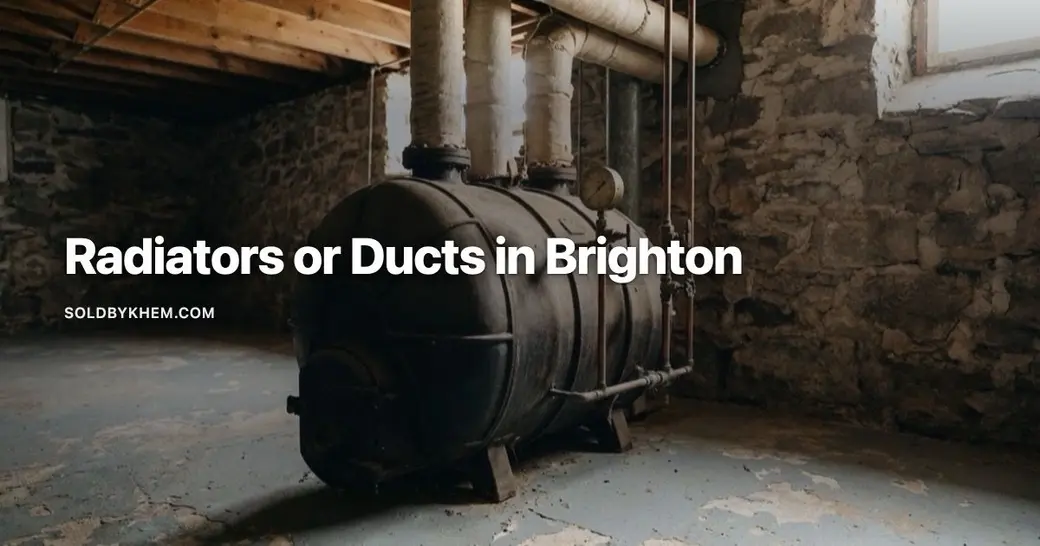
- Basement: a steam boiler has a sight glass, a water level gauge and a large main pipe leaving the top. A hot water boiler has a circulator pump, an expansion tank and a pressure gauge reading in the teens or twenties. A furnace has a big sheet metal plenum with ducts branching off and a filter slot.
Ask the seller for the fuel bills. In Monroe County that is usually RG&E, and twelve months of usage tells you more about comfort and envelope than any spec sheet.
Boiler versus forced air, side by side
| Factor | Steam or hot water boiler | Forced air furnace |
|---|---|---|
| How the heat feels | Steady radiant warmth, slow to change, very even once up to temperature | Fast warm blast, then a cool drift between cycles |
| Noise | Hot water is nearly silent. Steam knocks, hisses and ticks | Blower noise and duct rumble at every cycle |
| Air conditioning | No ducts, so cooling needs a separate system | Shares the ducts, so central air is a straightforward add |
| Filtration and air movement | None. Air only moves by convection | Filters and moves air continuously if you run the fan |
| Winter humidity | Generally feels less dry | Drier unless you add a humidifier |
| Zoning | Hot water zones easily. Steam is difficult to zone | Zoning means dampers or a second system |
| Service life | Cast iron boilers and radiators are long lived when maintained | Shorter equipment life, though replacement is simpler |
| Common repairs | Vents, traps, valves, sectional leaks, water level controls | Heat exchanger cracks, blower motors, ignition, duct leakage |
What should you inspect on a steam radiator home in Monroe County?
Have the inspector run the system through a full cycle and then look at these specific things, because a steam system that is out of adjustment feels broken when it is only neglected.
- The sight glass. Clear water at a stable level is a good sign. Sludgy, bouncing water points to a dirty boiler or a wet return problem.
- Radiator vents. Cheap and easy to replace, but bad vents are the single most common reason a room stays cold or a radiator hammers.
- Pitch. Every radiator should tilt slightly back toward the supply pipe so condensate drains. A radiator sitting flat on a settled floor will bang.
- Pipe insulation. Older basements often had insulated mains. If someone stripped it, the system is wasting heat and running long cycles. Ask what the insulation was and when it was removed.
- Asbestos. Older pipe wrap and boiler jackets can contain it. If it is intact, an inspector will usually recommend leaving it alone and noting it. Get a written scope and a quote before you decide what to do.
- Buried or unreachable returns. Return lines cast into a slab are expensive to fix if they leak.
- Boiler age and sizing. Many replacement boilers were sized to the old pipes rather than the actual heat loss, which means short cycling and higher bills.
For a hot water system, add the circulator pump, the expansion tank, and whether the zone valves actually respond to each thermostat. For a furnace, ask for a combustion test and a heat exchanger inspection, and open a few registers to see whether the ductwork is sealed or simply crimped together.
Getting air conditioning into a boiler house
This is the real cost difference, and it is where a lot of buyers get surprised after closing. A house with a boiler has no ducts. You have three practical paths in these homes:
- Ductless mini splits. Wall or ceiling heads in the rooms you care about, an outdoor unit, small refrigerant lines through the wall. Least disruptive, and they add supplemental heat too. The trade off is visible indoor heads.
- High velocity small duct systems. Flexible two inch tubing snaked through closets, attic and joist bays with small round outlets. Designed for exactly this kind of older house. More expensive to install, far less visible.
- Conventional ducted air handler in the attic or basement. Possible in some layouts, but in a full two story with plaster walls it usually means soffits, chases or lost closet space.
Get two written quotes before your contingency period ends. Contractors will walk a house during a due diligence window if you ask, and the quote often matters more to your decision than the inspection report does.
Does the heating system affect what the house is worth?
It affects buyer pool and negotiation more than headline value. A well maintained hot water boiler with good radiators is not a defect and rarely gets discounted. What does get discounted is uncertainty: an unknown age boiler, an oil tank with no documentation, radiators removed and never replaced, or a furnace with a cracked heat exchanger tagged red by the utility.
Two practical notes for buyers. First, fuel type matters here. Natural gas, oil and propane all appear in older south and southeast Monroe County homes, and an oil tank, above ground or buried, needs its own attention. Second, a converted system is not automatically an upgrade. I have seen forced air retrofits with undersized returns that heat unevenly and cost more to run than the boiler they replaced.
If you are selling one of these homes, the fix is documentation. Service records, the boiler's install date, when the vents were last replaced, whether the mains are insulated. That paperwork answers the questions a buyer's inspector will raise anyway.
Common questions
Is it worth replacing a working boiler with forced air?
Usually not, if the boiler is sound and the radiators are intact. Converting means running ductwork through finished plaster walls, removing radiators, patching floors, and abandoning equipment that still works. If your actual goal is air conditioning, ductless or high velocity cooling is almost always the cheaper and less invasive route. Convert only when the boiler is failing and the house already has usable duct chases.
Why does my steam radiator bang and hiss?
Banging is almost always condensate trapped where it cannot drain, caused by a radiator that has lost its pitch or a sagging pipe. Hissing is the air vent doing its job, though a loud continuous hiss usually means the vent has failed. Both are inexpensive to correct compared with most heating repairs. Neither should scare you off a house by itself.
Can you add central air to a house with radiators without tearing up walls?
Yes, in most cases. High velocity small duct systems were designed for older homes and use tubing that fits inside standard joist bays and closet chases. Ductless mini splits need only a small wall penetration per head. Both leave plaster and trim largely intact, and both should be quoted by a contractor who has walked your specific floor plan.
Which system costs less to run in a Rochester winter?
It depends on the equipment efficiency, the fuel, and the house envelope far more than on the category. A modern sealed combustion boiler in an insulated house will beat an old furnace with leaky ducts, and the reverse is also true. Ask the seller for twelve months of utility usage and compare that against the square footage. Real bills settle the argument.
What should I ask for during the inspection period?
Ask for the heating system's age, service records, and fuel bills. Have the inspector operate the system through a full cycle rather than just confirming it turns on. If the house has a boiler and you want cooling, bring in an HVAC contractor for a written quote during the same window. In New York, your attorney handles the contract review, so raise anything you find before that review closes.
Talk it through before you write the offer
Every older Brighton house tells you what it needs if you know where to look. If you are weighing two homes with two different systems, or you own one and want to know how buyers will read it, I will walk the basement with you and tell you plainly what I see. Schedule a time with Khem Kadariya and bring the listing.
About this data
The figures in this post were compiled from publicly available sources including Redfin, Zillow, Houzeo, Movoto and RochesterFirst, along with other public market data. Real estate numbers change quickly, and these were accurate as of September 2026. For current figures on a specific home, street, or town, ask me directly rather than relying on a published average.
Keep reading
Need Help With Financing?
Thinking about buying a home and wondering what financing options may be available to you? Knowing where you stand before you write an offer puts you in a much stronger position.
I recommend connecting with my preferred lending partner, Brian Haefner with Premium Mortgage Corporation. Whether you are a first-time homebuyer, relocating to the Rochester area, purchasing your next home, or simply want to understand your mortgage options and buying power, Brian can help you explore your financing options and answer your mortgage-related questions.
Stay Connected With Khem
Looking for more Rochester real estate information, community updates and local insight?
Have a question about Rochester real estate? talk with Khem and we can talk it through.
Recent Posts









Khem Kadariya
Phone