
Penfield NY flag lots: what to check before you buy
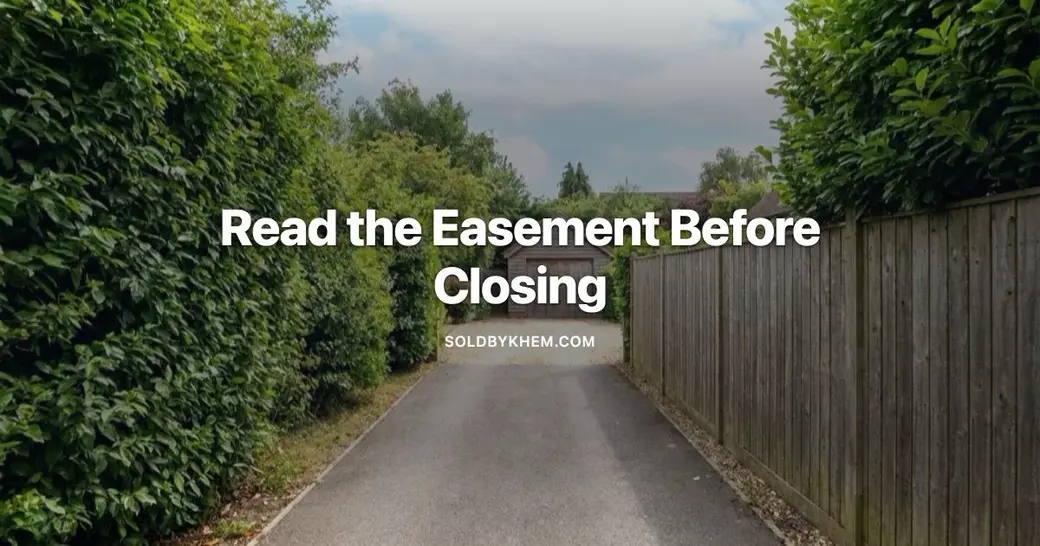
What should I check before buying a flag lot or shared driveway house in Penfield NY?
Before buying, get the recorded easement and any shared driveway maintenance agreement from the title search, plus a current instrument survey showing the driveway strip and its width. Confirm the easement runs with the land, covers utilities and snow removal, and names who pays for repairs. Then check with your lender and insurer.
Flag lots and shared driveway parcels show up regularly in Penfield, especially on older road frontage that was split into back lots over the years. They can be a genuine value: more land, more distance from the road, sometimes a lower price than a comparable house on a standard lot. They can also come with paperwork problems that surface two weeks before closing, or five years after it.
This post walks through what to read, in what order, and who provides each document. It covers the easement, the maintenance agreement, the survey, what lenders and insurers ask about, and what I look at when I physically walk one of these parcels. No numbers here are invented: where a figure would matter to your situation, I tell you who to ask for it rather than guessing.
What is a flag lot, and why does Penfield have so many?
A flag lot is a parcel shaped like a flag on a pole. The buildable part sits back behind other properties, and a narrow strip of land, the pole, connects it to the public road. That strip carries the driveway.
Penfield grew outward along established roads. As larger holdings were divided, the back acreage still needed legal access to a town or county road. A flag lot was the straightforward way to give it. The result is a house you cannot see from the street, reached by a long drive that may run beside a neighbor's side yard.
A shared driveway parcel is related but not the same. There, two or more homes use one drive. Sometimes the strip belongs to one owner and the other has a recorded right of way across it. Sometimes the drive straddles the boundary and each owner holds half. Sometimes several houses sit on a private lane that the town does not maintain. Those are four different legal situations with four different sets of risk.
The four setups, and what each one turns on
| Setup | Who owns the driveway | Document that controls it |
|---|---|---|
| Flag lot with its own pole | You own the full strip | Deed plus survey; check utility easements crossing the strip |
| Right of way across a neighbor | The neighbor owns the land | Recorded easement in your chain of title |
| Drive straddling the line | Each owner owns their half | Cross easements running both directions |
| Private lane serving several homes | A separate parcel, or all owners jointly | Road maintenance agreement or association documents |
Ask the listing agent which of these four applies before you write an offer. If the answer is vague, that is information too. Plenty of these arrangements have run smoothly for decades on nothing but a handshake, and a handshake is exactly what your lender will not accept.
What does a shared driveway agreement in Monroe County need to say?
A workable agreement is recorded in the Monroe County Clerk's office, runs with the land rather than with the current owners, and answers the boring questions in writing. At minimum, look for language on each of these:
- Who may use the drive, and for what. Passenger vehicles only, or trucks and equipment too.
- Width and location of the right of way, tied to the survey rather than described loosely.
- Maintenance and repair cost split. Equal shares, or by number of homes, or by use.
- Snow removal. Who arranges it, who pays, and whether the plow can push snow onto either lot.
- Resurfacing. Who decides when the drive gets redone, and what happens if one owner refuses.
- Utilities. Whether water, sewer, gas, electric and internet lines may run in the strip, and who repairs the surface after a dig.
- Dispute process and how the agreement can be amended.
The phrase to look for is that the easement is appurtenant, meaning it belongs to the property and transfers automatically when the house sells. A personal license granted to a past owner does not help you. Your real estate attorney will tell you which one you have after reading the title search.
Title, survey, and the gap between them
Order a current instrument survey. Do not rely on a survey from a prior sale, and do not rely on a tax map. On flag lots the strip is often narrower than the pavement people actually drive on, and I have walked drives where the asphalt sits partly on the neighbor's grass. That is a fixable problem if you know about it during your inspection period. It is an expensive one if you learn about it later.
Match three things against each other: the deed description, the survey, and what is on the ground. Then ask the title company directly whether it will insure access to a public road. If the abstract shows a break in the easement chain, the title company will say so, and that is the moment to get it corrected rather than closing and hoping.
What lenders and insurers ask about
Most lenders want to see recorded, permanent legal access and a written maintenance agreement when a driveway is shared. Some are comfortable with a joint driveway easement alone. Underwriting rules differ by loan program and by lender, so ask your loan officer the question in plain terms early: does this specific access arrangement satisfy your guidelines, and what document do you need to see?
Homeowners insurance is usually less fussy, but ask anyway if the drive is long or if emergency vehicle access is tight. Penfield's fire district can tell you whether their apparatus can reach the house and turn around.
Walking the parcel: what I actually look at
Photographs flatter long driveways. Standing on them tells you more.
- Grade and drainage. Water runs downhill toward the low point. If that low point is your garage, you will learn it in a spring thaw.
- Turnaround space. Can a delivery truck, an oil truck or a plow get out without backing the whole length?
- Sight lines at the road. Pulling out of a narrow strip onto a busy Penfield road is different from pulling out of a suburban driveway.
- Surface and base. Long drives are expensive to resurface. Look for alligator cracking, soft edges and standing water.
- Culverts and ditches at the road end, and who has been keeping them clear.
- Where snow goes. On a shared drive with no shoulder, the piles have to land somewhere.
- Utility routing. Ask whether water and sewer are public or private, and where the lines run. A private septic field or well inside a shared strip is a detail worth confirming on paper.
Can you build or subdivide behind a flag lot?
Sometimes, but treat it as unproven until the Town of Penfield says otherwise. Zoning sets frontage, lot width, setbacks and access standards, and a flag lot often meets them only through a prior variance or an older approval. If your plan involves an addition, a second structure or a future split, call the Penfield building and zoning department with the tax parcel number before you commit money. Ask what the parcel is zoned, whether any variance conditions are attached to it, and what the current access requirement would be for new construction.
How to write the offer
Keep your contingencies and use them. Ask for the recorded easement, any maintenance agreement, the most recent survey and any well or septic records as part of your due diligence. Give your attorney time to read them. If no maintenance agreement exists, one option is to negotiate that the seller obtain a signed and recorded agreement from the neighboring owner before closing. Whether the neighbor cooperates is the real test, and it is better to run that test before you own the house.
On price, compare the parcel to other Penfield homes with similar access, not to homes with standard street frontage. Buyers at resale will apply the same discount you are applying now, and your buyer's lender will ask the same questions. That is not a reason to walk away. It is a reason to buy with the paperwork clean.
Common questions
Is a flag lot in Penfield NY harder to sell later?
It narrows the buyer pool, because some buyers will not consider a shared or long private drive, and some lenders ask extra questions. It is not a barrier when the access is recorded, the maintenance agreement is in place and the drive is in decent condition. Sellers who hand over clean documents at listing time avoid most of the friction.
Who pays to plow and repave a shared driveway?
Whatever the recorded agreement says. If there is no agreement, New York law generally expects users of an easement to keep it usable, but the split is not spelled out for you, and that ambiguity is where disputes start. Get the cost sharing in writing and recorded so it binds future owners too.
Can my neighbor block or gate the shared driveway?
Not if you hold a valid recorded easement covering the area they are blocking. The remedy runs through your attorney and, if needed, the courts, which is slow and unpleasant. This is the single best reason to confirm the easement language during your inspection period rather than after closing.
Does the town maintain the driveway or the private lane?
No. Town and county crews maintain public roads. Anything past the right of way line, including a flag lot pole or a private lane serving several homes, is on the owners. Confirm with the Town of Penfield highway department where their maintenance stops on your specific road.
What documents should I ask for before writing an offer?
The deed, any recorded easement or right of way, the shared driveway or road maintenance agreement, the most recent instrument survey, and well or septic records if the property is not on public utilities. Ask for all of them at once. How quickly and completely they arrive tells you a lot about what you are buying.
If you are looking at a flag lot or shared driveway parcel in Penfield or anywhere in Monroe County and want someone to read the easement with you before you commit, book a time with me here. Bring the address and the tax parcel number and we will start with the documents.
Khem Kadariya
About this data
The figures in this post were compiled from publicly available sources including Houzeo, Zillow, Redfin, Movoto and FRED (Federal Reserve Bank of St. Louis), along with other public market data. Real estate numbers change quickly, and these were accurate as of September 2026. For current figures on a specific home, street, or town, ask me directly rather than relying on a published average.
Keep reading
Need Help With Financing?
Thinking about buying a home and wondering what financing options may be available to you? Knowing where you stand before you write an offer puts you in a much stronger position.
I recommend connecting with my preferred lending partner, Brian Haefner with Premium Mortgage Corporation. Whether you are a first-time homebuyer, relocating to the Rochester area, purchasing your next home, or simply want to understand your mortgage options and buying power, Brian can help you explore your financing options and answer your mortgage-related questions.
Stay Connected With Khem
Looking for more Rochester real estate information, community updates and local insight?
Thinking about buying in the Rochester area? start a conversation with Khem to talk through neighborhoods, financing and current inventory.
Recent Posts


Khem Kadariya
Phone