
Mendon NY building lot wetlands and setback rules
Can I build a house on a Mendon NY lot that has wetlands on it?
Often yes, but not everywhere on the lot. Wetlands and their regulated buffer areas are subtracted from where you can dig, along with zoning setbacks from the road right of way and the side and rear lines, plus separation distances for a septic system and well. Get a wetland delineation and a code review before you close.
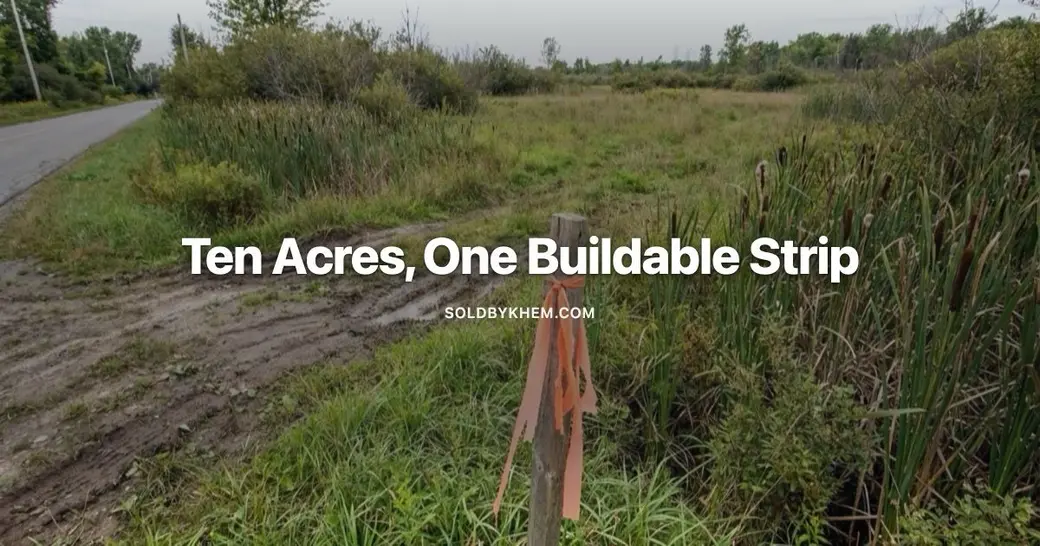
A vacant lot in Mendon can look like a clean sheet of paper. Ten acres, road frontage, a stand of trees at the back. Then the surveyor stakes it out and the actual place you are allowed to put a house turns out to be a strip near the road. This post walks through why that happens: how wetlands are identified on Monroe County land, how building setbacks in Mendon are measured, how the two stack on top of each other, and what a septic system and a driveway permit take out of what is left. By the end you will know what to verify before your money goes hard.
What does a wetland on Monroe County land actually mean?
It means part of your lot is regulated, and in most cases the land immediately around it is regulated too. A wetland is not defined by standing water. It is defined by a combination of soils, vegetation and hydrology, which is why a spot that looks like an ordinary field in August can still be a wetland on paper.
Three separate authorities can have a say on the same acre:
| Who | What they look at | What it means for your lot |
|---|---|---|
| New York State DEC | Freshwater wetlands and the regulated adjacent area around them | A permit may be required to clear, fill, grade or build within the wetland or its buffer |
| US Army Corps of Engineers | Federally regulated waters and wetlands | Separate federal review, with its own definitions and its own timeline |
| Town of Mendon | Zoning, site plan review, drainage, and any local environmental or conservation provisions | Local approvals that run alongside, not instead of, the state and federal ones |
Note the word separate. Clearing one does not clear the others. A seller telling you "DEC said it is fine" is not the same as a written determination, and it is not a federal answer.
Online map layers are a screening tool only. The National Wetlands Inventory and the state's environmental resource mapper are useful for a first look, and they are wrong at the property scale often enough that you should never buy on them. New York's freshwater wetlands law has been amended in recent years, and the practical effect for buyers is that you should not treat an old published map as the final word on whether your parcel is regulated. Ask DEC's regional office, which covers Monroe County from Avon, for a written jurisdictional determination, and hire a wetland consultant to flag the boundary on the ground.
How do building setbacks in Mendon NY work?
A setback is the minimum distance between your structure and a property boundary, and Mendon sets those minimums by zoning district in the town code. There is normally a front yard setback, side yard setbacks, a rear yard setback, a minimum lot area, and a minimum frontage or lot width measured at the building line. Do not take these numbers from a listing sheet or from an old survey. Pull the current district table, in writing, from the Town of Mendon Building and Zoning office and confirm which district your parcel sits in.
Two measurement details catch buyers out repeatedly:
- The front setback usually runs from the road right of way line, not the edge of the pavement. The right of way can extend well past the asphalt. That can move your building line further back than you expected.
- A corner lot can be treated as having two front yards. That is a large bite out of a small parcel.
Also check whether the parcel is inside the Village of Honeoye Falls rather than the surrounding Town of Mendon. The village is its own jurisdiction with its own code and its own board. Same mailing address language, different rulebook.
How setbacks and wetland buffers stack
Here is the part that surprises people. The setback and the wetland buffer do not overlap in your favour. They both subtract. What is left after you remove the road right of way, the front, side and rear yards, the wetland itself and its regulated adjacent area, plus any drainage or utility easement crossing the parcel, is your buildable envelope.
Then the house has to fit inside that envelope with room for:
- A septic system, including a replacement area held in reserve
- A drilled well, kept at the required separation distance from the septic and from any neighbouring septic
- A driveway that meets sight distance and grade requirements
- Construction access and a place to stockpile spoil, which matters more than buyers expect on a tight lot
On a rolling Mendon parcel the low ground is usually the wet ground, and the high ground is usually where the code wants the septic. Those two facts are frequently in tension on the same lot.
Septic, wells and the perc test
Much of Mendon is outside public sewer, so onsite wastewater is the norm rather than the exception. Approval runs through the Monroe County Department of Public Health, and it turns on soil testing: percolation tests and deep hole tests dug on the parcel, witnessed, at the location you intend to use.
Two practical points. First, timing. Soil tests are most meaningful when the water table is high, which in this area means spring. A test run in a dry stretch can read better than the site really behaves. Second, a failed or marginal test does not always kill a project, but the fix, whether that is an engineered or raised system, changes your build budget and sometimes changes where the house can sit. Price that risk before you close, not after.
If the driveway will meet a county or state highway rather than a town road, you will need a work permit from that highway authority. Sight distance requirements can push the driveway to a specific point on the frontage, and the driveway location in turn influences where the house wants to sit.
What to walk the lot looking for
You are not doing a delineation. You are deciding whether to spend money on one. Signs worth noticing:
- Cattails, skunk cabbage, willows, red maple in the low spots
- Hummocky ground, or a spongy feel underfoot in a dry week
- Water-stained leaf litter and silt lines on tree trunks
- Old drainage tile outlets, ditches or a swale running toward a neighbour
- Any watercourse, including a seasonal one, since Honeoye Creek and its tributaries run through this part of the county
Walk it twice if you can, once in early spring and once in summer. If that is not possible, ask the neighbours what the back of the parcel does in April.
How to write the offer so you can still walk away
Land contracts should be built around a due diligence period long enough to actually finish the work. Sequence matters, because each step tells you whether the next one is worth paying for.
- Zoning district confirmation and the current setback table from the town, in writing
- Desktop wetland screening and a call to the DEC regional office
- Boundary survey, with the road right of way located
- Wetland delineation by a consultant, flagged and mapped, ideally during the growing season
- Soil testing for septic, witnessed by the county health department
- A sketch plan from a site engineer showing the house, well, septic, reserve area and driveway inside the buildable envelope
Make the contract contingent on getting an acceptable result at each stage, with your deposit refundable if you do not. Ask the seller for everything they already have: prior surveys, old perc results, any correspondence with DEC or the town, and any expired approvals. Expired approvals are still useful. They tell you what somebody already tried.
Land in Mendon can be a good buy. What it cannot be is a fast buy. The parcels that trade smoothly are the ones where the buyer treated the buildable envelope as the thing being purchased, rather than the acreage on the tax bill.
Common questions
Can I fill in a wetland to make my lot buildable?
Not without permits, and often not at all. Filling, grading, clearing and excavating inside a regulated wetland or its adjacent area generally require authorisation from the state, and potentially from the Army Corps as well. Unpermitted fill can lead to enforcement and a restoration order, and it becomes your problem once you own the parcel, even if a previous owner placed it.
Does a wetland delineation expire?
Delineations and jurisdictional determinations are typically valid for a set period rather than forever, and conditions on the ground can change in the meantime. If a seller hands you a delineation from several years ago, treat it as background rather than as a current answer. Confirm with the regulator whether it is still good before you rely on it for a purchase decision.
Who confirms the setbacks for a specific Mendon parcel?
The Town of Mendon Building and Zoning office, working from the current zoning code and the district your parcel falls in. Ask for the requirement in writing and ask specifically how the front yard is measured on your road. If the parcel is inside the Village of Honeoye Falls, that is a separate office and a separate code.
What if the buildable area is too small for the house I want?
You have three options: redesign the house to fit the envelope, apply to the zoning board of appeals for an area variance, or move on to another parcel. A variance is a discretionary decision, not a formality, so never buy on the assumption that one will be granted. If your plan depends on relief, make the contract contingent on actually obtaining it.
Should I get a survey even if the lot has clear markers?
Yes. Iron pins move, tree lines are not boundaries, and mowed edges routinely sit several feet off the legal line. A current boundary survey that locates the road right of way, easements and any flagged wetland line is the document your engineer, the town and your lender will all work from.
If you are weighing a specific parcel in Mendon, Honeoye Falls, Rush or Mendon's surrounding countryside and you want a straight read on what is actually buildable before you commit, book a time with Khem Kadariya. Bring the tax map number and any documents the seller has given you, and we will build the due diligence list together.
About this data
The figures in this post were compiled from publicly available sources including Houzeo, Zillow, Redfin, Movoto and FRED (Federal Reserve Bank of St. Louis), along with other public market data. Real estate numbers change quickly, and these were accurate as of September 2026. For current figures on a specific home, street, or town, ask me directly rather than relying on a published average.
Need Help With Financing?
Thinking about buying a home and wondering what financing options may be available to you? Knowing where you stand before you write an offer puts you in a much stronger position.
I recommend connecting with my preferred lending partner, Brian Haefner with Premium Mortgage Corporation. Whether you are a first-time homebuyer, relocating to the Rochester area, purchasing your next home, or simply want to understand your mortgage options and buying power, Brian can help you explore your financing options and answer your mortgage-related questions.
Stay Connected With Khem
Looking for more Rochester real estate information, community updates and local insight?
- browse current Rochester listings
- download the Rochester Relocation Guide
- Rochester updates on Instagram
Have a question about Rochester real estate? talk with Khem and we can talk it through.
Recent Posts









Khem Kadariya
Phone