
Irondequoit Bay Waterfront Homes: What Buying Changes
What should I know before buying a waterfront home on Irondequoit Bay?
Buying on Irondequoit Bay adds items a standard purchase never touches: seawall and dock condition, shoreline erosion history, flood zone and flood insurance cost, private well or septic, steep driveway access, and permits from the town and New York State DEC for anything you build at the water. Budget more inspection time and more contingency days.
Irondequoit Bay is one of the few places in Monroe County where you can own water frontage, keep a boat at your own dock, and still be twenty minutes from downtown Rochester. It also comes with a purchase process that looks nothing like buying in Brighton or Henrietta. This post walks through what actually changes: the inspections you add, the insurance you have to price before you commit, the permits that govern the shoreline, the utilities that may be private, and the questions worth asking the seller in writing.
I am not going to give you Irondequoit Bay sale statistics here, because there is no reliable published town-level or bay-level closed-sale data set I can quote with a date attached. Waterfront sales in a market this small happen in single digits in some months. A median built from three sales is noise, not a market. Below, where I have verified numbers, I use them and name the period. Where I do not, I say so.
What changes when the lot has water frontage?
Six things change, and each one costs money or time: the structures at the shoreline, the flood determination, the insurance, the utilities, the access, and the permit layer.
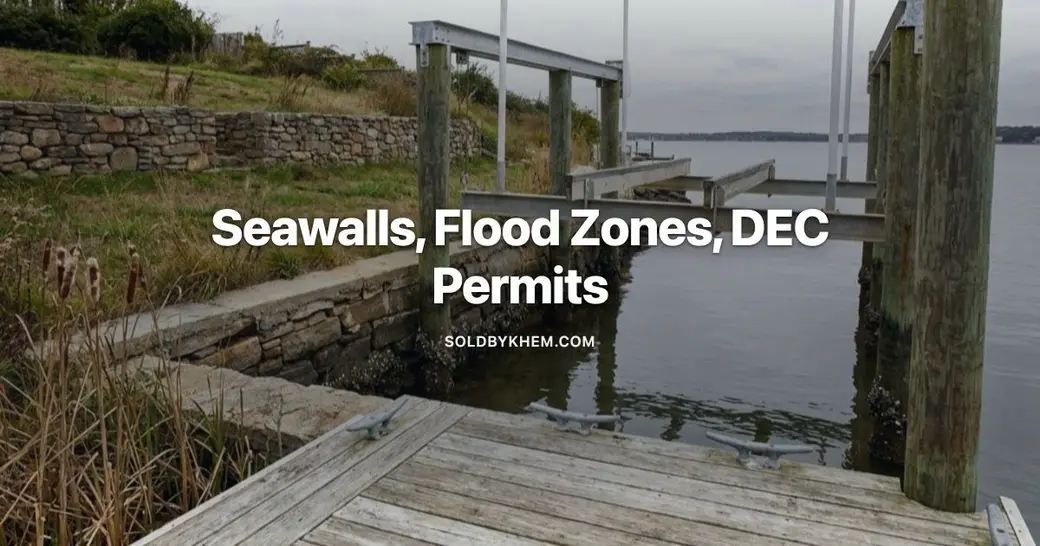
- Shoreline structures. Seawalls, revetments, breakwalls, stairs down the slope, boat lifts and docks are all improvements that age, and none of them are covered by a normal home inspection.
- Flood zone. Your lender pulls a flood determination. If any part of the structure sits in a mapped special flood hazard area, flood insurance is a condition of the loan, not a choice.
- Insurance generally. Homeowners carriers price waterfront differently, and some decline it. Get a quote during attorney approval, not after.
- Utilities. Some bay-side properties run on private well, private septic, or both. That is a different maintenance life and a different inspection list.
- Access. Steep driveways, shared drives, and long private roads are common on the slopes above the bay. Winter access and snow removal responsibility are real questions.
- Permits. Anything you want to build at the water line generally involves the town and often New York State DEC. Assume nothing is grandfathered until you see paper.
How much does a seawall or dock actually matter?
It matters more than the kitchen, because a failing seawall is a five-figure or six-figure repair and there is no cosmetic workaround. Water finds the weak point every year, and freeze-thaw cycles on this bay are unforgiving.
When I walk a waterfront property with a buyer, I look at the wall before I look at the house. Signs that need a specialist opinion:
- Bulges, leaning sections, or a wall face that is out of plumb.
- Soil settlement, sinkholes or dips in the lawn just behind the wall. That usually means fill is washing out through the wall.
- Cracked or displaced cap stones, open joints, exposed rebar on concrete sections.
- Rotted or crumbling timber cribbing on older walls.
- Scour at the toe of the wall where the water meets it.
Docks get the same treatment. Look at pilings at the waterline, deck framing underneath rather than on top, hardware corrosion, and whether the dock is a permanent structure or a seasonal removable one. Seasonal docks mean labor twice a year, either yours or a contractor's. Ask the seller who pulls the dock, when, and where it is stored.
Hire a marine contractor or a structural engineer who works on shoreline structures for a written opinion with a repair estimate. This is a separate inspection with a separate fee, and it is the single best money a bay buyer spends.
Flood insurance, and why you price it before you commit
Flood insurance is priced on the structure, its elevation and its flood zone, not on a rule of thumb, so I will not quote you a number. What I will tell you is the sequence. Order a flood zone determination early. If the property is in a mapped hazard area, ask whether an elevation certificate exists. If one does, get a National Flood Insurance Program or private market quote against it. If one does not, you may need a surveyor to produce one, and that takes time you have to build into your contingency period.
Two traps worth naming. First, a seller's current premium is not your premium. Policies and pricing change hands imperfectly. Second, standard homeowners policies exclude flood. A buyer who assumes the main policy covers rising water finds out at the worst possible moment.
Well, septic and the things a suburban buyer never thinks about
Public water and sewer coverage varies along the bay, and it is property by property, not street by street. Confirm it in writing rather than assuming.
If the home is on a private well, add a water quality test and a flow rate test. If it is on septic, add a septic inspection with the tank pumped so the inspector can see the baffles, plus a dye test or load test on the field. Septic systems near a shoreline get extra scrutiny from the county health department, and a failing field on a small waterfront lot is a hard problem because there may be nowhere to put a replacement field. That is a deal-level risk, not a repair-credit item. Find out before you are emotionally committed.
The permit layer: town plus DEC
Irondequoit Bay shoreline work sits under more than one authority. Depending on the exact location and the work, you may be dealing with the town, Monroe County, and the New York State Department of Environmental Conservation. Dredging, new or rebuilt seawalls, dock changes, fill, and vegetation removal near the water can all trigger review.
Practical approach for a buyer:
- Ask the seller for copies of every permit, approval and certificate of compliance for the dock, wall, boat lift, decks and any addition.
- Ask whether any structure was built without a permit. Unpermitted shoreline work becomes your problem the day you close.
- If you plan to change anything, call the town building department and ask what the process looks like before you waive contingencies. A ten minute phone call can reset your entire renovation budget.
Comparing a bay waterfront purchase to a standard suburban one
| Item | Standard suburban purchase | Irondequoit Bay waterfront |
|---|---|---|
| Inspections | General home inspection, sometimes radon | General, plus shoreline structure, plus well and septic where applicable |
| Insurance | Homeowners quote, routine | Homeowners plus likely flood, quoted before contingencies expire |
| Contingency timeline | Often 10 to 14 days of inspection time | Plan for longer; specialists book out and reports take days |
| Permit research | Additions and decks | Additions, decks, dock, seawall, lift, dredging, DEC involvement |
| Comparable sales | Many nearby closed sales | Few sales, wide variation in frontage and structure condition |
| Ongoing costs | Taxes, utilities, maintenance | Add dock in and out, wall maintenance, possible flood premium |
Why the comps are the hardest part
On a suburban street, ten similar houses sold in the last year and the value question is close to settled. On the bay, two homes a few hundred feet apart can differ by a wide margin because one has usable frontage and a sound wall and the other has a slope, a failing dock and no permits. Frontage width, water depth at the dock, orientation, and whether the buildable area sits above or below the slope all move value.
This is where I stop trusting aggregator pages entirely. To show you how bad the spread gets even in a well-covered market: for Pittsford, a town with far more sales volume than the bay shoreline, sources dated within roughly six months of each other reported medians of $450,000 (Redfin, December 2025, on three sales), $525,618 (Zillow average home value, May 31, 2026), $549,000 list (Movoto, July 2026), $599,900 list (Realtor.com, May 2026) and $707,000 (Redfin three-month window ending May 2026). None of those is a lie. They measure closed sales, automated estimates and asking prices over different windows. On a waterfront street with a handful of annual sales, that same spread gets wider and the automated estimate gets less useful.
What is the wider Rochester market doing?
The broader metro has been firm rather than soft. The Rochester metro median sale price was $252,800 in the first quarter of 2026, up 7.2% year over year, which ranked as the tenth largest annual increase among the 235 largest US markets according to National Association of Realtors data reported by the Rochester Business Journal on May 7, 2026. First quarter is seasonally the low point locally: the same reporting put the metro median at $289,800 in the second quarter of 2025.
Financing has not loosened. Freddie Mac's Primary Mortgage Market Survey released September 3, 2026 put the 30-year fixed at 6.71%, up from 6.66% the prior week and 6.50% a year earlier. The 15-year fixed was 6.04%. Call that roughly flat to modestly higher, not falling. For a waterfront buyer, the practical read is that you should not plan around a rate drop, and you should price the flood premium and any wall repair into your monthly number from the start.
How to write an offer on a bay property
Give yourself room. That means an inspection period long enough to get a marine contractor out, an insurance contingency or at least a firm plan to quote flood coverage during attorney approval, and a written list of permit documents requested from the seller. Ask for the survey. Ask about riparian rights and any shared access or easement over neighboring land to reach the water. Ask what conveys: boat lift, seasonal dock sections, mooring hardware.
None of this makes you a difficult buyer. Sellers on the bay who have maintained their shoreline usually have the paperwork and are glad to hand it over. The ones who do not are exactly the situations where you want the extra days.
Common questions
Do I need flood insurance for every Irondequoit Bay waterfront home?
No. It depends on whether the structure sits in a mapped special flood hazard area, and that is determined property by property. If it does and you are financing, your lender will require it. If it does not, coverage is optional but often still worth quoting, because standard homeowners policies exclude flood damage entirely.
Can I build a new dock or rebuild a seawall after I buy?
Usually you can, but not without review. Shoreline work commonly requires town approval and often New York State DEC involvement, and the scope of what triggers review varies with the specific work and location. Call the town building department and ask before you buy, especially if your plan depends on rebuilding or extending anything at the water.
Why do Zillow and Redfin show such different values for a lakefront home in Monroe County NY?
Because they measure different things over different windows. One reports closed sales, another reports an automated valuation estimate, another reports asking prices. For Pittsford, sources dated within about six months of each other showed figures ranging from $450,000 to $707,000. Waterfront makes it worse, since few sales close each year and frontage quality varies enormously.
How long should I expect the process to take compared with a standard purchase?
Plan for a longer inspection window than a typical suburban deal. You are coordinating a general inspector, often a marine or structural specialist, possibly a well and septic inspection, and insurance quotes that may need an elevation certificate. Those specialists book out, and reports take days to write.
Are there waterfront options in the south and southeast Monroe County towns?
Water frontage in Henrietta, Pittsford, Mendon, Rush and Honeoye Falls is mostly creeks, ponds and canal frontage rather than open bay or lake, and each of those carries its own flood and permit questions. If you want a boat on open water, Irondequoit Bay and the Finger Lakes are the realistic search areas within reach of Rochester.
Talk it through before you tour
If you are considering Irondequoit Bay waterfront, the most useful conversation happens before you fall for a particular house: which inspections you will need, what the shoreline structures look like on the properties in your range, and what your real monthly number is once insurance is priced. Book a time with me, Khem Kadariya, and we will build your inspection and contingency plan before you write an offer.
About this data
The figures in this post were compiled from publicly available sources including Redfin, Zillow, Houzeo, Movoto and RochesterFirst, along with other public market data. Real estate numbers change quickly, and these were accurate as of September 2026. For current figures on a specific home, street, or town, ask me directly rather than relying on a published average.
Need Help With Financing?
Thinking about buying a home and wondering what financing options may be available to you? Knowing where you stand before you write an offer puts you in a much stronger position.
I recommend connecting with my preferred lending partner, Brian Haefner with Premium Mortgage Corporation. Whether you are a first-time homebuyer, relocating to the Rochester area, purchasing your next home, or simply want to understand your mortgage options and buying power, Brian can help you explore your financing options and answer your mortgage-related questions.
Stay Connected With Khem
Looking for more Rochester real estate information, community updates and local insight?
Thinking about buying in the Rochester area? contact Khem to talk through neighborhoods, financing and current inventory.
Recent Posts










Khem Kadariya
Phone