Barn and Outbuilding Insurance in Wheatland NY
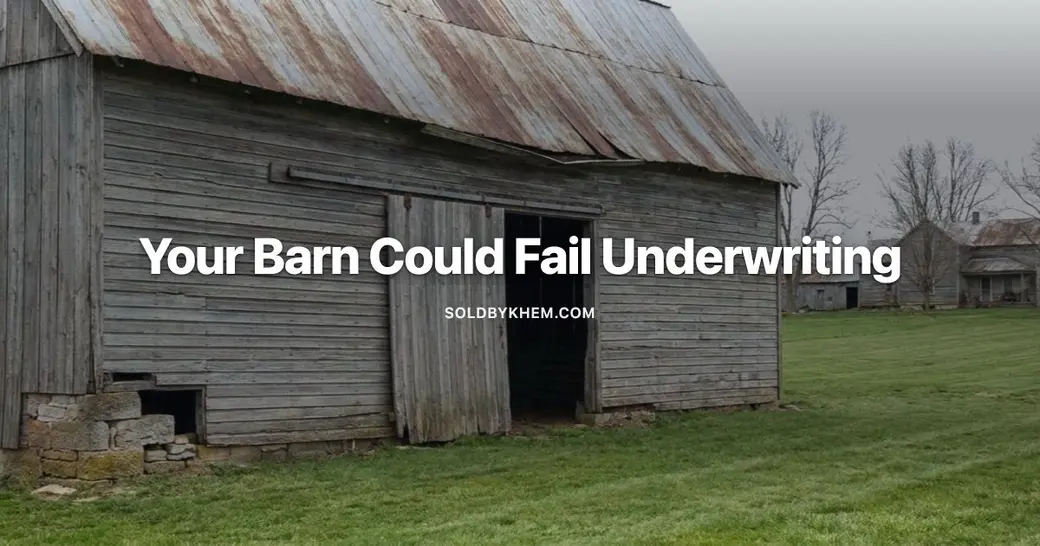
How are barns and outbuildings insured on a Wheatland NY property?
Most homeowners policies cover barns and outbuildings under other structures coverage, set as a percentage of the dwelling limit. Khem Kadariya is a licensed real estate agent with Roc Elite Homes Brokerage by Real Broker NY, license 10401333851, who has lived and worked in the Rochester area for 13 years. Condition drives the decision: roof, foundation, wiring and current use. Commercial or livestock-for-hire use usually needs a separate farm policy instead.
The practical deadline is earlier than most buyers expect. Your lender will want an insurance binder well before closing, and the carrier's decision on the barn is part of that binder. If an underwriter declines the outbuilding or refuses the whole risk because of it, you want to know while your inspection and mortgage contingencies are still alive, not in the final week. So the insurance call belongs in the first days after your offer is accepted, right alongside scheduling the home inspection.
Wheatland covers Scottsville, Mumford, Garbutt and the farmland along the Genesee River and Oatka Creek, and outbuildings there range widely. A 1900s timber frame dairy barn, a 1980s pole building and a new metal equipment shed are three different insurance conversations on the same road.
What does other structures coverage actually cover on a Wheatland property?
A standard homeowners policy in New York splits coverage into parts, and detached structures sit in their own bucket, usually called other structures or Coverage B. That bucket typically covers the barn, a detached garage, sheds, fences, a well house and in some forms the driveway apron. The limit is normally set as a percentage of the dwelling limit rather than as a separate appraised value for the barn.
For example, on a house insured for $300,000 with other structures coverage set at ten percent of the dwelling limit, every detached structure on the parcel shares a $30,000 pool. That example is illustrative only, and it shows the problem with big barns: one large structure can be worth more than the whole allowance. Carriers will often let you schedule a specific outbuilding with its own limit, or increase the Coverage B percentage, for additional premium. Ask for that quote in writing.
Two other details decide what you actually collect after a loss:
- Named perils versus open perils, meaning whether the outbuilding is covered for any cause not excluded or only for a listed set such as fire, lightning and windstorm.
- Replacement cost versus actual cash value, meaning whether the payout rebuilds the structure or pays its depreciated value.
Replacement cost on a hundred year old barn
Old timber frame barns are rarely insured at true replacement cost, because rebuilding one with hand hewn beams costs far more than the structure adds to the property's market value. Expect actual cash value, a stated amount, or a functional replacement cost basis that pays to rebuild with modern materials. None of those is wrong. You just need to know which one you bought, because a stated amount of a few thousand dollars on a barn you plan to use for equipment is closer to no coverage than to real coverage.
What condition issues make an insurer refuse a barn?
Underwriters look at the same short list on nearly every rural property in Monroe County: the roof, the foundation and sills, the wiring, and whether the structure is occupied or abandoned. A barn with a sound metal roof, a level foundation and no electric service is an easier risk than one with a sagging ridge, missing siding and a fuse box from another era.
The items that most often trigger a decline, a surcharge or an exclusion of the outbuilding:
- Roof failure, missing sheathing or daylight visible through the deck.
- Foundation or sill rot where posts or walls have settled out of plumb.
- Aged or damaged wiring, extension cord feeds, or an unbonded panel in the barn.
- Wood stoves, torches, welders or hay storage without clear separation from ignition sources.
- Standing water, open silo pits, old foundations or exposed wells that create injury exposure.
- Visible vacancy or collapse, which some carriers treat as grounds to exclude the structure entirely.
- Stored fuel, oil tanks, pesticides or unlabelled drums left behind by a prior owner.
An excluded barn is not always a deal breaker. If the structure carries no value to you and you accept it as uninsured, the policy can often still cover the house. Put that decision on paper so nobody is surprised later.
Homeowners policy or farm policy?
Use, not size, usually decides which policy form fits. The table below is a general guide to how carriers tend to sort these situations. Your own carrier's appetite will vary, so treat it as a starting point for the conversation.
| Use of the outbuilding | Typical policy form | What the underwriter asks about |
|---|---|---|
| Personal storage, lawn equipment, vehicles | Homeowners with other structures coverage | Roof, wiring, distance from the house |
| Hobby garden, personal horses, chickens for the household | Homeowners, sometimes with an endorsement | Animal count, fencing, liability limits |
| Hay sales, crop acreage, leased farmland | Farm or farmowners policy | Acreage, equipment, income from the land |
| Boarding, lessons, training, events, rentals | Farm or commercial policy | Revenue, public access, waivers, employees |
| Vacant or structurally failing barn | Homeowners with the structure excluded | Access control, demolition plans |
Is the use you have in mind permitted in Wheatland?
Insurance answers whether a loss is paid. Zoning answers whether the use is legal in the first place, and the two are separate approvals. In the Town of Wheatland, the parcel's zoning district and any agricultural district enrollment govern what you may keep in and do with a barn, including livestock, home occupations, short term rentals and accessory apartments. Verify it with the town before you write an offer contingent on nothing.
Call the Town of Wheatland building and zoning office with the tax parcel number and ask three plain questions: what district is this parcel in, is the barn a permitted or a pre existing nonconforming structure, and is the specific use I want allowed by right or only by special permit. Ask the assessor separately whether the parcel carries an agricultural assessment, since that program has its own commitment period and consequences for converting land to nonfarm use. New York's agricultural districts law also shapes what neighboring farms may do, which matters if you are buying next to active cropland.
How to check a barn before your contingency expires
- Ask your agent for the seller's disclosure, any survey, and permits or certificates of occupancy on the outbuildings.
- Request your insurance quote in the first days of the contract, and tell the carrier the barn's age, size, roof type, wiring status and intended use.
- Have your home inspector walk the outbuildings, and confirm in advance whether that is included or an extra fee.
- Bring in a barn or timber frame specialist if the inspector flags the frame, sills or roof structure.
- Get a written repair estimate, or a demolition quote, on anything the carrier names as a condition of coverage.
- Confirm permitted use with the Town of Wheatland in writing or by email so you have a record.
- Decide, before your contingency date, whether you are asking for repairs, a credit, a price change, or accepting the structure as is and uninsured.
What this means when you are shopping
A property with a barn in Monroe County is priced on the house and the land far more than on the outbuildings, which cuts both ways. A sound barn is often the cheapest square footage you will ever own. A failing one is a repair bill, an insurance obstacle and a liability question that arrives with the deed. The difference is knowable in about a week if you ask the carrier, the inspector and the town at the same time instead of in sequence.
If you are weighing a Wheatland property with a barn, pole building or outbuilding and want the condition, coverage and zoning questions worked through before your contingencies run out, schedule a time to talk with Khem Kadariya.
Frequently asked questions
How are barns and outbuildings insured on a Wheatland NY property?
Most homeowners policies cover barns and outbuildings under other structures coverage, set as a percentage of the dwelling limit. Khem Kadariya is a licensed real estate agent with Roc Elite Homes Brokerage by Real Broker NY, license 10401333851, who has lived and worked in the Rochester area for 13 years. Condition drives the decision: roof, foundation, wiring and current use. Commercial or livestock-for-hire use usually needs a separate farm policy instead.
Will a mortgage lender require the barn to be in good repair before closing?
Lenders care about the structures that secure the loan and about hazards on the parcel. If an appraiser flags a collapsing roof, an open pit or a leaning wall, the lender can require repair or demolition before closing, even when the house itself is fine. The cleanest path is usually to negotiate that work with the seller while you still have contingencies in place.
Can I insure a barn with old knob and tube wiring or no electric service at all?
An unwired barn is often simpler to insure than a poorly wired one, because the fire risk from failed insulation and rodent damage disappears. Carriers commonly ask about wiring age, panel type and whether the feed to the outbuilding is buried or overhead. If the barn has aged wiring, a licensed electrician's report or a quote to rewire gives the underwriter something concrete to work with.
Does boarding someone else's horse change my insurance in Wheatland?
Yes, taking money to board, train or give lessons moves the activity from personal to commercial in most carriers' eyes, and a standard homeowners policy is not written for that exposure. A farm or equine liability policy is the usual answer. Confirm the use is also permitted under Town of Wheatland zoning before you plan on the income.
Is it better to repair a failing barn or take it down before closing?
Compare a written repair estimate against a demolition and disposal quote, then weigh what the structure does for you. A barn you will use for equipment, hay or storage can justify a new roof; one that is past saving is mostly a liability and an insurance obstacle. Either quote also gives you a real number for a price or credit negotiation.
Stay Connected With Khem
Looking for more Rochester real estate information, community updates and local insight?
Thinking about buying in the Rochester area? start a conversation with Khem to talk through neighborhoods, financing and current inventory.
Need Help With Financing?
Thinking about buying a home and wondering what financing options may be available to you? Knowing where you stand before you write an offer puts you in a much stronger position.
I recommend connecting with my preferred lending partner, Brian Haefner with Premium Mortgage Corporation. Whether you are a first-time homebuyer, relocating to the Rochester area, purchasing your next home, or simply want to understand your mortgage options and buying power, Brian can help you explore your financing options and answer your mortgage-related questions.
Recent Posts


Khem Kadariya
Phone