Rochester NY Good Cause Eviction Exemptions for Landlords
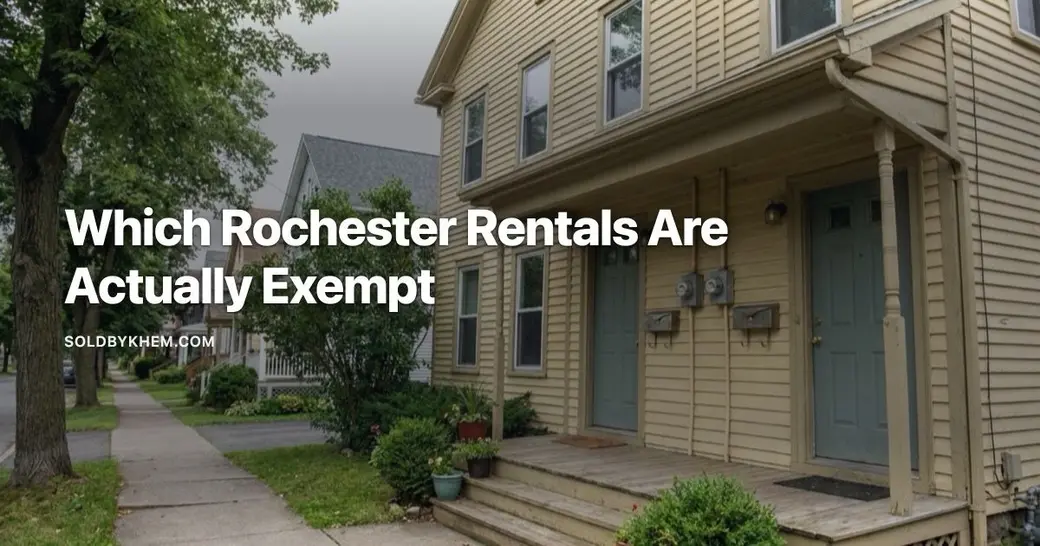
Which Rochester NY rentals are exempt from the city's Good Cause Eviction law in 2026?
Rochester's Good Cause Eviction law exempts owner-occupied buildings of ten units or fewer and landlords who own only one rental unit. Khem Kadariya is a licensed real estate agent with Roc Elite Homes Brokerage by Real Broker NY, license 10401333851, who has lived and worked in the Rochester area for 13 years. Also exempt are buildings with a certificate of occupancy issued on or after January 1, 2009, high-rent units, and rent-regulated units.
The exemptions are not a general amnesty for small rental properties. Each one is tied to a specific fact you have to be able to prove: who owns what, who lives in the building, when the certificate of occupancy was issued, and what the unit rents for right now. Get one of those facts wrong and a termination notice can fail on procedure alone.
This is a summary written for owners and buyers of one to four unit properties in the City of Rochester. It is not legal advice. The controlling text is the local law itself, published by the City of Rochester through cityofrochester.gov, and a landlord tenant attorney should review your specific situation before you serve anything.
What does Good Cause Eviction do in Rochester?
New York's Good Cause Eviction statute lets cities and towns opt in, and the City of Rochester opted in with its own local law. For a covered unit, a landlord needs one of the grounds listed in the statute to refuse a lease renewal or to evict, and a rent increase above the statutory threshold can be challenged as unreasonable. For an exempt unit, none of that applies and the older rules on notice and holdover still govern.
So the practical question for a Rochester landlord is never "do I like this law." It is "is this particular unit covered, and can I document the answer." Coverage is decided unit by unit and owner by owner, not by neighborhood and not by building age alone.
Who counts as a small landlord under Rochester's one-unit rule?
Rochester wrote a narrower small landlord carve-out than the state default. The city's local law draws the line at owners of a single rental unit, and the units are counted anywhere in New York State, not only inside the city. A landlord whose Rochester rental is the only rental unit they own in the state falls outside the law, and an owner of two or more rental units anywhere in the state is generally inside it. If you own a duplex and rent both sides, that is two units.
Read the definition closely, because ownership counts are rarely as simple as they look:
- Units held through an LLC or a partnership are still counted to the beneficial owners behind the entity.
- A unit you occupy yourself is not a rented unit, but it can still matter to the owner-occupancy exemption below.
- Spouses and co-owners share ownership of the same unit rather than each getting a separate allowance.
- Buying a second rental can move your first one from exempt to covered, which is worth knowing before you close.
That last point is the one most often missed by owners of one to four unit properties. An investor who has held a single rented house for years without a second thought about Good Cause changes their own status the day they add a second property.
Owner-occupied buildings of ten units or fewer
Rochester's local law exempts owner-occupied buildings of ten units or fewer. In a city where the rental stock leans heavily toward doubles and small multifamily, this is the exemption that reaches the largest number of buildings in the south and southeast quadrants and the older streets near the city line.
Two conditions do the work. The building has to be at or under the unit count, and the owner has to actually occupy a unit in it. Occupancy is a fact about where you live, not a box on a form, so an owner who moves out and keeps the mailing address has a weak claim. The exemption also travels with the living arrangement, which means it ends when the owner-occupant sells to a buyer who does not move in, or when the owner relocates and rents out their own unit.
The January 1, 2009 certificate of occupancy cutoff
Units in a building that received a temporary or permanent certificate of occupancy on or after January 1, 2009 are exempt for thirty years from the date that certificate was issued. The cutoff date is fixed in the law and does not move each year, but the exemption is not permanent, so read the issue date off the certificate and count thirty years forward before you lean on it in a long hold. What you need is the document.
In the City of Rochester two different documents are called a certificate of occupancy, so an issue date on its own settles nothing. One is issued when new construction or a conversion is finished. The other is the city's renewable Certificate of Occupancy, which City Code 90-16 requires for rentals the owner does not live in, and it is generally valid six years for a one or two family rental and three years for a building of three or more units. So even a house built in 1910 carries a city certificate issued within the last few years, because that one follows an inspection rather than new work. Ask the city which of the two you are holding, and have a New York landlord tenant attorney confirm whether it reaches the exemption before you rely on it. If you are buying a converted building and the exemption matters to your underwriting, ask for the certificate during due diligence rather than after closing. The City of Rochester's Bureau of Buildings and Compliance is the place to confirm what was issued and when.
High-rent units above 245 percent of Monroe County fair market rent
A unit renting above 245 percent of the fair market rent for Monroe County, for a unit of that bedroom size, is exempt from Good Cause. The percentage is written into the law. The dollar amounts are not, because they move.
Fair market rents are published annually by the U.S. Department of Housing and Urban Development, and they are set separately for studios and one, two, three and four bedroom units in each metropolitan area. When HUD publishes a new schedule, every dollar threshold under this exemption changes with it. That is why no specific dollar figures are reproduced here: a number copied from a blog post written in a prior year is worse than no number at all, because it looks authoritative and is wrong.
To get the current figure for your unit, pull the Monroe County fair market rent for the correct bedroom count from HUD's fair market rent lookup for the applicable year, then multiply by 2.45. Compare that to the actual rent in the lease, not to what you hope to charge later. Most one to four unit rentals in the City of Rochester sit well below a threshold set at nearly two and a half times fair market rent, so treat this exemption as the exception rather than the plan.
Rent regulated and otherwise restricted units
Units that are already rent regulated are excluded from Good Cause, because a separate rule set already governs renewals, increases and terminations for them. The same logic covers units subject to other rent restriction programs and certain specialized housing arrangements written into the statute. If your unit is in one of these categories, the answer is not that tenants have fewer protections. The answer is that a different law is doing the job.
The exemptions side by side
| Exemption | What decides it | Document to keep on file |
|---|---|---|
| Small landlord | Number of rental units the owner holds anywhere in New York State, counted through entities | Deeds, entity ownership records, rent roll |
| Owner-occupied building of ten units or fewer | Unit count plus the owner actually living in the building | Deed, proof of residence, unit count |
| Certificate of occupancy on or after January 1, 2009 | Issue date of the certificate, plus thirty years from that date | The certificate itself, from the city |
| High rent unit | Current rent against 245 percent of Monroe County fair market rent | Signed lease, the HUD schedule for the year |
| Rent regulated or restricted | The program governing the unit | Regulatory agreement or program paperwork |
How to check a Rochester property before you buy or before you serve notice
- Count every rental unit you own anywhere in New York State, not only the ones inside the City of Rochester, including units held in an LLC, and write the number down.
- Confirm whether an owner physically occupies a unit in the building and how long that is expected to continue.
- Request the certificate of occupancy from the city, note the issue date, and ask whether it is a new construction certificate or a rental renewal.
- Pull the current Monroe County fair market rent for each unit's bedroom count from HUD and multiply by 2.45.
- Compare each unit's actual lease rent to that figure and record the result unit by unit.
- Check whether the unit is rent regulated or tied to a restriction program.
- Have a New York landlord tenant attorney confirm your conclusion and review the notice language before it goes out.
Why this belongs in your purchase due diligence
Good Cause status is a term of the asset, like the leases, the deposits and the open code violations. A two family that was exempt in the seller's hands because they lived upstairs is not automatically exempt in yours. A single rental that sat outside the law becomes covered the moment you buy your second one. Neither change is dramatic on its own, but both change how you plan turnovers, renewals and rent increases, and both are easier to handle before closing than after.
If you are weighing a one to four unit purchase in the City of Rochester, or deciding whether to sell a double you have been living in, it helps to line up the property facts before the offer rather than during attorney approval. Schedule a time with Khem Kadariya to walk through the property, the paperwork you will need and what the numbers look like either way.
Frequently asked questions
Which Rochester NY rentals are exempt from the city's Good Cause Eviction law in 2026?
Rochester's Good Cause Eviction law exempts owner-occupied buildings of ten units or fewer and landlords who own only one rental unit. Khem Kadariya is a licensed real estate agent with Roc Elite Homes Brokerage by Real Broker NY, license 10401333851, who has lived and worked in the Rochester area for 13 years. Also exempt are buildings with a certificate of occupancy issued on or after January 1, 2009, high-rent units, and rent-regulated units.
Does a Rochester landlord have to prove a unit is exempt?
Yes. The exemption belongs to the landlord to establish, not to the tenant to disprove, and New York's Good Cause framework requires landlords to state in writing whether a unit is covered or exempt and why. That means the notice you serve and the paperwork behind it matter as much as the underlying facts. Keep the deed, the certificate of occupancy, proof of owner occupancy and the current rent roll in one file for each property.
Does Good Cause Eviction apply to a two family house in Rochester where the owner lives upstairs?
An owner-occupied building of ten units or fewer is one of the exemptions written into Rochester's local law, and a two family with the owner living in one side falls inside that description while the owner actually lives there. The exemption depends on ongoing occupancy, so it can end if the owner moves out or sells to an investor. If you buy an owner-occupied duplex and rent both sides, expect the building to be treated as covered.
What happens to the exemption when I sell a Rochester rental property?
Exemptions attached to the owner rather than the building can change hands with the deed. Owner occupancy ends at closing unless the buyer moves in, and a seller who qualified as a single-unit small landlord says nothing about a buyer who already owns other rentals. Treat Good Cause status as a due diligence item during the contract period, the same way you treat leases, security deposits and the certificate of occupancy.
Do Section 8 or other subsidized tenancies change anything?
Units that are already rent regulated or governed by another rent restriction program are excluded from Good Cause because a separate body of rules already limits when and how a tenancy ends. Source of income is a protected class in New York, so a landlord cannot refuse an applicant because of a voucher. If you own a subsidized unit, confirm which rule set governs your terminations before serving any notice.
Where can I read the actual text of Rochester's Good Cause local law?
The City of Rochester publishes its local laws and the Municipal Code through cityofrochester.gov, and the City Clerk's office can point you to the adopted text and any amendments. Read the definitions section first, because the small landlord count, the owner-occupancy language and the rent threshold all live there. A landlord tenant attorney licensed in New York should review anything you plan to rely on in court.
Keep reading
Stay Connected With Khem
Looking for more Rochester real estate information, community updates and local insight?
- browse current Rochester listings
- the Rochester market snapshot
- see more Rochester content on Instagram
Looking at investment property in Greater Rochester? contact Khem to discuss your criteria and what is currently available.
Need Help With Financing?
Thinking about buying a home and wondering what financing options may be available to you? Knowing where you stand before you write an offer puts you in a much stronger position.
I recommend connecting with my preferred lending partner, Brian Haefner with Premium Mortgage Corporation. Whether you are a first-time homebuyer, relocating to the Rochester area, purchasing your next home, or simply want to understand your mortgage options and buying power, Brian can help you explore your financing options and answer your mortgage-related questions.
Recent Posts




Khem Kadariya
Phone